
OPTIMIX · Repair mortar
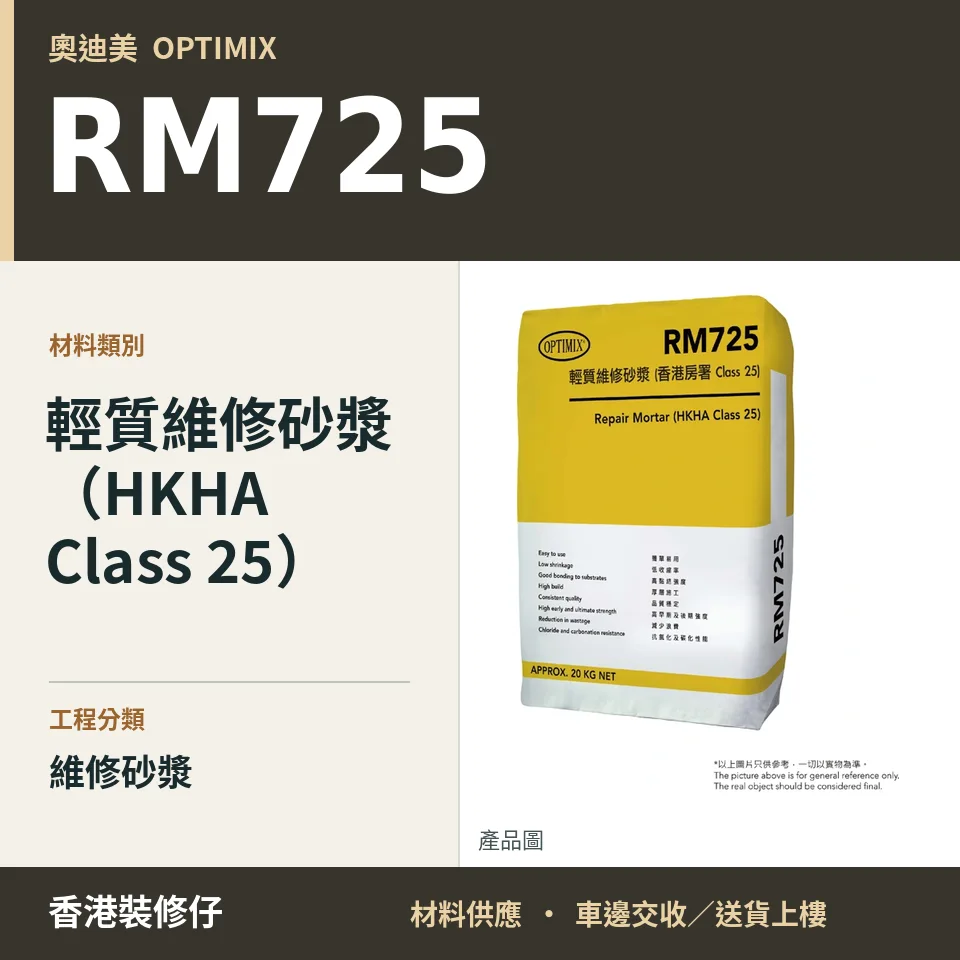
OPTIMIX RM725 lightweight repair mortar (HKHA Class 25)
OPTIMIX RM725 Repair Mortar (HKHA Class 25)(RM725)
You can buy materials separately from HK Create Design. Tell us the quantity and district to check unit prices, lead times and charges for kerbside delivery or delivery to your floor.
OPTIMIX RM725 is a polymer-modified, shrinkage-compensated structural repair mortar with lightweight aggregate. It is commonly used on walls and overhead, including concrete ceilings that have spalled and exposed the reinforcing steel. The manufacturer states that RM725 meets Hong Kong Housing Authority Class 25 repair mortar requirements and has certification under the Hong Kong Concrete Institute's PCCS-RM scheme. Applications include spalling caused by corroded reinforcement, honeycombing and voids. Normal repair depth is at least 10 mm, with a local minimum of 5 mm. Maximum single-layer thickness is 50 mm on walls and 40 mm overhead. Preparation includes removing unsound concrete, cutting the edges, cleaning and priming the reinforcement, wetting the substrate and applying a PE emulsion and cement bonding slurry before placing and curing the mortar. Extensive spalling, severe corrosion or damage to common structural elements requires an engineer's assessment. Check the building's deed of mutual covenant and Buildings Department requirements.
Buy materials: kerbside handover or delivery to your floor
Your quote lists the material price, transport and any charge for carrying the goods to your floor separately. Choose a delivery option to enquire.
Add other materials (optional)
Repairing spalled concrete and exposed reinforcement on walls and ceilings
HK Create Design · Materials and delivery quotations: 5243 7747
OPTIMIX RM725 lightweight repair mortar (HKHA Class 25) · Application illustration
How is localised spalling repaired on a concrete column?
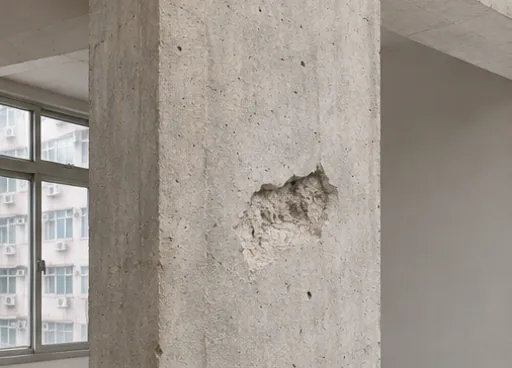
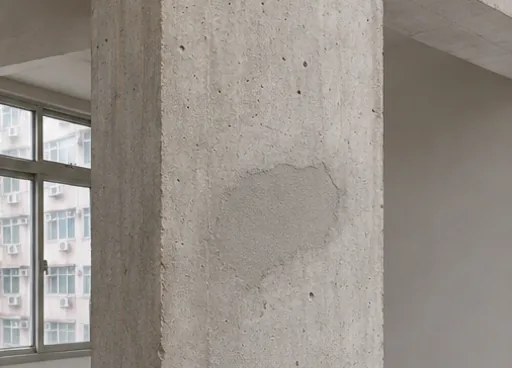
Illustration of the work sequence. Colour, finish and drying conditions vary on site.
- Material features
- The lightweight, shrinkage-compensated formulation can be applied in layers on vertical and overhead surfaces.
- Where to use it
- For localised spalling on a concrete wall, column or soffit, first assess the cause and the condition of the reinforcement.
- Application method
- A professional removes unsound concrete, treats exposed reinforcement and prepares the substrate, then compacts the mortar in layers and allows it to cure.
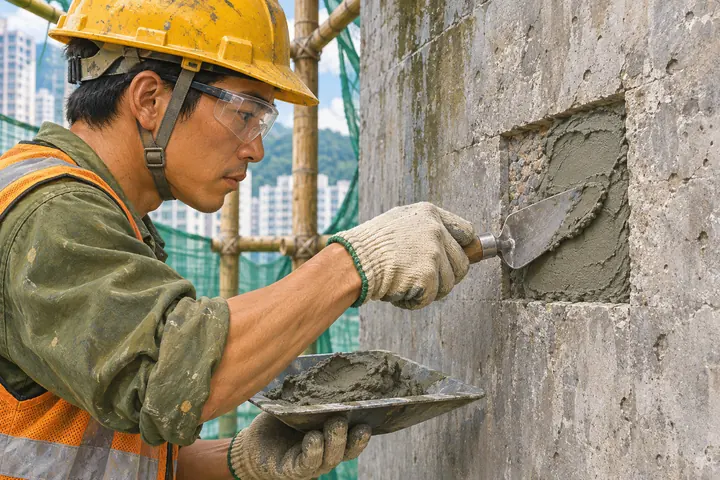
RM725 application steps
- Remove loose concrete and cut square edges at least 10 mm deep around the repair to avoid feather edges.
- Remove dust and loose particles. Expose the reinforcement, remove loose rust, then coat the steel with OPTIMIX PE emulsion and cement slurry (PE to cement ratio 1:1.5). Allow it to dry into a protective film.
- Wet the concrete to a saturated, surface-dry condition and remove excess water. Brush on a coat of PE bonding slurry and place the mortar while the primer is still tacky. Reapply the slurry if it dries.
- Add 3.6–4.0 litres of clean water per 20 kg bag and mix with a forced-action mixer or low-speed drill for about 5 minutes until lump-free.
- Press the mortar firmly into place with a trowel or gloved hand. Build up in layers if it sags or a greater thickness is needed.
- Immediately after finishing, apply a curing compound or use another curing method to prevent rapid drying.
Manufacturer’s specifications
View RM725 Manufacturer's information and sources
| Property | Specification |
|---|---|
| Meets specifications | HKHA Class 25 Repair Mortar; PCCS-RM Certified [2] |
| 28-day compressive strength | Meets HKHA Class 25 requirements (20–40 MPa) [2] |
| 7-day bond strength | Meets requirements (> 1.5 MPa) [2] |
| 28-day elastic modulus | Meets requirements (9–15 GPa) [2] |
| 28-day shrinkage (Coutinho ring) | No cracks [2] |
| 28-day flexural strength | > 5 MPa [2] |
| Single layer thickness | Up to 50 mm per layer on walls and 40 mm overhead. Normal repair depth ≥10 mm, with a local minimum of 5 mm. [2] |
| Working time | 5°C >60 minutes; 15°C 60 minutes; 25°C 45 minutes; 35°C 30 minutes [2] |
| Mixing water | 3.6–4.0 liters per pack [2] |
| Wet density | 1,400 kg/m³ [2] |
| Packaging and yield | 20 kg per pack, approx. 17 L [2] |
| Application temperature | 5°C to 35°C [2] |
Suitable applications
- Repairing spalled concrete and exposed reinforcement on walls and ceilings
- Concrete honeycombing, voids and similar defects
- Damp-related concrete spalling on bathroom and kitchen ceilings
- Concrete repairs to balcony soffits and window surrounds
Applications to avoid
- Thin repairs under 5 mm. Use an appropriate render or skim coat instead.
- Extensive structural damage or damage to common structural elements without an engineer's assessment
How we use this material on site
For spalled concrete ceilings, we remove loose material, cut square edges, clean rust from the reinforcement and apply a protective slurry. We place the repair mortar in layers, then skim and paint the repaired area.
View the work details Hong Kong waterproofing services for leaking roofs and bathroomsSpalling on a bathroom ceiling is often linked to water ingress from above or prolonged damp. We help trace the source and coordinate the repair and waterproofing.
View the work details Hong Kong painting services, wall skimming and refurbishmentOnce the repaired area has cured, we skim and paint to restore an even ceiling finish.
View the work detailsApplication notes
- The construction temperature should be between 5°C and 35°C.
- It is an alkaline product, so wear gloves and a mask.
- If the cause of spalling remains, such as water ingress or inadequate concrete cover over reinforcement, the damage can recur.
OPTIMIX products
Specifications are drawn from manufacturers' websites or technical data sheets. Refer to the manufacturer's latest data sheet for updates. HK Create Design is independent of the brands shown. Brand names and trademarks belong to their owners.