
01
How much does it cost to renovate a 35 sq ft bathroom? Itemised example at our 2026 reference rates
The cost of a bathroom renovation depends mainly on how much is stripped out, which pipes are replaced and the floor and wall areas to be tiled. Our example assumes a 35 sq ft floor and 170 sq ft of wall tiling, using tiles up to 600 × 600 mm in a straight pattern. It prices selected items at our 2026 rates and represents neither an all-inclusive package nor a completed sale.
| Item (company price-list code) | Unit of measure | Reference unit price | 35 sq ft bathroom example |
|---|---|---|---|
| Strip out bathroom and remove waste (A10) | room | HK$9,950 | HK$9,950 |
| Full set of hot and cold water pipes for a bathroom (G04) | items | HK$13,300 | HK$13,300 |
| Bathroom waterproofing with 24-hour flood test (C02, approx. 30–40 sq ft) | room | HK$4,850 | HK$4,850 |
| Flood test for the same area (C04) | times | Included in C02 | HK$0 (already included) |
| Floor tiles up to 600 × 600 mm (D01) | square feet | HK$78 (minimum HK$3,250) | 35 sq ft → minimum charge of HK$3,250 applies |
| Wall tiles up to 600 × 600 mm (D02) | square feet | HK$78 (minimum HK$3,250) | 170 sq ft × 78 = HK$13,260 |
| Suspended aluminium ceiling for a kitchen or bathroom (F05) | room | HK$3,650 | HK$3,650 |
| Install a complete set of bathroom fixtures and fittings (K06) | set | HK$5,650 | HK$5,650 |
| Total for the items listed above | HK$53,910 |
If the site inspection confirms that a full pipe replacement is unnecessary, deduct HK$13,300 for G04. The total for the listed items then comes to HK$40,610. Check the supply of tiles, fixtures and unlisted equipment, additional floor levelling or wall repairs, waste pipe rerouting and special handling or building management requirements separately. C02 includes the flood test for this area, so the HK$1,400 charge for C04 is not added again. Final scope, quantities and costs depend on site verification and the written quote. Use the renovation calculator to compare items.
Gather a wide bathroom photo, approximate floor and wall dimensions, existing pipe locations and the fixtures you want to keep. Ask on WhatsApp about strip-out, waterproofing and tiling. We explain site visit arrangements and applicable conditions when confirming your appointment.
REAL PROJECT PHOTOS
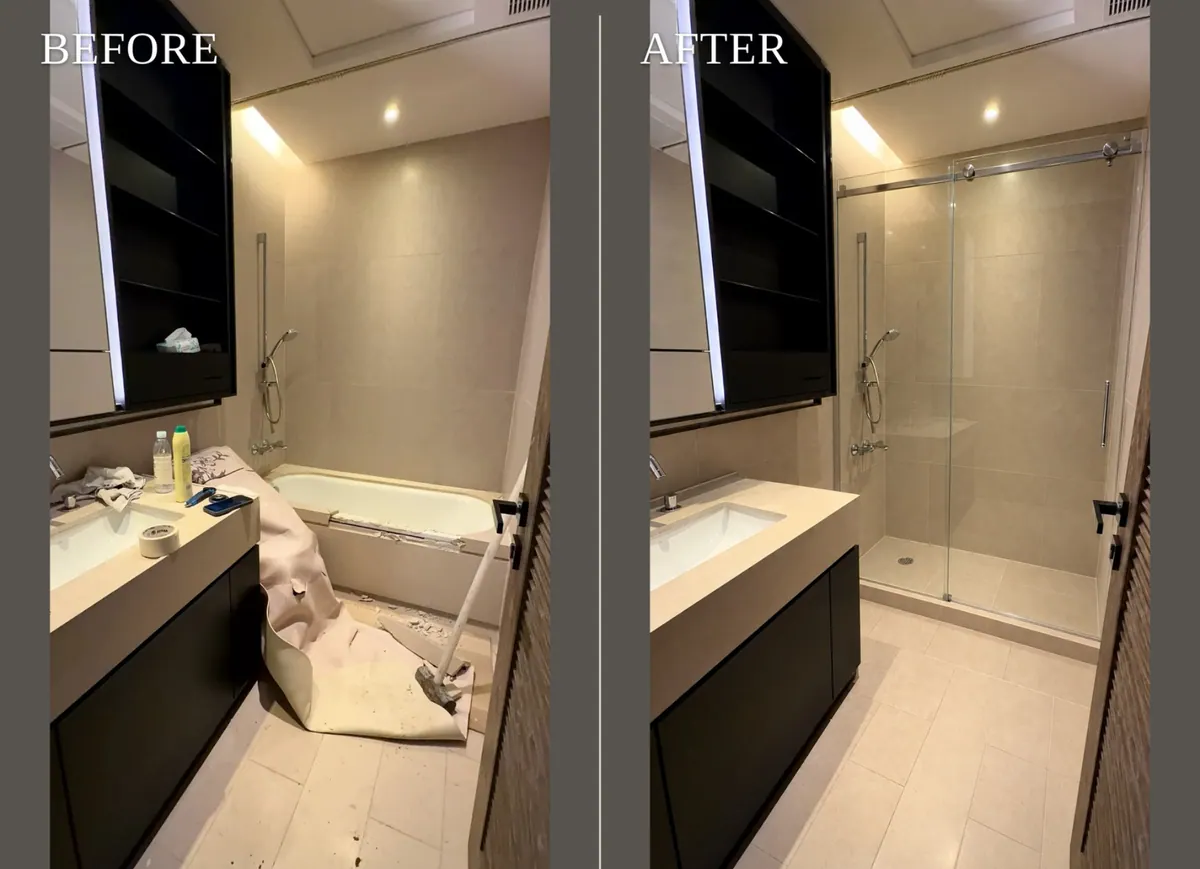
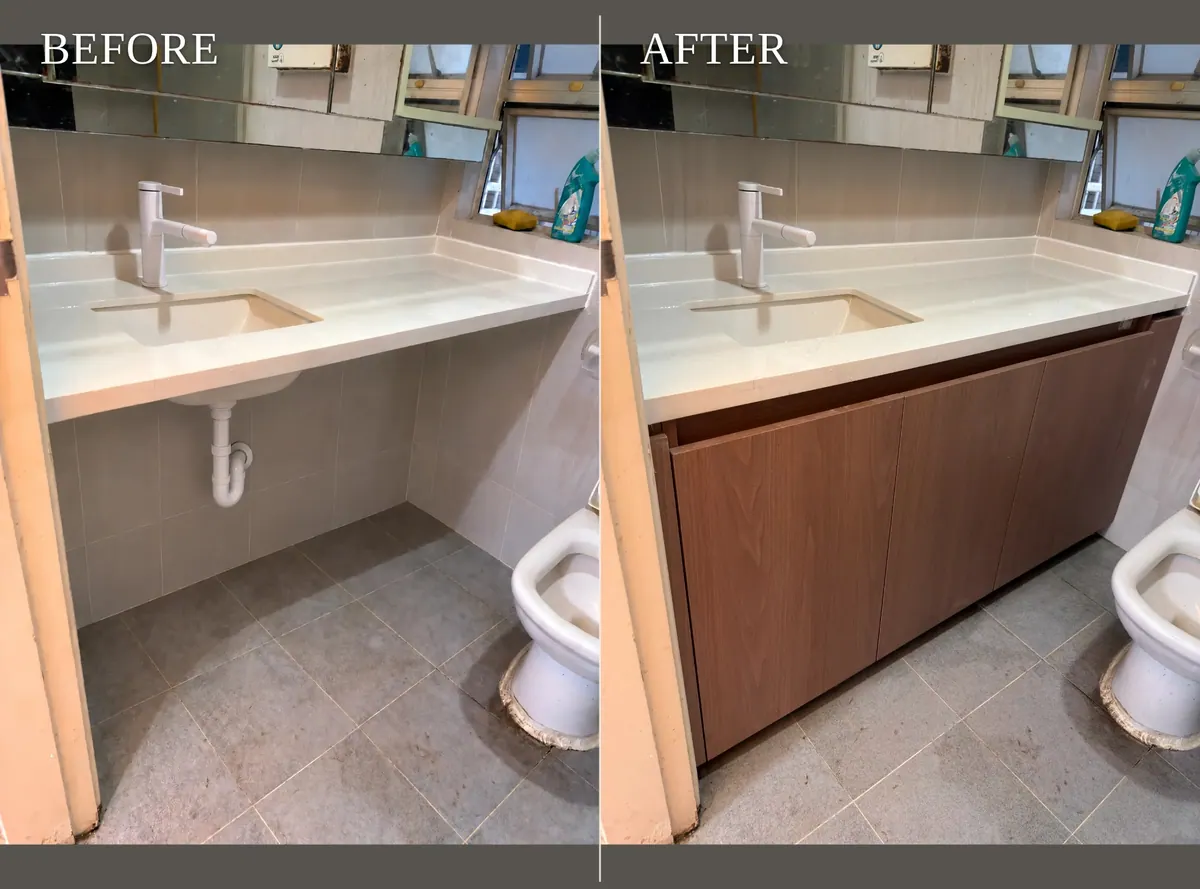
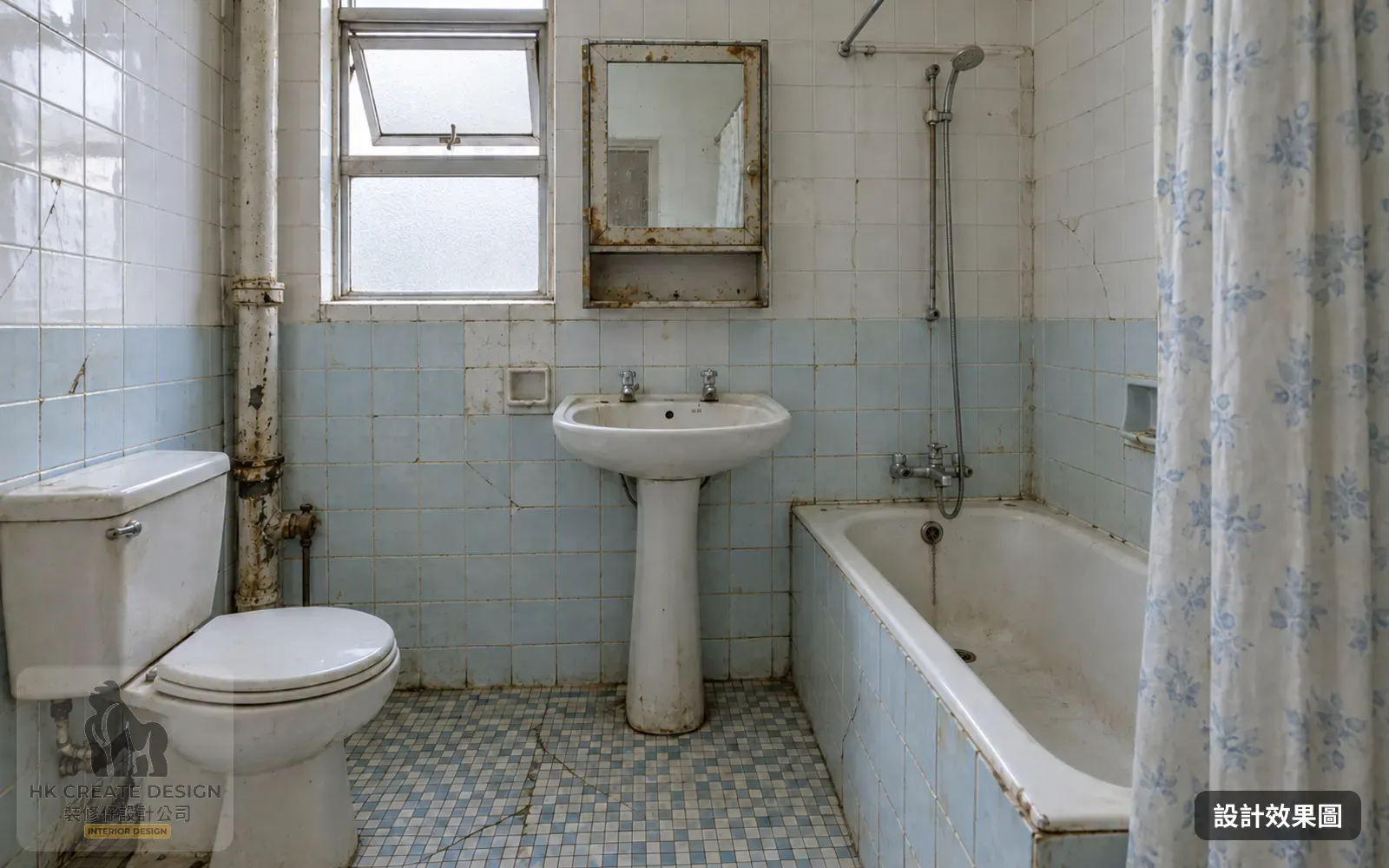
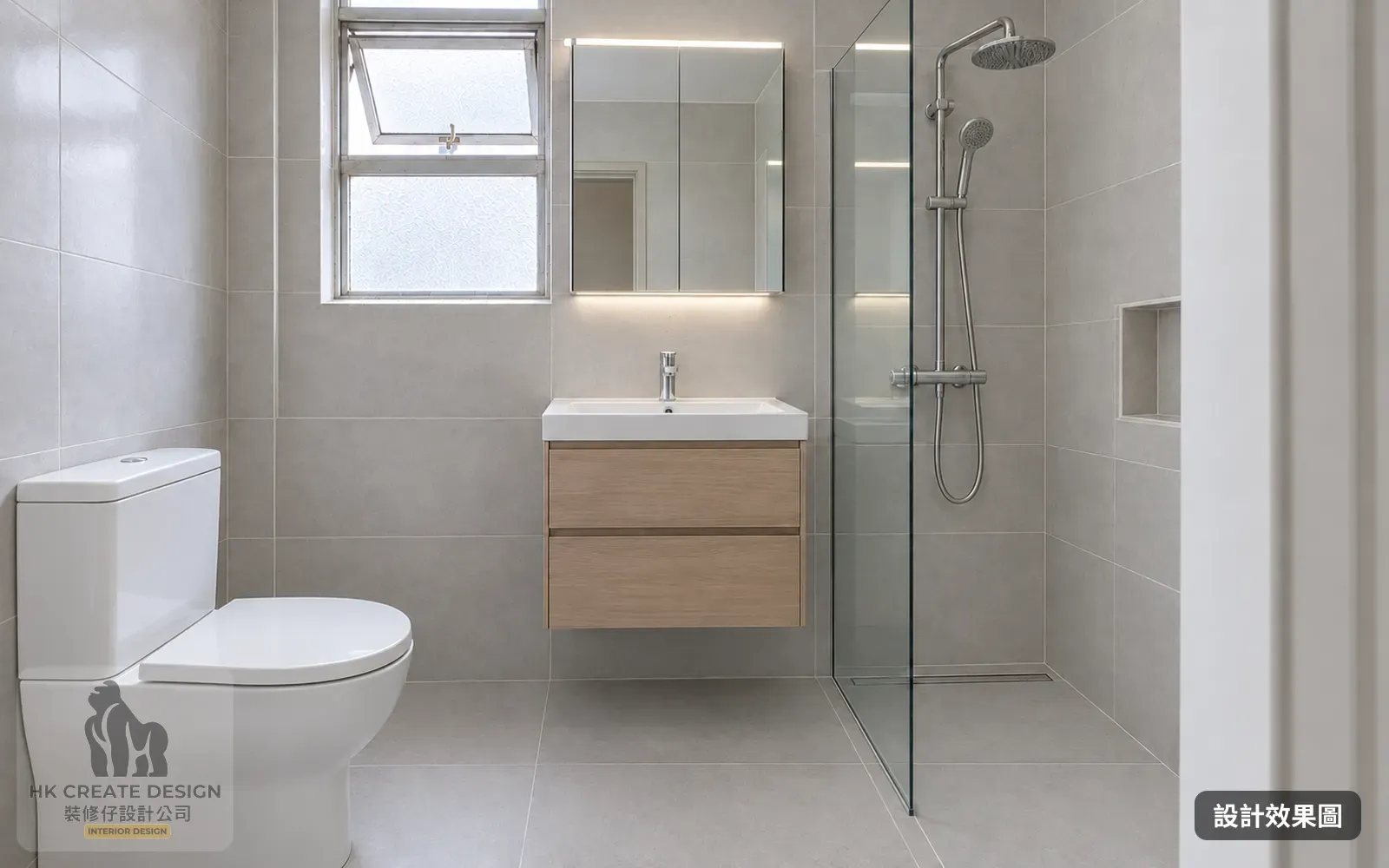
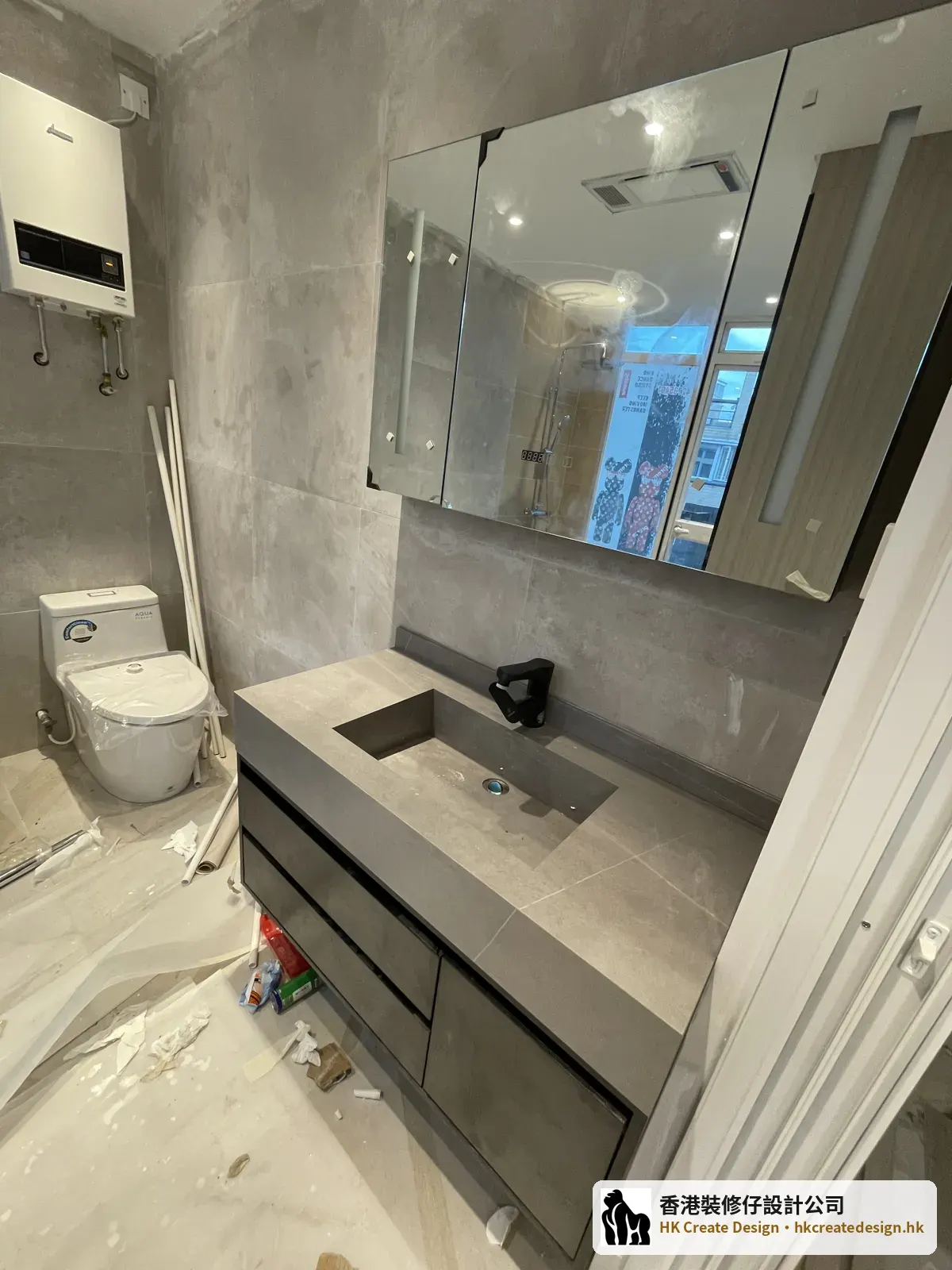
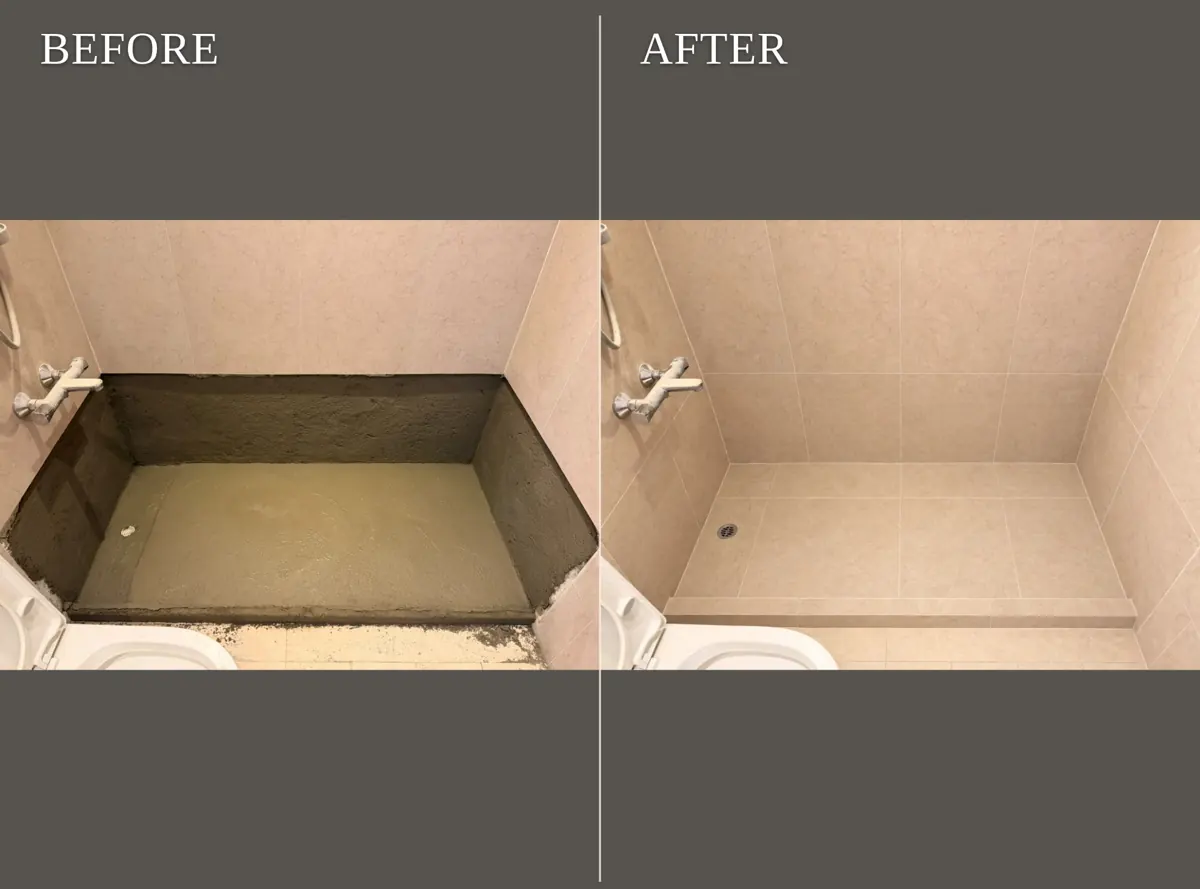
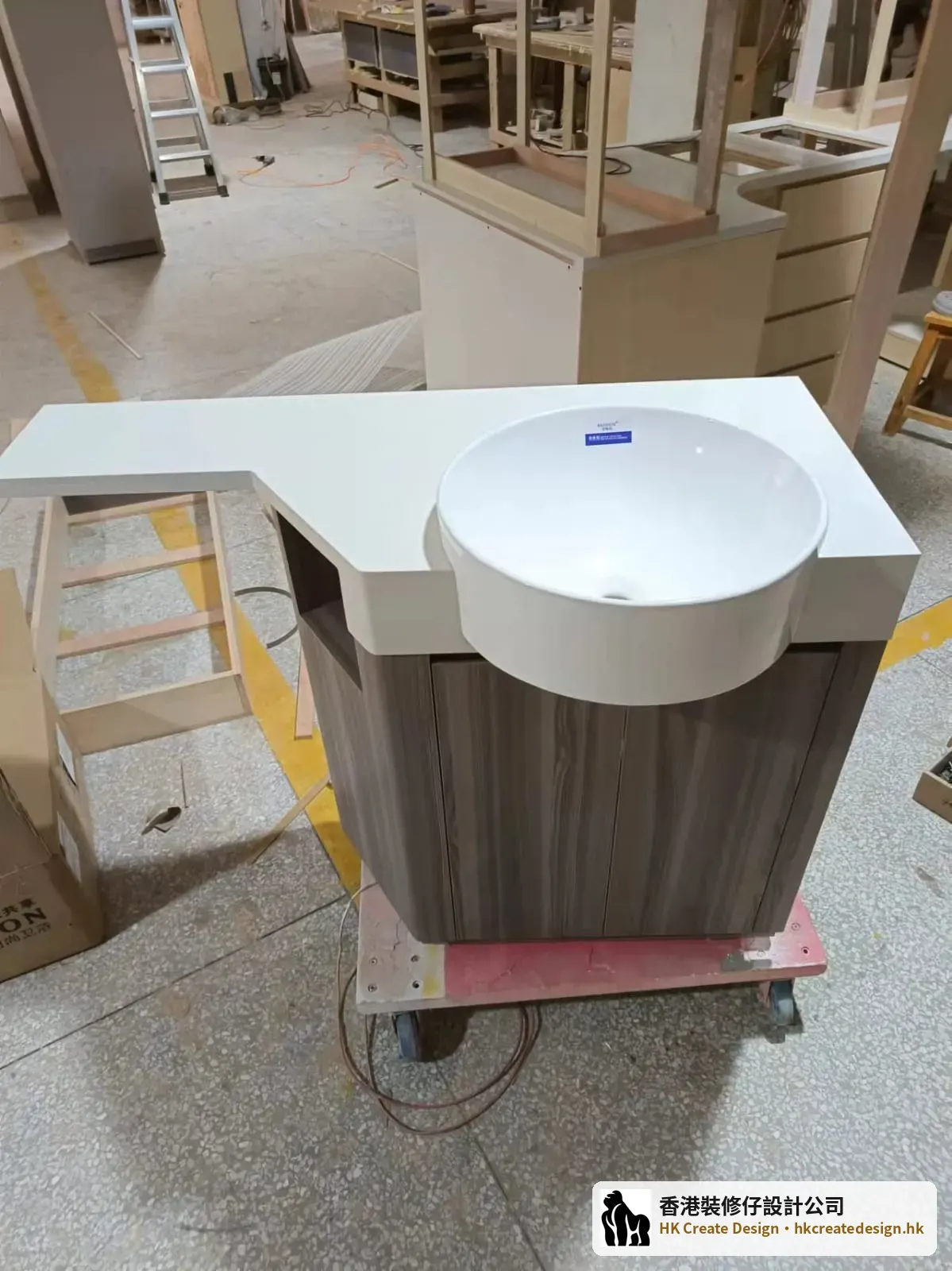
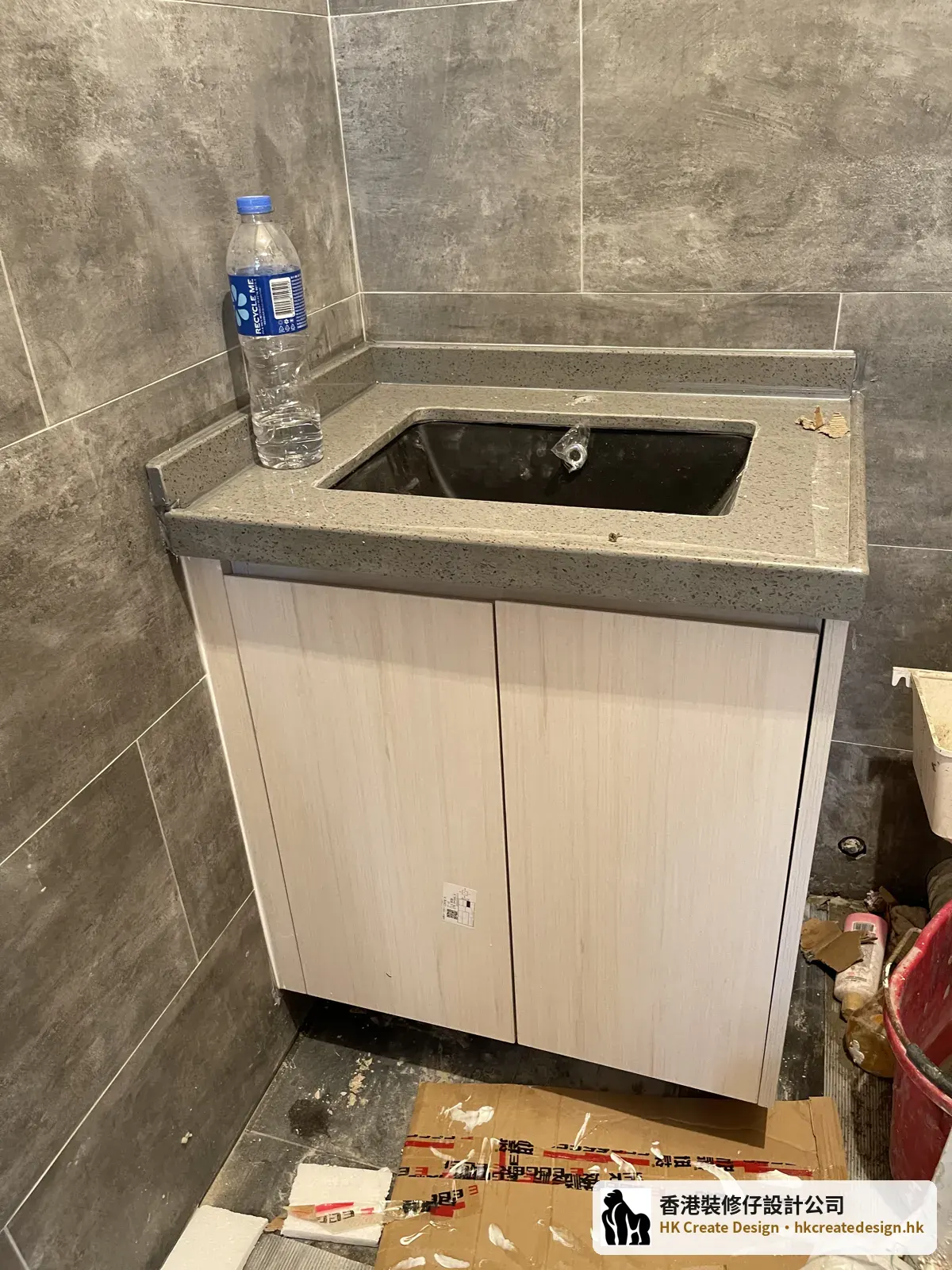
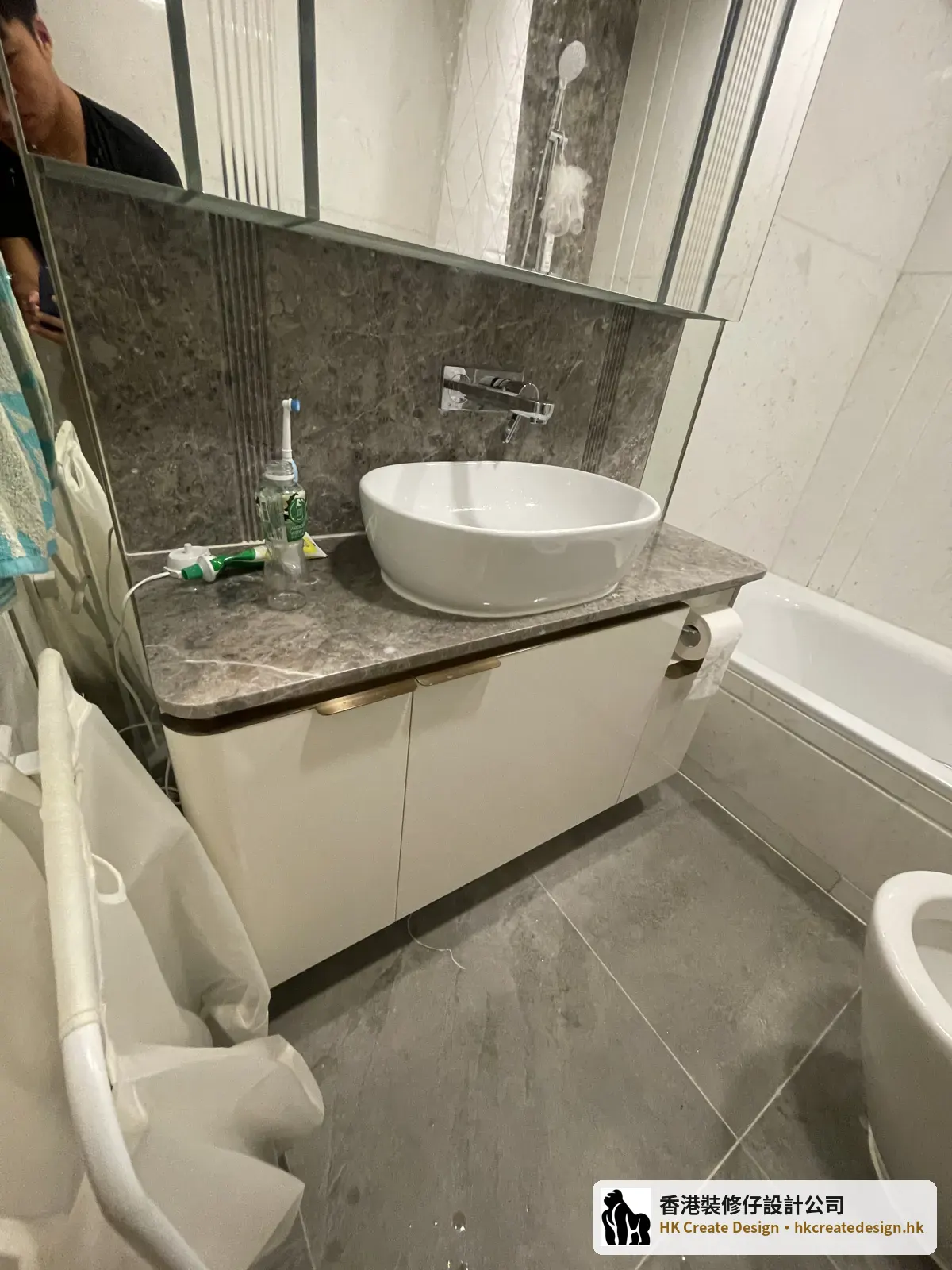
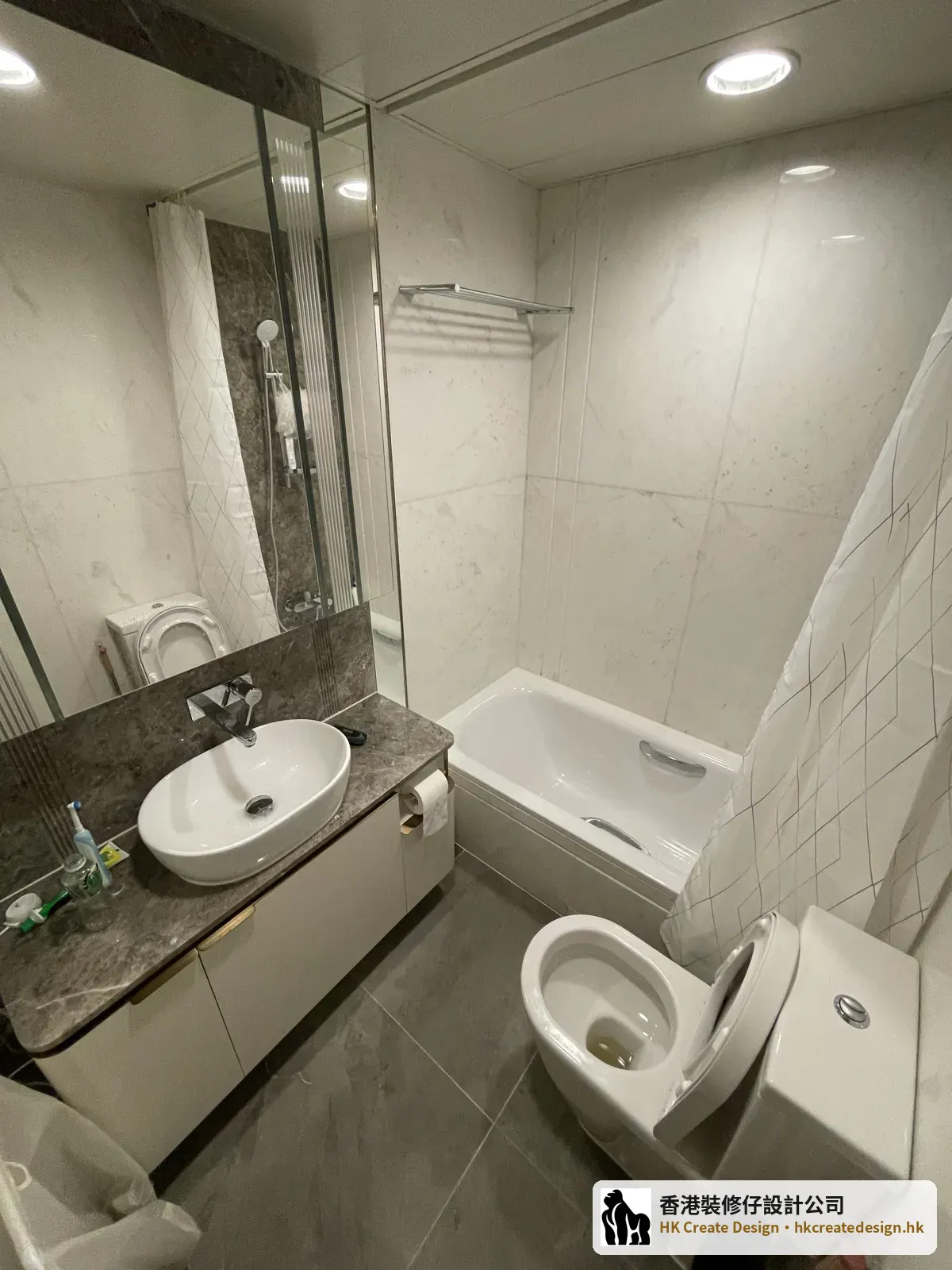
Bathroom renovation work in progress and completion photos
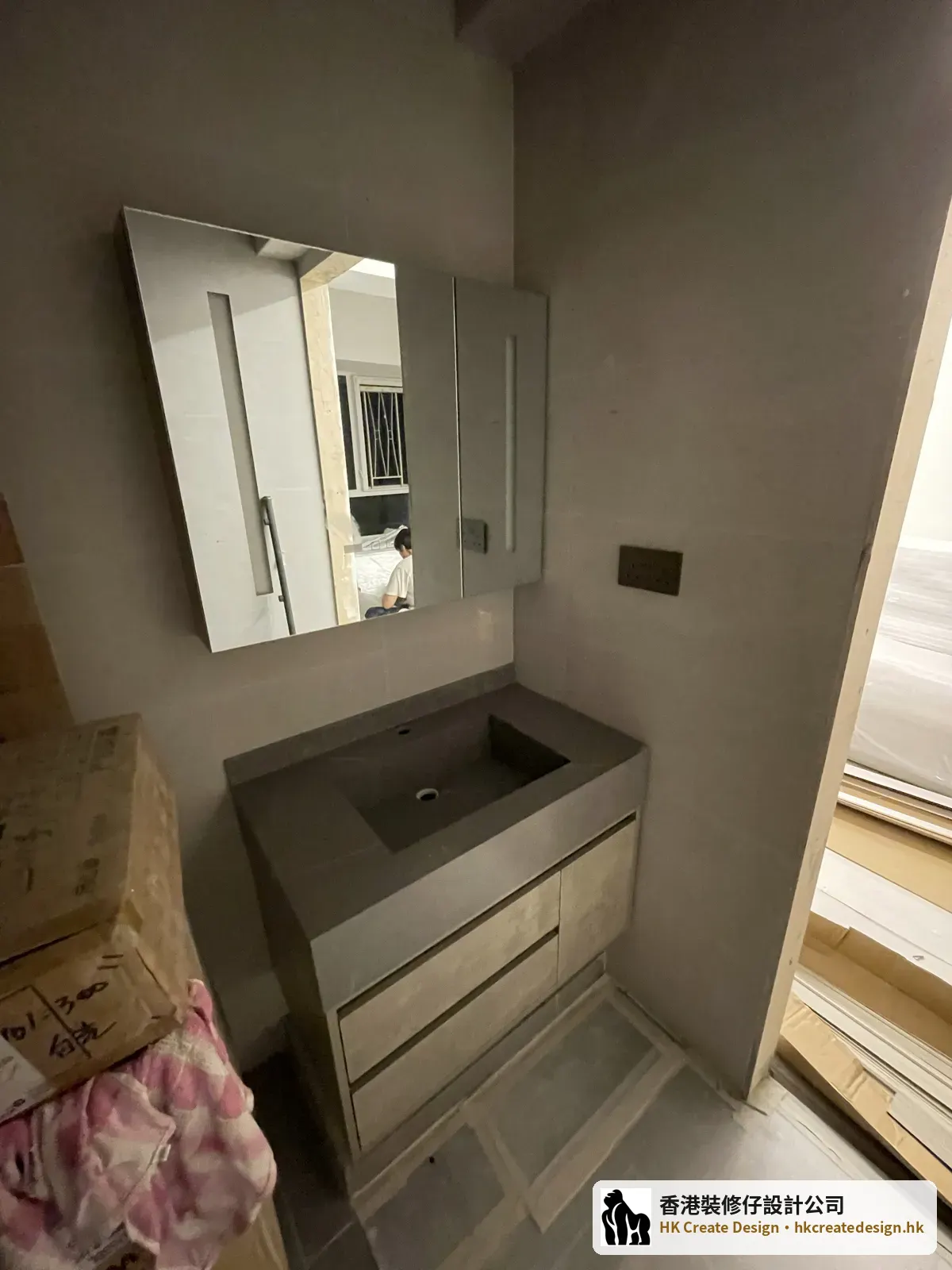
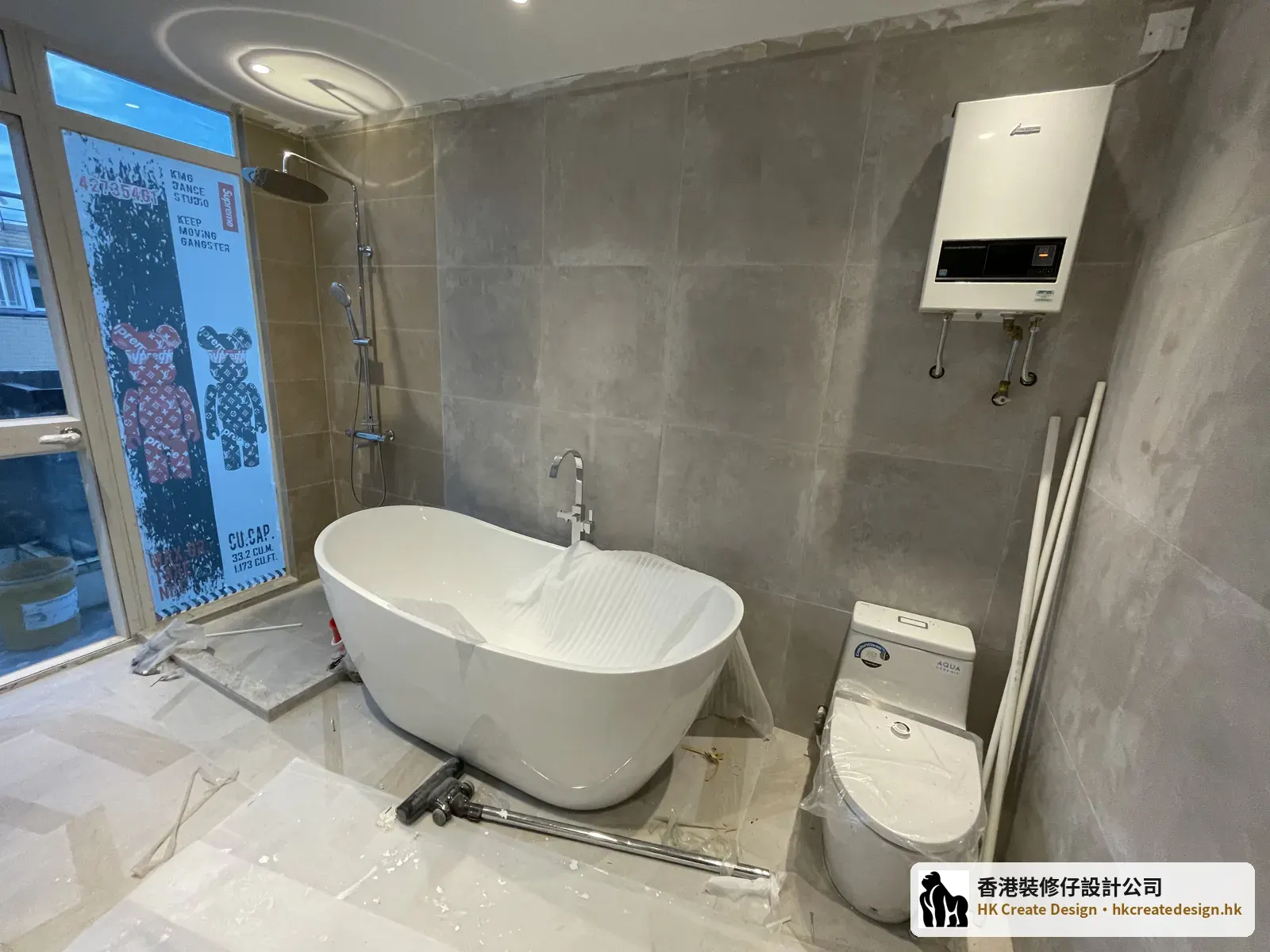
These photographs were taken on actual HK Create Design projects. Client details have been removed.
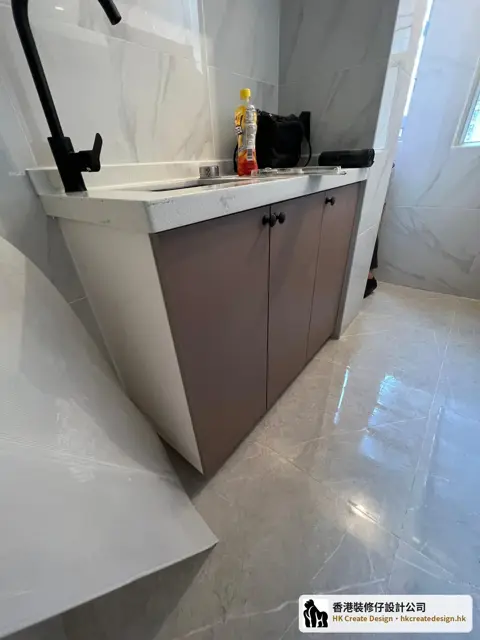
Completed project photosHK Create Design · Bathroom renovation site photo 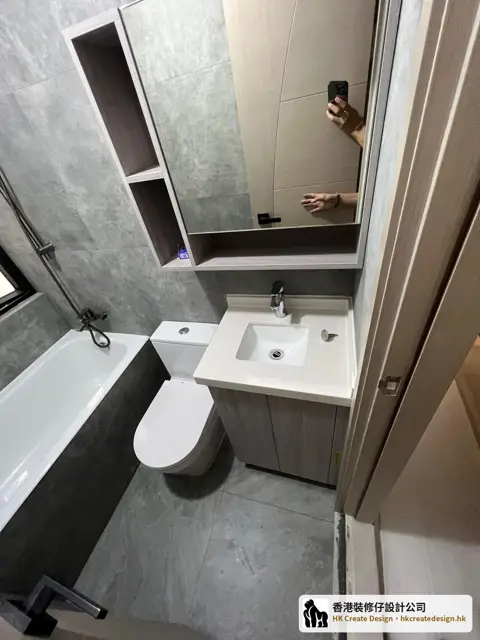
Completed project photosHK Create Design · Bathroom renovation site photo 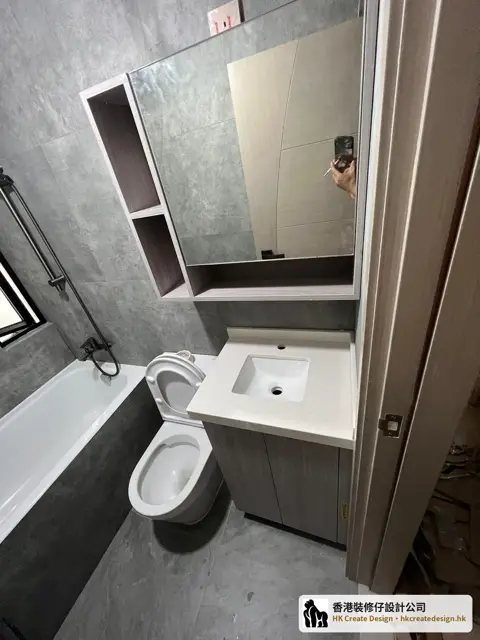
Completed project photosHK Create Design · Bathroom renovation site photo 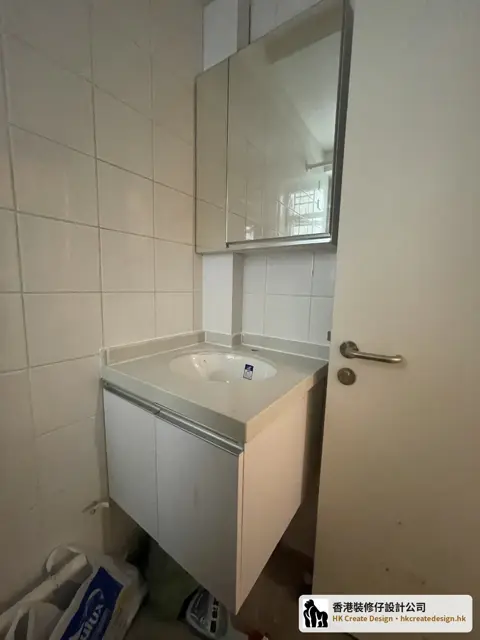
Completed project photosHK Create Design · Bathroom renovation site photo 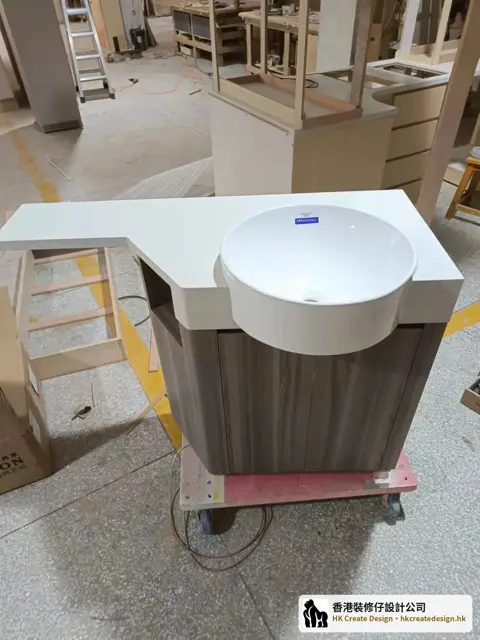
Completed project photosHK Create Design · Bathroom renovation site photo 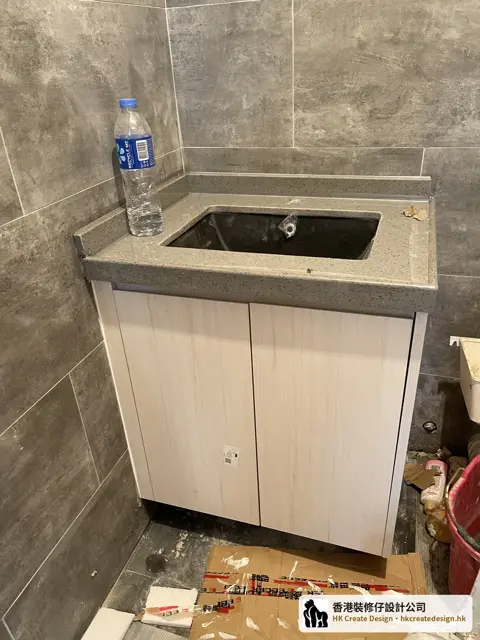
Completed project photosHK Create Design · Bathroom renovation site photo 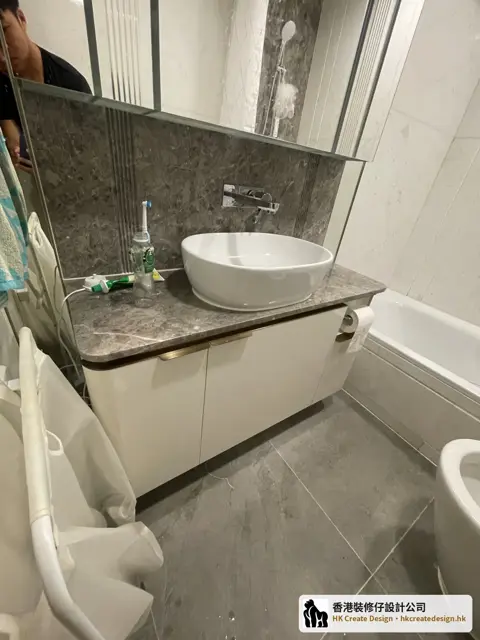
Completed project photosHK Create Design · Bathroom renovation site photo 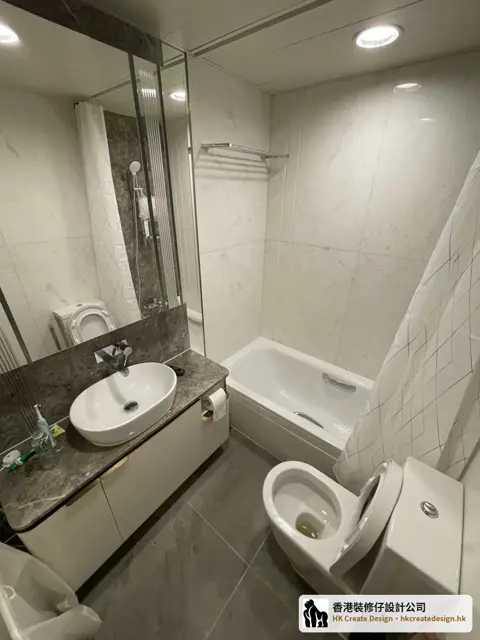
Completed project photosHK Create Design · Bathroom renovation site photo
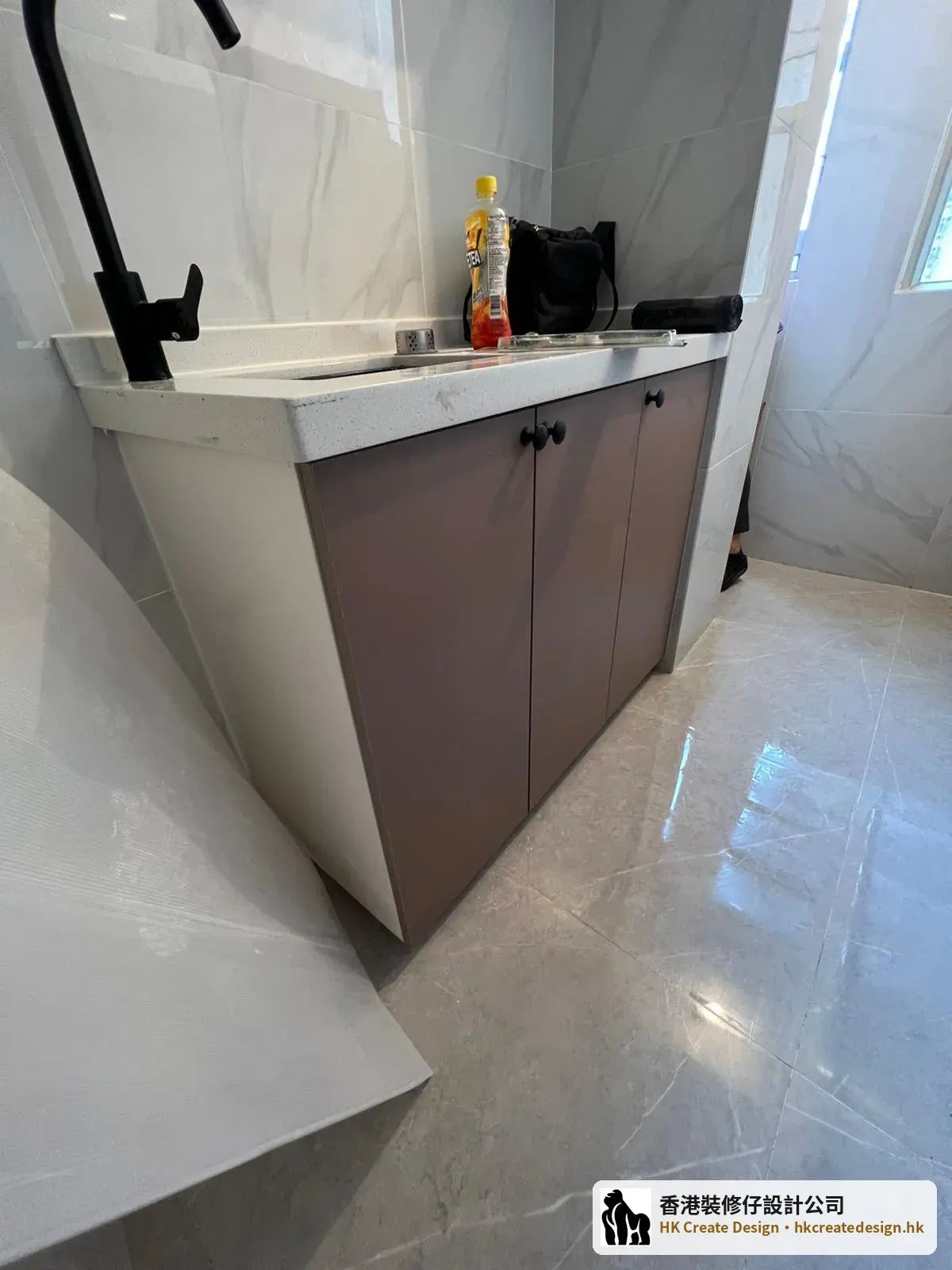
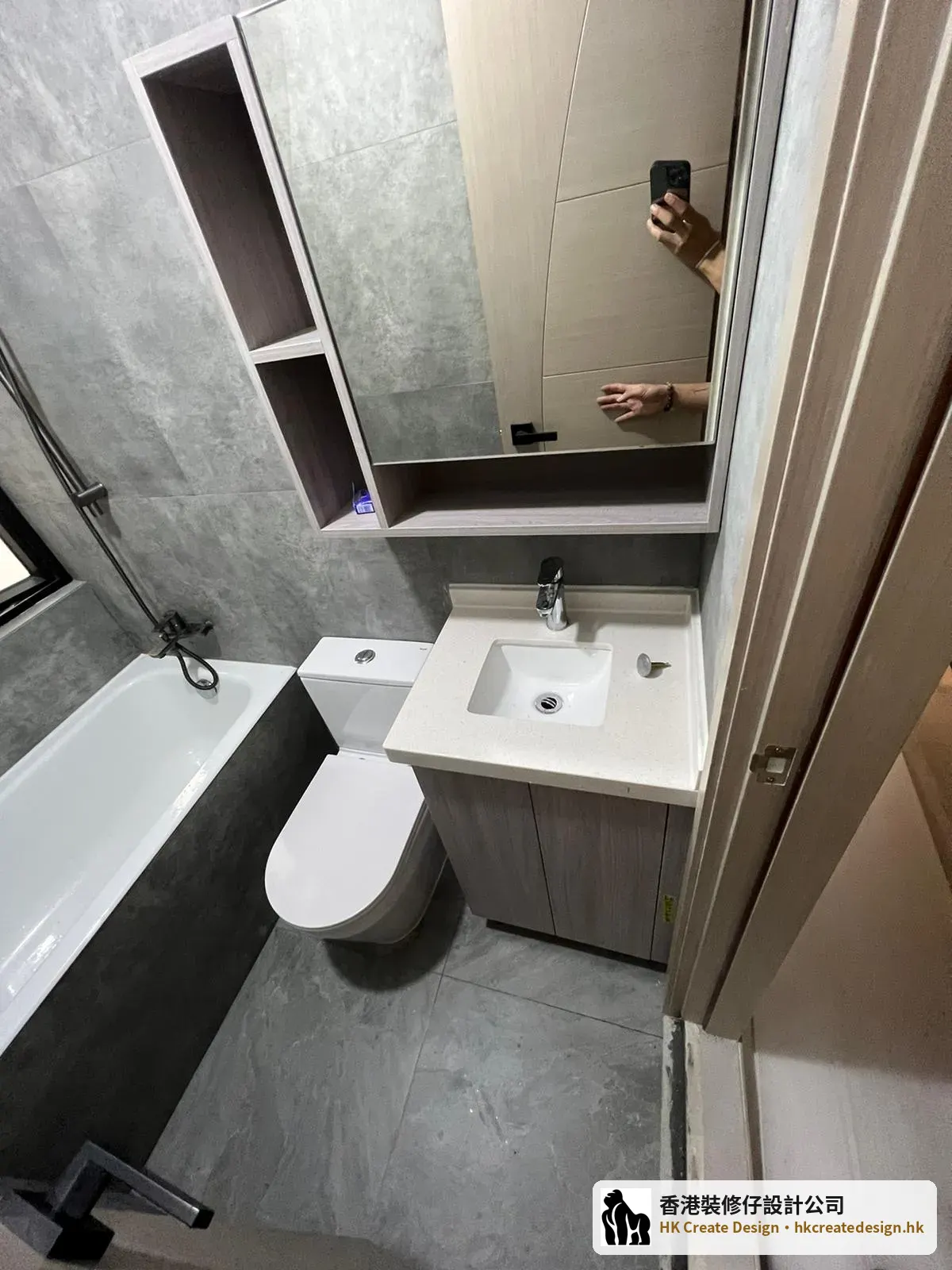
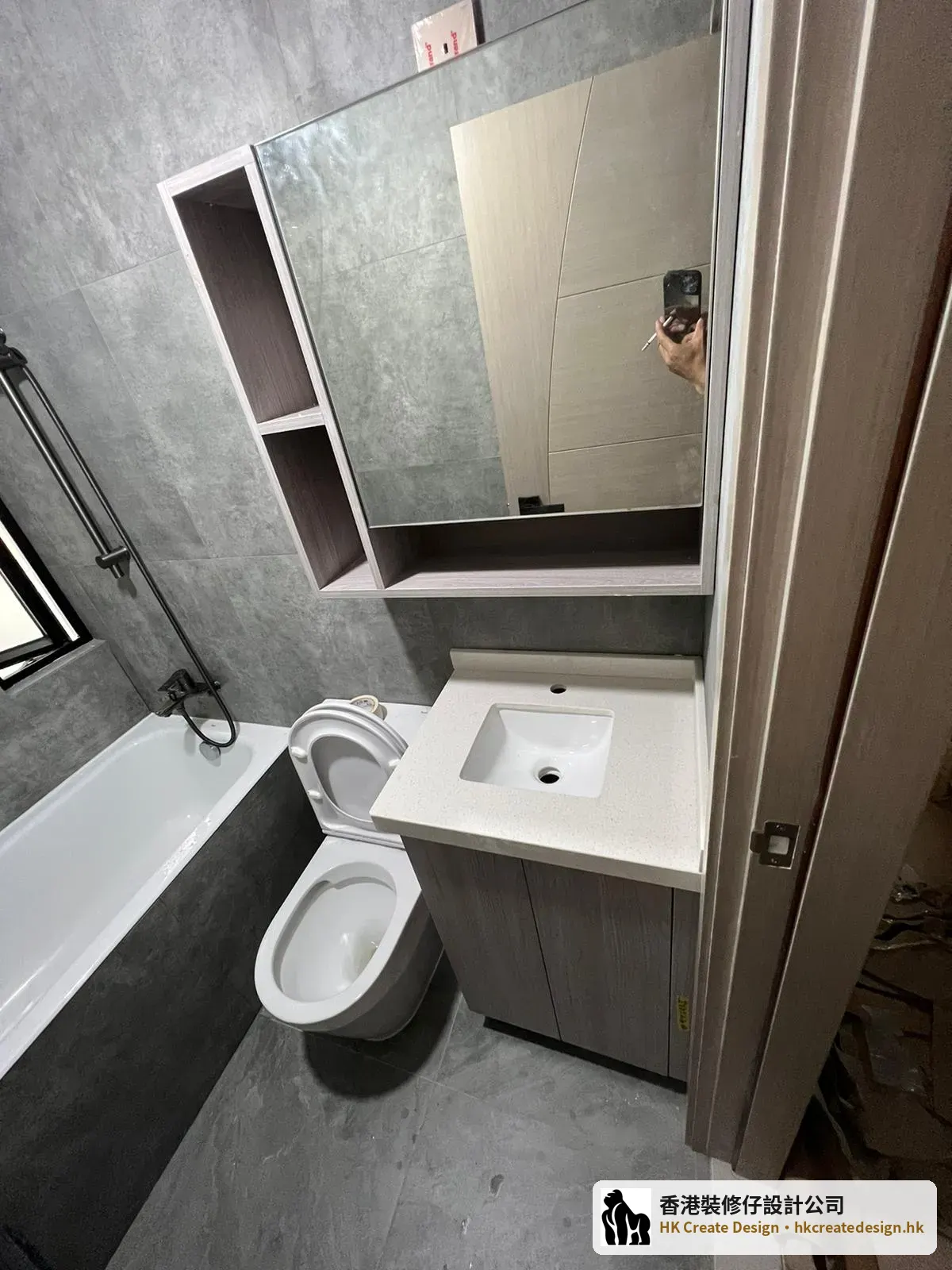
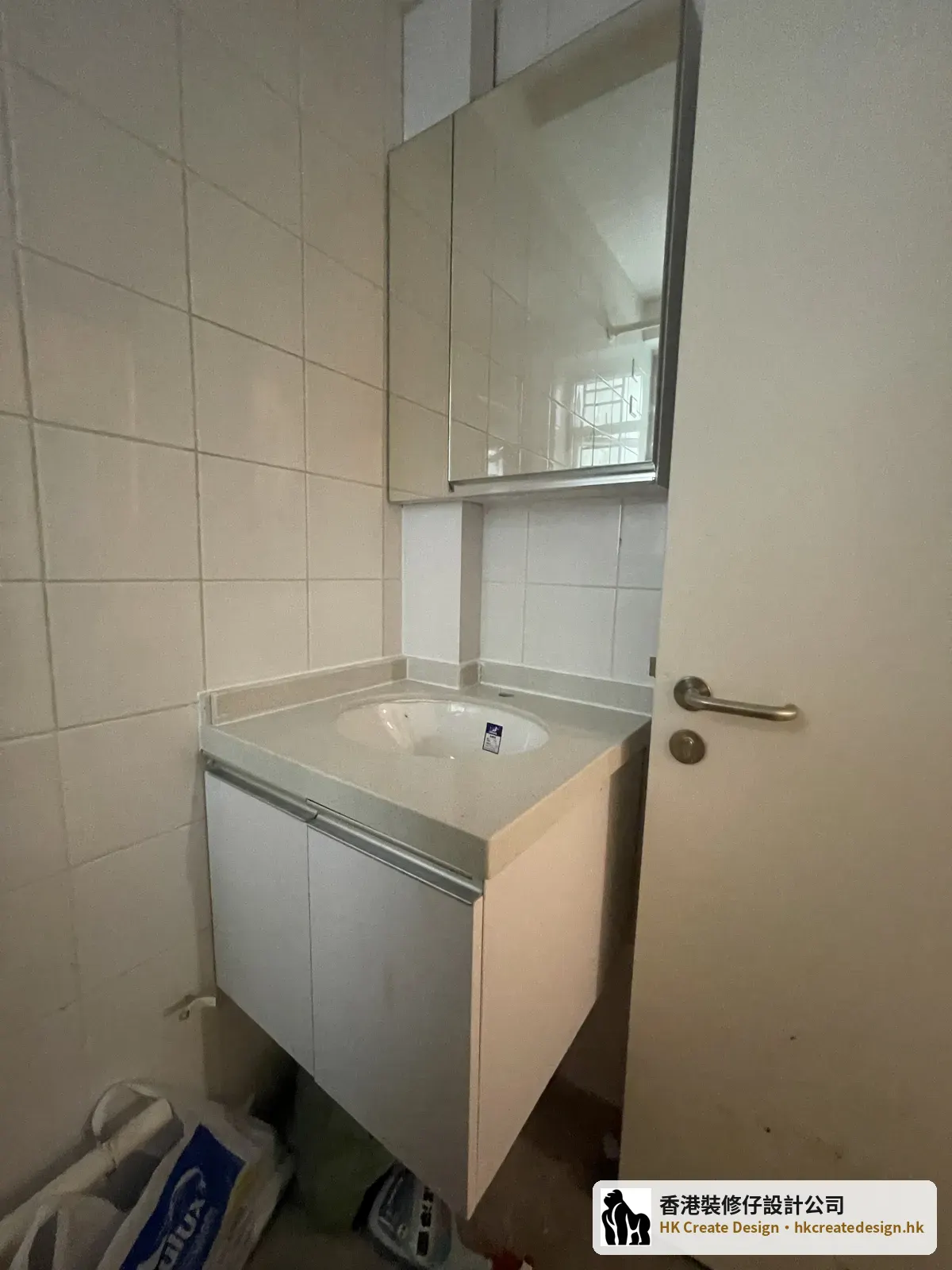
View all 21 Bathroom renovation project photos Send photos on WhatsApp for a free quote
02
Seven bathroom renovation stages: which should never be skipped?
- Registration and protection: register the work with building management and protect the lift lobby, corridor and flat entrance.
- Strip back to the substrate: remove old tiles, fittings and the suspended ceiling. Check for cracks in the floor and inspect the old waterproofing and drain.
- Replace or relocate pipework: renew concealed hot and cold pipes, pressure-test them and take photos before closing the walls. Moving a toilet also requires waste pipe rerouting.
- Two layers of waterproof: apply two coats of SikaTop Seal-107 across the floor and up the foot of the walls. Extend the waterproofing higher on the shower walls.
- Flood-test for 24–48 hours: retain water on the floor and confirm with the flat below that there is no seepage before tiling. Skipping the test could mean removing the tiles again if leaks appear.
- Tiling and drainage falls: form a fall towards the drain to prevent ponding. Align the wall tiles and finish the corners neatly.
- Suspended ceiling, fixtures and sealing: fit the aluminium ceiling and extractor fan, install the fixtures and fittings, apply mould-resistant silicone and clean before handover.
The written quote sets the warranty for waterproofing, masonry and other work outside demolition. Demolition carries no warranty. For installation and acceptance checks, see our waterproofing scope, masonry and tiling rates and bathroom tiling sequence.
03
Renovating a small bathroom in a public rental or subsidised ownership flat
- Public rental housing: apply to the estate office before adding or altering facilities. Do not alter communal drains or pipework yourself. See the public rental housing renovation rules.
- Home Ownership Scheme flats: new subsidised ownership flats come with a basic bathroom. Replacing fixtures, adding storage and fitting a shower screen are often sufficient. Check pipes and waterproofing first in older flats. See the Home Ownership Scheme renovation guide.
- Small bathroom design: separate wet and dry areas with a shower screen, store toiletries in a recessed niche and use a wall-hung vanity for easier cleaning. Light-coloured slip-resistant tiles help the room look larger.
- Older residents: add grab rails and slip-resistant floor tiles, use a level-access shower and avoid a step at the door.
04
Hong Kong bathrooms: damp, mould and hard-to-clean corners
Hong Kong is humid, and many residential bathrooms are small and poorly ventilated. Many homeowners who renovate notice mould, slippery floors, slow drainage and blackened silicone within the first year.
A bathroom needs to look good and also stay dry, mould-resistant, easy to clean and durable. The right design and installation choices can make even a small bathroom in a public rental or subsidised ownership flat easier to maintain over time.
05
Waterproofing and drainage for a drier bathroom
This guide attributes more than 90% of problems with persistent damp, mouldy walls and slippery bathroom floors to inadequate early planning for waterproofing and drainage.
Failed waterproofing lets moisture enter walls and floor slabs. Finishes can look sound while damp and mould build up beneath, making later repairs harder and more expensive.
A practical bathroom needs careful checks from the masonry stage onwards. Cleaning and mould removal cannot make up for poor concealed work.
Essential waterproofing checks
- The recommended height for wall waterproofing is at least 1.2–1.5 metres
- In the shower area, consider full-height wall waterproofing to protect the walls from prolonged exposure to moisture
- Reinforce the waterproof coating at floor-to-wall junctions, corners and drain outlets.
- When renovating an older flat or a public rental or subsidised ownership bathroom, inspect the old waterproofing for powdering, peeling or failure
- If pipes have deteriorated, consider replacing them during renovation to reduce the risk of burst pipes and leaks later.
Drainage details to check
- Form a clear fall in the floor (approximately 1:80) so water flows naturally towards the drain.
- Avoid placing drains in inaccessible corners or at the edge of the shower where standing water and dirt can collect.
- Consider a stainless-steel floor drain with an odour trap to help reduce smells and hair blockages.
- An open-plan bathroom needs sufficient drainage capacity to stop water spreading across the room.
Waterproofing and drainage reference table
| Property | Recommended practices | What can go wrong |
|---|---|---|
| Wall waterproofing height | 1.2–1.5 m (full height in the shower) | Damp walls and mould patches |
| Floor gradient | Approximately 1:80 | Ponding and persistently wet flooring |
| Drain position | Avoid corners and direct water towards the low point | Slow drainage and odours |
| Pipework in older flats | Inspect during renovation and replace as needed | Seepage and leaks into the flat below |
| Waterproofing test | Flood test for 24–48 hours | Leaks that are difficult to repair later |
Waterproofing and drainage are foundational works best completed in one go. They take up only a small part of the bathroom budget, but their effects can last 8–10 years or longer. Correcting an installation error often means removing tiles again, increasing the cost, extending the programme and disrupting daily life.
06
Ventilation and mould prevention
Mould on walls, black spots on ceilings and discoloured silicone can be signs of persistently poor ventilation.
Even daily cleaning with a specialist mould remover will not prevent regrowth if moisture stays in the room.
Bathrooms in Hong Kong public rental flats, subsidised ownership flats and other small homes often share the same problems.
Limited space and little cross-ventilation leave floors, walls and ceilings wet long after a shower. Over time, dark patches, musty smells and even respiratory irritation can develop.
1. A window alone may provide too little ventilation
Check how much air actually moves through the bathroom window.
- A small vent window allows very little air exchange.
- A cabinet or decoration blocking the window restricts airflow.
- Keeping windows closed in winter or during rain allows moisture to accumulate.
Recommendation:
Use an extractor fan alongside the window, especially after showering, to help clear moisture.
2. Extractor fans in bathrooms without windows
A windowless bathroom needs a high-performance extractor fan. Check how well it actually clears humid air.
- Consider a continuous-running or high-airflow extractor fan.
- Discharge to the outside directly or through the communal exhaust duct and prevent backflow.
- A small fan incorporated in a light fitting may provide very limited extraction.
Low airflow or a poorly positioned fan can allow mould to develop even after a renovation.
3. Give the extractor fan a separate switch
A useful detail that is easily overlooked is independent switching for the fan and light:
- Leave the extractor running after a shower with the light off. 20–30 minutes
- Clear moisture more quickly and reduce condensation on walls and ceilings.
- Over time, this can slow the darkening of silicone and grout.
Separate switching costs little and can make a noticeable difference to mould control.
4. Allow for maintenance above the suspended ceiling
An extractor needs occasional servicing. Plan space for access before installing the ceiling.
- Include an access panel
- so the fan can be cleaned, wiring checked and parts replaced.
- Access can save the cost of dismantling the ceiling for a repair.
An extractor that cannot be reached becomes a problem as soon as it needs a repair.
Summary
Ventilation is the first line of defence:
against bathroom mould. It affects wall and ceiling finishes, odours, cleaning and long-term maintenance costs.
Good ventilation helps the bathroom dry faster, slows mould and can halve cleaning time, making it a worthwhile renovation investment.
07
How material choices can halve cleaning time
A common mistake when renovating a bathroom is
giving appearance more attention than long-term cleaning and durability.
A bathroom may look good for the first year, then develop dark grout, stained worktops, mould under cabinets or blackened silicone in the second.
According to this guide, more than 80% of how easy a bathroom is to maintain comes down to materials. Choosing suitable finishes during renovation can mean fewer stains, less mould and less cleaning, even in a small public rental or subsidised ownership flat.
Practical materials to consider
1. Floor tiles: put slip resistance first
For bathroom floors that get wet regularly, check grip before choosing the finish.
- Consider R10–R11 slip-resistant tiles for better footing, particularly in homes with older people or children.
- Avoid glossy and polished floor tiles that become slippery when wet.
- A lightly textured finish can help reduce visible water marks and soap build-up.
Slip-resistant tiles may cost little more and can offer better grip and durability.
2. Larger wall tiles mean fewer grout lines to clean
Mould on tiled walls often starts in the numerous grout joints:
- Consider a Large-format tiles (for example, 600 × 1200 mm)
- Larger tiles need fewer joints, giving mould fewer places to grow.
- Wipe the tile surface without scrubbing each grout line.
Small tiles give a different look but usually require more cleaning and upkeep.
3. Quartz is a practical basin worktop
A basin worktop regularly comes into contact with water, soap and skincare products.
- quartz stone: scratch-resistant, water-resistant and less prone to staining.
- Wood-effect veneer and ordinary engineered stone are less suitable where repeated wetting can cause water marks and stains.
- Light-coloured quartz with a matt finish is easy to wipe and gives a lasting look.
Once stains penetrate a worktop, they are very difficult to repair.
4. Choose moisture-resistant cabinet construction
Mould on a vanity often starts at its base.
- Choose a cabinet made from moisture-resistant board or a board specifically designed for bathrooms.
- Choose a wall-hung cabinet with clearance beneath it to limit prolonged exposure to moisture.
- Floor-standing cabinets and units fitted flush with the floor are vulnerable in Hong Kong's humid conditions.
A wall-hung unit also leaves the floor easier to clean.
5. Mould-resistant silicone needs a well-finished joint
Even good materials can develop black edges if the silicone is poorly applied.
- Use mould-resistant silicone in place of ordinary glazing silicone.
- Apply a straight, even bead without ripples.
- A neat joint gives water and dirt fewer places to settle.
This guide attributes 90% of blackened silicone joints to application problems, rather than cleaning.
Bathroom material comparison
| Property | Less suitable option | Practical option | Cleaning and durability |
|---|---|---|---|
| Floor tiles | Glossy tiles | R10–R11 slip-resistant tiles | Better grip, safer footing and fewer visible water marks |
| Wall tiles | Small-format tiles | Large-format tiles | Fewer grout joints and less mould |
| Countertop | Ordinary engineered stone | quartz stone | Stain- and scratch-resistant |
| Bathroom vanity | Floor-standing timber unit | Wall-hung unit made of moisture-resistant board | Resists mould and warping |
| Silicone | Ordinary glazing silicone | mould-resistant silicone | Black edges may take 2–3 times as long to appear |
Prices may be close even where service life differs by 3–5 years or more.
Choosing suitable materials up front can save the time and cost of repeated cleaning, resealing and cabinet replacement.
08
Simple, durable designs with fewer hard-to-clean areas
Some bathrooms look impressive when new, yet a year later owners find
cleaning takes longer and awkward corners are harder to reach.
Every extra corner, recess and shelf gives moisture, dirt and mould another place to collect.
One practical design principle is to
👉 minimise hard-to-reach spaces so each surface is easy to wipe.
1. Keep decorative recesses to a minimum
In Hong Kong's humid conditions, recessed niches and shelves need care.
- Multiple joints around a recess can trap water.
- Niches require careful waterproofing. Poor workmanship increases the risk of leaks.
- Each corner needs scrubbing, adding to maintenance.
If you want a niche, consider one main recess and use a mirror cabinet or wall-hung storage for the rest.
2. Contain splash within the shower
Overspray is a common reason bathroom floors remain wet and slippery.
- Consider a Sliding glass doors or a fixed shower screen help contain splashes.
- A shower curtain can cling, leak at the edges and develop mould.
- Sliding doors save more space than hinged doors in a small bathroom.
Keeping the floor dry helps reduce mould and water marks.
3. An accessible floor drain can halve cleaning time
A floor drain is easily overlooked when planning bathroom hygiene.
- Consider a A removable, washable drain makes it easier to clear hair regularly.
- An odour-trap insert helps prevent smells from rising through the drain.
- Avoid tucked-away drains with inaccessible corners.
A suitable drain need not cost much and can reduce blockages and odours.
4. Use wall-hung fittings to keep the floor clear
Objects on the floor make cleaning harder.
- Wall-hung toilet: there is no floor pedestal to mop around.
- Wall-hung vanity: keeps standing water and mould away from the foot of the cabinet.
- Clear floor space also makes a small bathroom look larger.
Wall-hung fittings require more care at installation but can be easier to clean and maintain over time.
5. Replace the shelf and mirror with a mirror cabinet
Open shelves are convenient but quickly collect
- dust, water marks and clutter
- . This leaves the bathroom looking busy and means cleaning more often.
A practical option is to
➡️ use a mirror cabinet in place of a mirror and shelf
- Keep toiletries together and surfaces tidy.
- Close the doors to keep clutter out of sight.
- Wipe one flat surface.
Bathroom design and cleaning effort compared
| Feature | More complex option | Practical option | Cleaning and durability |
|---|---|---|---|
| Storage | Multiple shelves and recesses | Mirror cabinets and wall-hung cabinets | Fewer inaccessible corners and less mould |
| Shower | Shower curtain | Glass shower screen or sliding door | Keeps more of the floor dry |
| Floor drain | Fixed | A removable, washable drain | Can halve cleaning time |
| Toilet | Floor-standing | Wall-hung | Easier mopping |
| Overall design | Multiple decorative features | Simple lines | Fewer repairs |
Simpler bathroom designs tend to last longer.
Fewer decorative details mean less cleaning and fewer repairs, a practical choice for busy Hong Kong households.
2026 PRICE LIST
2026 bathroom renovation rates for popular items
HK$9,950/ room from
Remove wall and floor tiles, sanitary ware, and bathroom cabinets, including transportation.
HK$13,300/item from
Run water in and out of showers, toilets, and washbasins, and test the pressure.
HK$4,850/ room from
The floor is all-round, the wall is turned up 6 feet, the shower seat is all over the wall, Sika 107 has two floors, and the water is closed 24 hours a day for water testing; if it exceeds 40 feet, it will be charged as C01.
The same work is charged once: C04 flood test (24–48 hours)
HK$78/ft from
Minimum charge: HK$3,250
Laying out lines, arranging tiles, laying tile adhesive/sand, sweeping and closing.
HK$78/ft from
Minimum charge: HK$3,250
Laying out lines, arranging bricks, laying tile glue, sweeping openings, and closing external corners.
HK$3,650/ room from
Aluminum gusset false ceiling with 2 LED lights and reserved access opening; over 40 feet, the price is HK$90/sq.
HK$5,650 per set from
Faucets, bathroom accessories, exhaust fans, toilets, pendants.
Rates are from our 2026 price list. Select only the items you need. A process already included in a package is charged once. We confirm final prices in writing after site measurement.Calculate each item
FAQ
Bathroom renovation FAQs
01How much does a bathroom renovation cost?
Our example assumes a 35 sq ft floor and 170 sq ft of wall tiles. Our published rates for the selected strip-out, pipe replacement, waterproofing and flood test, tiling, suspended ceiling and fixture installation total HK$53,910. If inspection confirms that the full G04 pipe replacement is unnecessary, the total is HK$40,610. C02 already includes flood testing for the same area, so C04 is not added. Confirm tile and fixture supply, extra preparation and unlisted items separately. This example covers selected works. The final price depends on site verification and the written quote.
02How long does a bathroom renovation take?
The programme depends on demolition, concealed defects, curing, flood testing, tiling, fixture deliveries and the building's permitted working hours. The quote should set out each stage and when the bathroom will be unavailable. Floor area alone cannot determine a fixed number of days. Confirm curing and test times for the chosen waterproofing system and site conditions.
03Can new tiles be laid over existing ones?
First check adhesion, hollow spots, cracks, leaks, floor levels and drain positions. If the waterproofing needs replacing, prepare the substrate and junctions as required by the system. New tiles alone will not repair a leak. See our requirements for tiling over tiles.
04How many coats of bathroom waterproofing do you apply?
We apply two coats of SikaTop Seal-107 across the floor and up the foot of the walls, extending higher in the shower area. We then carry out a 24–48-hour flood test and check for leaks before tiling.
05What is a flood test, and can I skip it?
Water is held on the waterproofed floor for 24–48 hours, and the flat below is checked for damp on the ceiling. This verifies the waterproofing under standing water before tiling. We advise against skipping it.
06How can I deal with bathroom mould?
Poor ventilation and trapped humidity often cause mould. Consider a larger extractor or a timed fan, a screen separating wet and dry areas, mould-resistant silicone and an aluminium suspended ceiling. If water is entering through a wall, repair the source of the leak first.
07Can I renovate a public rental flat bathroom?
Routine renovation is possible. Apply to the estate office before altering fixtures or pipework or installing additions. Follow Housing Department requirements and do not alter communal drains yourself.
08Can the toilet be moved?
Moving a toilet is possible if the floor depth and drainage fall allow it. Our G07 rate of HK$9,300 includes the toilet relocation and waste pipe rerouting. Check restrictions first in public rental flats and other buildings.
09What size bathroom tiles should I choose?
Small bathrooms often use 300 × 600 mm or 600 × 600 mm tiles for fewer joints and easier cleaning. Choose slip-resistant floor tiles. Larger 600 × 1200 mm tiles look tidy but need more cuts in a small room, increasing waste and cost. Our D04 rate is HK$120 per sq ft.
10Should I choose a shower screen or curtain?
We recommend a shower screen for a small bathroom. It separates wet and dry areas and helps reduce wet floors and mould. Our K05 labour rate is HK$860 for installation. The glass screen is priced separately.
11What should I use for a suspended bathroom ceiling?
We recommend an aluminium suspended ceiling (F05, HK$3,650 per room). It is moisture- and mould-resistant, and panels can be removed for pipe inspections. Plasterboard can distort in sustained bathroom humidity.
12Is there a charge for measuring up?
Send a full bathroom photo, a close-up of the issue, dimensions and details of fixtures you want to keep by WhatsApp. We can discuss the scope and confirm site assessment arrangements and conditions before booking. The formal price is set out in writing.