
OPTIMIX · self-levelling floor
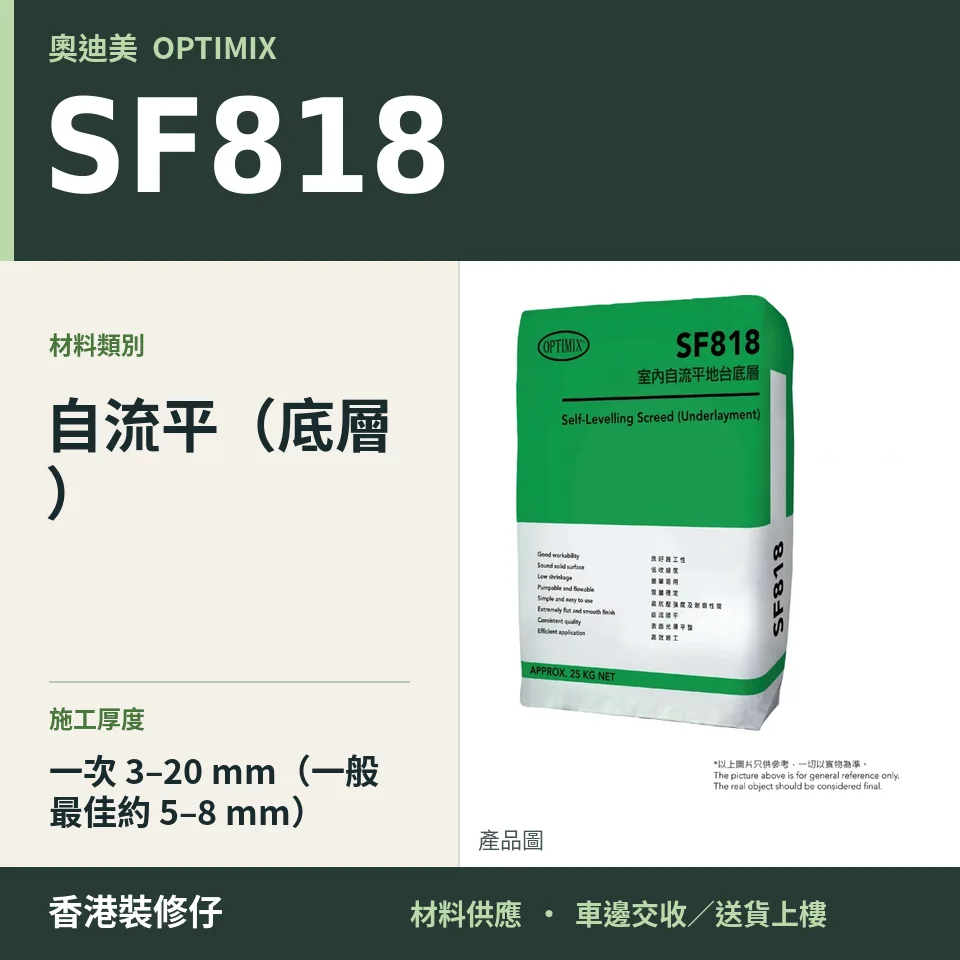
OPTIMIX SF818 Self-Levelling Screed (Underlayment)
OPTIMIX SF818 Self-Levelling Screed (Underlayment)(SF818)
Materials can be purchased separately from HK Create Design. Give us the quantity and district for unit prices, lead times and kerbside or upstairs delivery rates.
OPTIMIX SF818 is a flowable cement-based self-levelling underlayment. Mix with water and pour or pump in a single 3–20 mm application over a sound base. It forms a smooth, seamless surface for carpet, vinyl, wood, tiles or epoxy. The manufacturer describes a hard, dust-free surface with low shrinkage to reduce cracking, 28-day compressive strength over 30 MPa, bond strength of at least 1 MPa and linear shrinkage below 0.1%. The casein- and ammonia-free formulation suits hospitals and kitchens as well as homes, malls, offices, hotels and schools. Uneven subfloors in older Hong Kong buildings can cause gaps or noise in SPC or engineered wood floors. Level the base first. The manufacturer strongly recommends priming with diluted SF80 to reduce pinholes and using an experienced crew. Shelf life is only 6 months, so check the manufacture date when buying.
Buy materials: kerbside handover or delivery to your floor
The quote lists materials, delivery and any applicable upstairs delivery fee separately. Choose a handover option to request a price.
Add other materials (optional)
Floor levelling before laying SPC, resilient or timber flooring
HK Create Design · Materials and upstairs delivery quotes · 5243 7747
How many bags of SF818 are needed before laying flooring?
SF818 provides a levelling base beneath interior flooring. Measure changes in level at several points and estimate from the floor area and average thickness.
| 10 m² floor | Calculated at approximately 1.7 kg per square metre per millimetre |
|---|---|
| 3 mm average | Approximately 51 kg, or 3 bags of 25 kg. |
| 5 mm average | Approximately 85 kg, or 4 bags of 25 kg. |
| 8 mm average | Approximately 136 kg, or 6 bags of 25 kg. |
The manufacturer specifies 3–20 mm per coat. For a quote, state the substrate, moisture condition and intended floor covering. Car park driving areas need a suitable separate wearing system.
Check the manufacturer's data sheet and application conditions
OPTIMIX SF818 Self-Levelling Screed (Underlayment) · Application illustration
How is a concrete subfloor levelled before flooring?
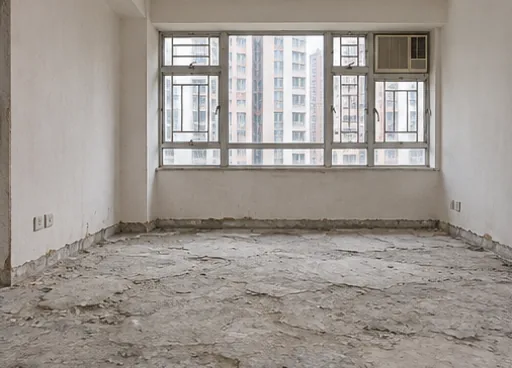
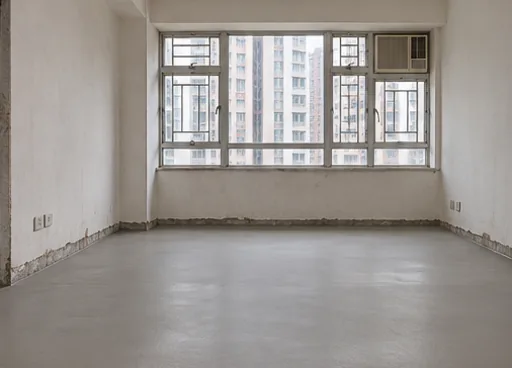
Illustrative application result. Colour, detailing and drying conditions vary on site.
- Material benefits
- The high-flow material produces a smooth, continuous underlayment on a sound substrate.
- Where to use it
- Before laying resilient flooring, timber flooring or carpet in living rooms, bedrooms or offices.
- Application method
- Treat loose areas and cracks, prime and spread the mixed SF818. Check moisture against the flooring system’s requirements before covering.
Compare floor levelling materials, applications and methods
View flooring project photos from Dandenong Mansion, Wan Chai
SF818 application steps
- Remove loose material and oil from the base. Pressure-washing is recommended.
- The manufacturer strongly recommends brushing diluted OPTIMIX SF80 primer over the substrate, removing excess and waiting until touch dry or slightly tacky. Highly absorbent surfaces may need another coat.
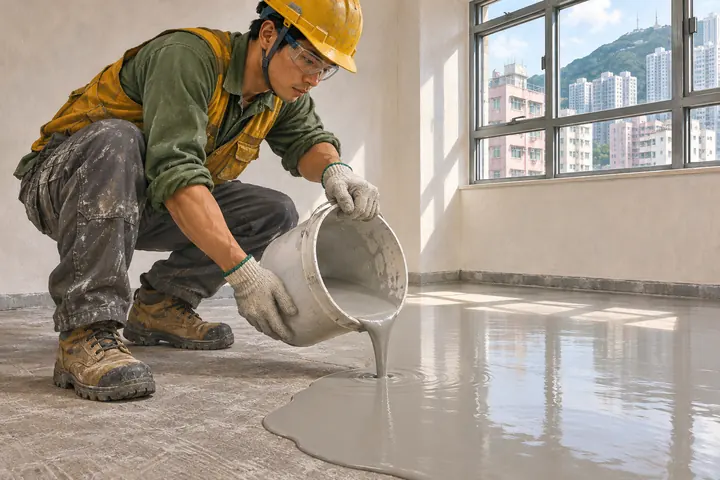
- Add 5.0–5.5 litres of clean water per 25 kg bag, mix with a low-speed drill for 3–4 minutes until lump-free, rest for 1 minute and remix briefly. For pumping, adjust the flow to approximately 140 mm at the point of application.
- Pour within the working time and self-healing time, then spread evenly with a rubber squeegee or gauge rake. The usual preferred thickness is about 5–8 mm.
- Use a spiked roller to release air. Avoid overworking so the surface remains continuous and smooth.
Manufacturer’s specifications
View SF818 Manufacturer's information and sources
| Item | Specification |
|---|---|
| Application thickness | 3–20 mm per application, with a usual preferred thickness of about 5–8 mm [2] |
| 28-day compressive strength | > 30 MPa [2] |
| 28-day flexural strength | > 7 MPa [2] |
| 28-day bond strength | ≥ 1 MPa [2] |
| 28-day linear shrinkage | < 0.1% [2] |
| Flow | At least 130 mm. For pumping, 140 mm at the point of application is recommended. [2] |
| Self-healing time | 20 minutes [2] |
| Mixing water | 5.0–5.5 L per 25 kg bag [2] |
| Consumption | 1.7 kg/mm/m² [2] |
| Wet density | 2,050 kg/m³ [2] |
| Packaging | 25 kg per bag [2] |
| Shelf life | 6 months [2] |
Suitable applications
- Floor levelling before laying SPC, resilient or timber flooring
- Underlayment for carpet or epoxy flooring
- Large-area floors for shops and office buildings
- Kitchens, clinics and other places with high hygiene requirements
Applications to avoid
- Level differences over 20 mm (the manufacturer also offers SF806 thick-layer self-levelling compound for 10–50 mm)
- Unstable substrates or substrates that move
- Direct use as the exposed finish on an outdoor floor (the manufacturer offers SF868 for outdoor use)
How we use this material on site
Before replacing flooring throughout a home, we measure level differences. Where suitable, we prime, pour self-levelling compound and use a spiked roller to release air.
View the work details Hong Kong commercial renovation, shopping mall and retail painting worksFor vinyl flooring or carpet in shops and offices, a self-levelling compound gives an even base over large areas efficiently.
View the work details Hong Kong strip-out work, site protection and debris removalAfter removing old floor tiles, we patch deep depressions and apply a self-levelling compound for a smooth base.
View the work detailsApplication notes
- The flatness of the finish depends largely on the profile of the base.
- The shelf life is 6 months, which is shorter than other products.
- It is an alkaline product, so wear gloves and a mask.
OPTIMIX Other products
Specifications are drawn from the manufacturer’s website or technical data sheets (TDS). Refer to the latest manufacturer’s information for updates. HK Create Design is independent of the brands, whose names and trademarks belong to their respective owners.