01
Why is matching materials difficult?
Walls, floors, ceilings, cabinets, worktops, tiles, doors, window frames, curtains and sofas all contribute colours and textures. Even two or three mismatches among a dozen surfaces can make a room feel disjointed.
Another challenge is seeing the whole scheme when the floor, cabinet doors and worktop are chosen in different shops. Similar but mismatched woods or greys may only become obvious once everything is installed.
Limit the number of colours with a simple rule, then view all the material samples together, ideally in the flat under its actual lighting.
- More than a dozen surfaces in one home
- Separate samples make the whole scheme hard to judge
- Use the rule to limit the number of colours
- Lay the samples out together
- 60%Main colourWalls, floors and large cabinets
- 30%Secondary colourFurniture and worktops
- 10%AccentHandles and soft furnishings
Compiled by HK Create Design.
02
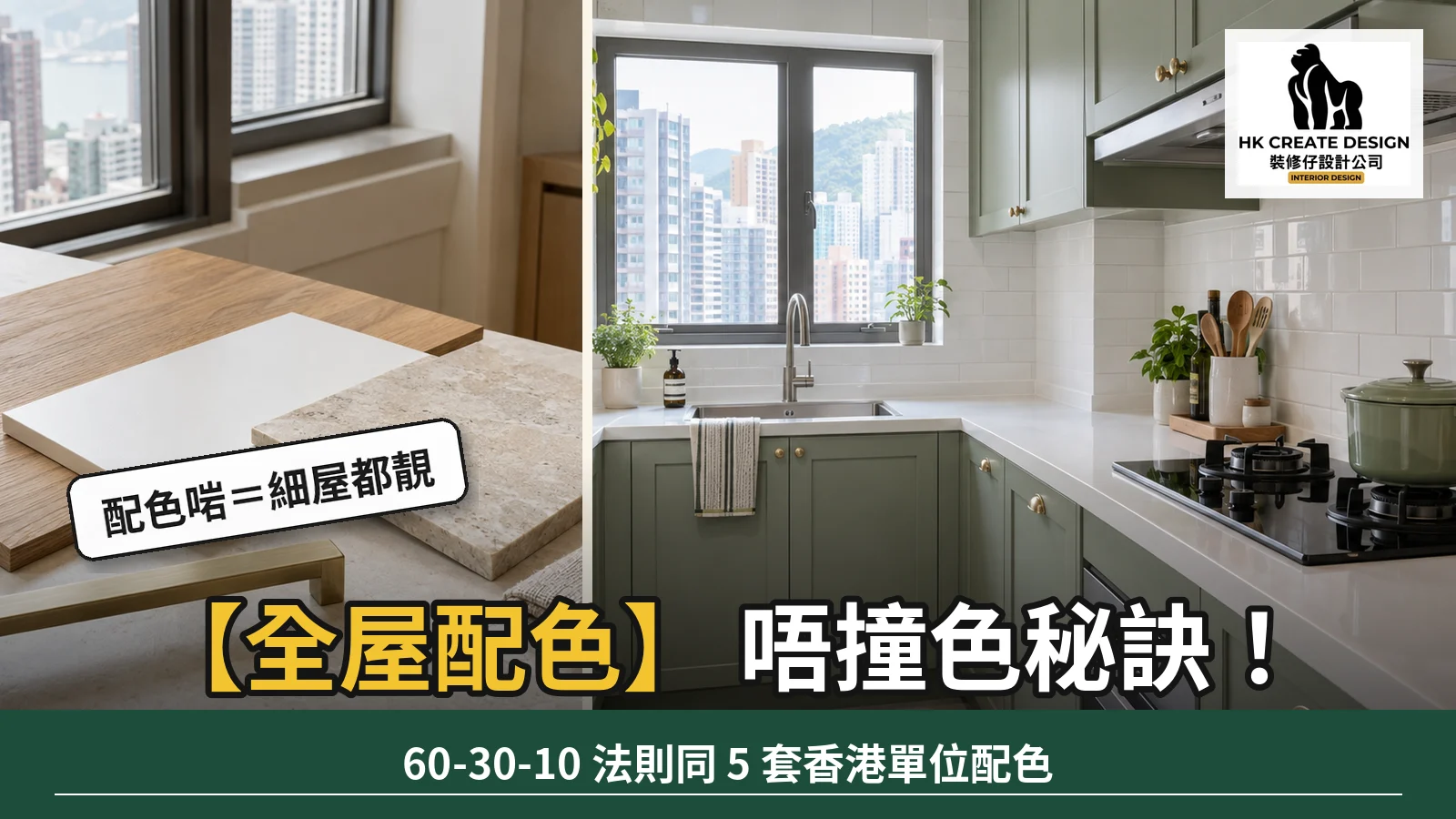
The 60-30-10 colour rule
The 60-30-10 rule isInterior designa common way to build a palette. The main colour covers about 60%, including walls, floors and large cabinet fronts. Common choices are white, ivory, pale grey and light wood.
The secondary colour covers about 30% of the sofa, bed, worktop and selected fronts. Try a deeper tone or texture such as medium wood, grey or stone veining. The 10% accent comes from handles, lights, pictures, cushions and plants, with options such as black, gold or deep green.
Use the ratio as a guide. Equal thirds can leave no dominant colour, while too many accents make a scheme look busy.
For a small Hong Kong flat, a pale main colour can extend the sense of space. Use secondary and accent tones to express character.
- Main colour 60%: walls, floors and large cabinets
- Secondary colour 30%: furniture and worktops
- Accent 10%: handles and soft furnishings
- Set a clear hierarchy
You can swipe left or right on your phone to view the complete table.
| Plan | Main colour 60% | Secondary colour 30% | Accent 10% |
|---|---|---|---|
| Scandinavian and Japanese | White | Light wood | Black |
| Cream-toned and understated luxury | Ivory | Medium-toned wood | Matt gold |
| Modern minimalist | Pale grey | White and woodgrain | Black or silver |
| Wabi-sabi | Warm grey | Earth tones | Natural timber and ceramics |
| Mid-century style | White | Walnut | Deep green |
Compiled by HK Create Design. [1]
- White, pale wood and blackScandinavian and Japanese.
- Ivory, medium wood and matt goldCream-toned and understated luxury.
- Pale grey, white and woodgrainModern minimalist.
- Warm grey, earth tones and timberWabi-sabi.
- White, walnut and deep greenMid-century.
03
5 colour palettes for Hong Kong flats
Palette 1. White, light wood and black. Pair white walls with pale oak floors and cabinet doors and black handles and lights. Common in Scandinavian and Japanese interiors, this combination is easy to coordinate.
Palette 2. Ivory, medium wood and matt gold. Combine ivory walls and doors, medium-toned flooring and matt gold handles for a warm cream-toned or understated luxury scheme.
Palette 3. Pale grey, white and woodgrain. Pair pale grey walls or doors with white worktops and woodgrain flooring. Choose a slightly warm grey for a softer modern minimalist interior.
Palette 4. Warm grey, earth tones and natural timber. Textured grey walls, brown or earth-toned fabrics and timber furniture suit wabi-sabi. Limit the darker colours in small rooms.
Palette 5. White, walnut and deep green. Pair white walls and walnut furniture with green cabinet doors, a sofa or plants. For a mid-century feel in a small flat, keep dark finishes below 30%.
- White, pale wood and black: easy to coordinate
- Ivory, medium wood and matt gold: warm palette
- Pale grey, white and woodgrain: minimalist
- Warm grey, earth tones and natural timber: wabi-sabi
- White, walnut and deep green: mid-century
- SuitableOne wood tone throughout, or two clearly different tones
- UnsuitableTwo or three almost-matching wood tones
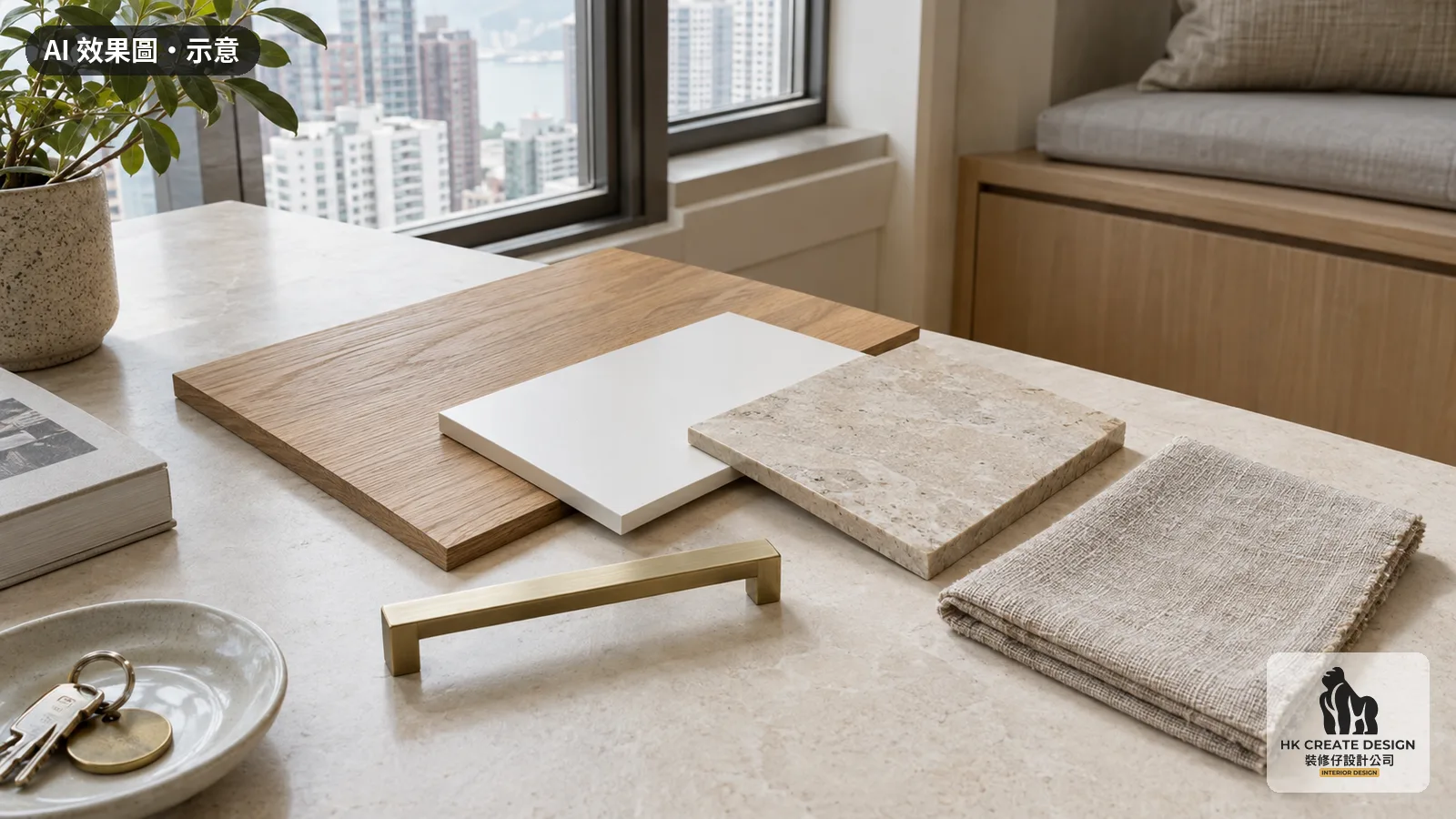
「I ask clients to put all the samples on the floor and look down at them together. It is much easier to see which one stands out or clashes than to judge them individually in different shops.」
04
Coordinating wood tones
Wood tones are particularly easy to mismatch. A different wood on floors, cabinet fronts and internal doors can look like pieces collected from three different eras.
1. Use one wood tone throughout or at most two, one light and one dark. 2. If using two, make the difference clear, such as pale oak and walnut. Two nearly matching shades can look accidental.
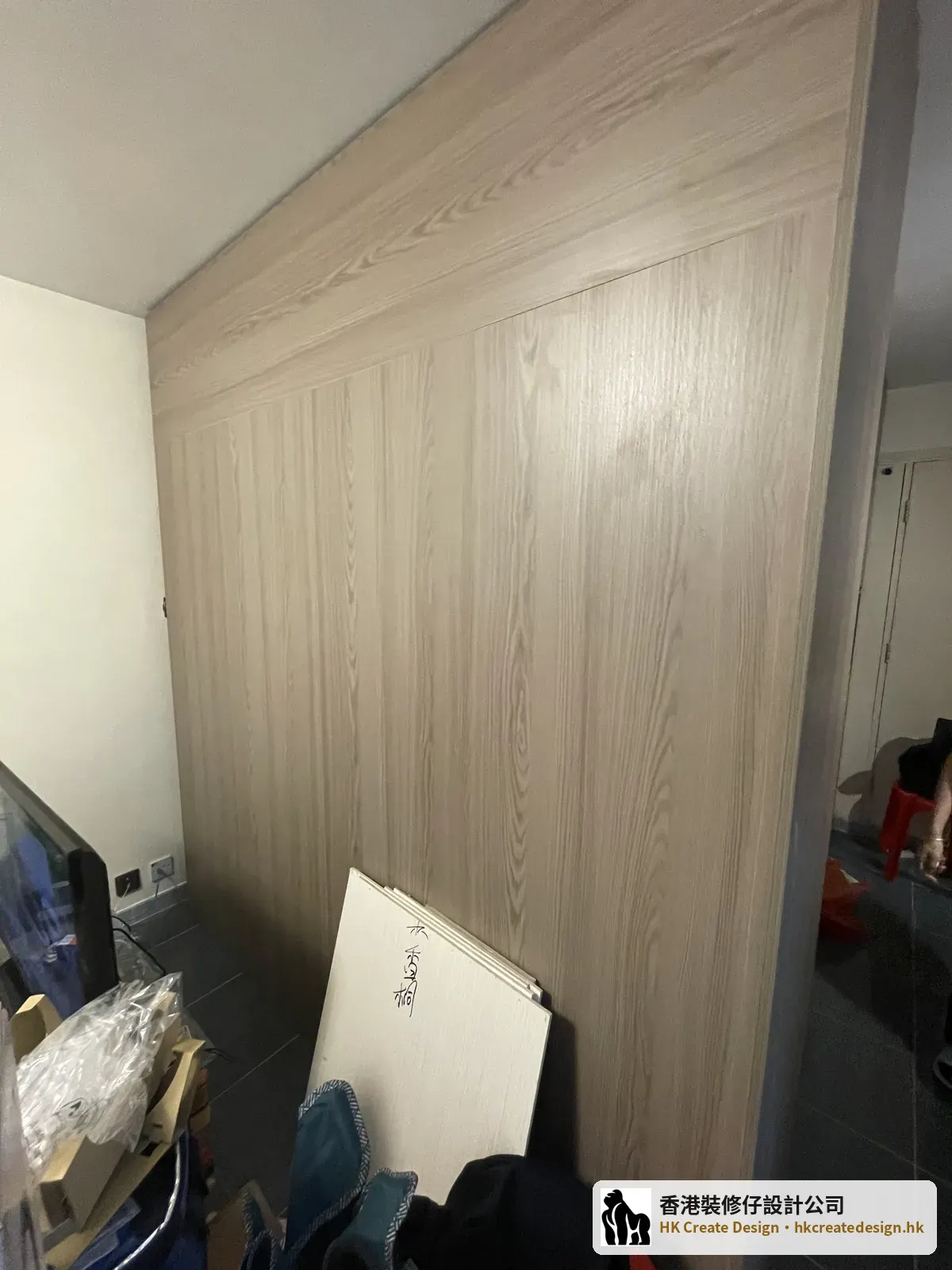
3. Floor and door grain need not run the same way, but keep the cabinet grain on one wall consistent. Vertical grain draws the eye up and horizontal grain draws it across.
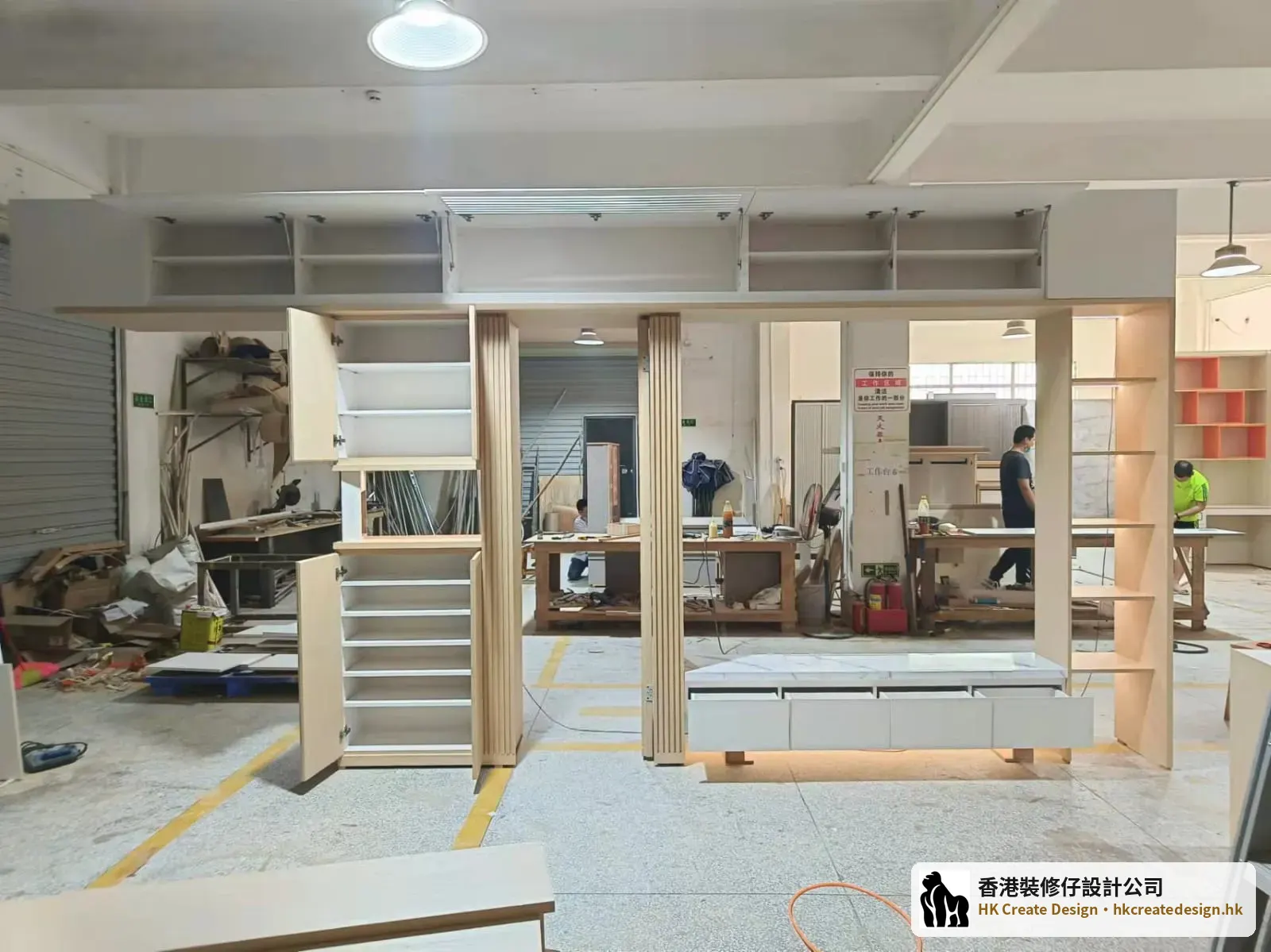
Compare flooring and cabinet samples side by side whenever you choose either. You can bring your flooring sample to HK Create Design's showroom and view it with our cabinet boards.
- Up to two wood tones throughout
- Make the difference deliberate
- Use one grain direction across the same wall
- Compare the colour and material samples together
05
Kitchen: cabinet doors, worktop and wall tiles
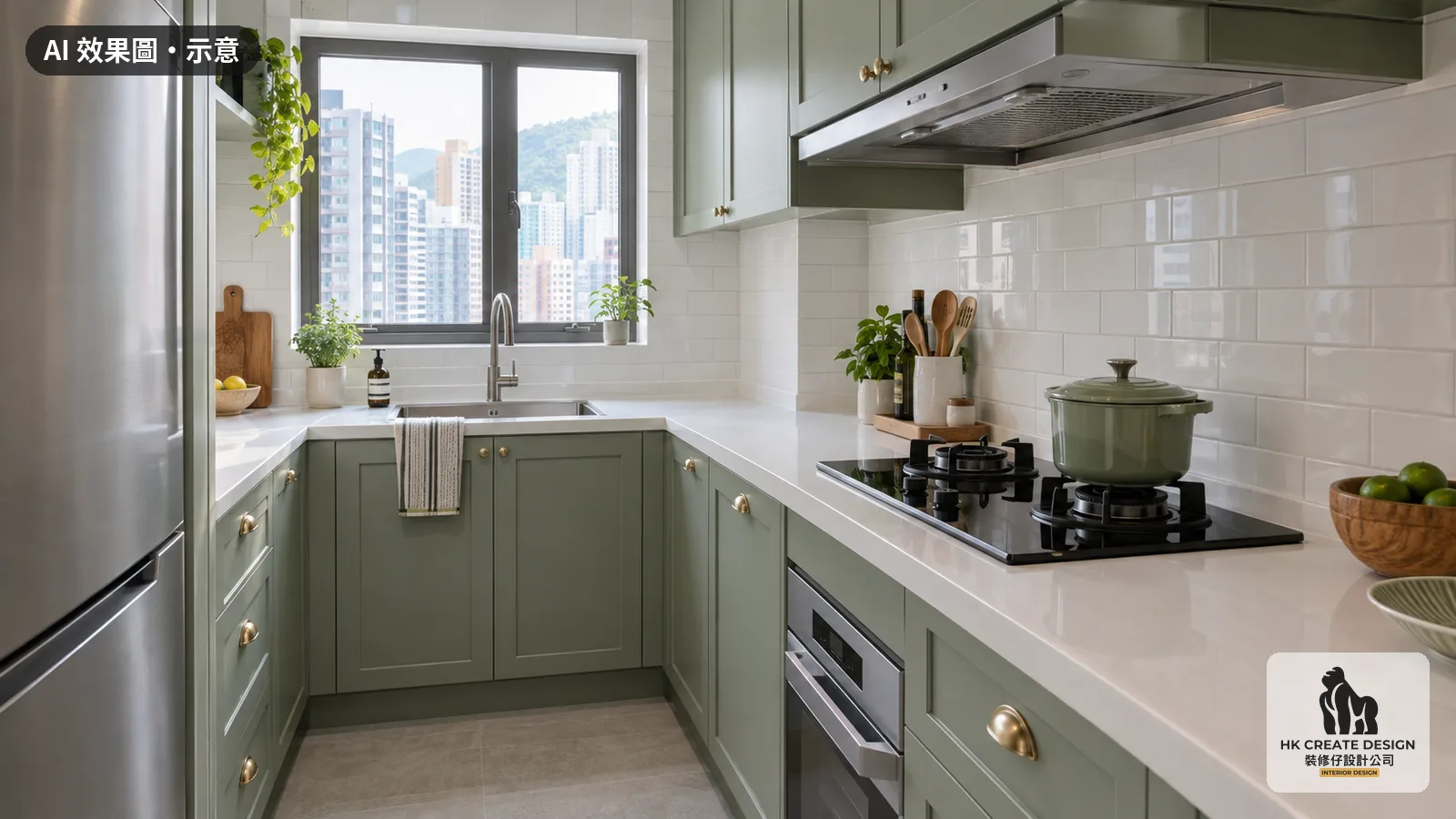
Coordinate cabinet doors, worktop and wall tiles in a kitchen. Choose one focal point. For dark cabinet fronts, use lighter counters and wall tiles. For a strongly veined worktop, keep the doors and wall tiles plain.
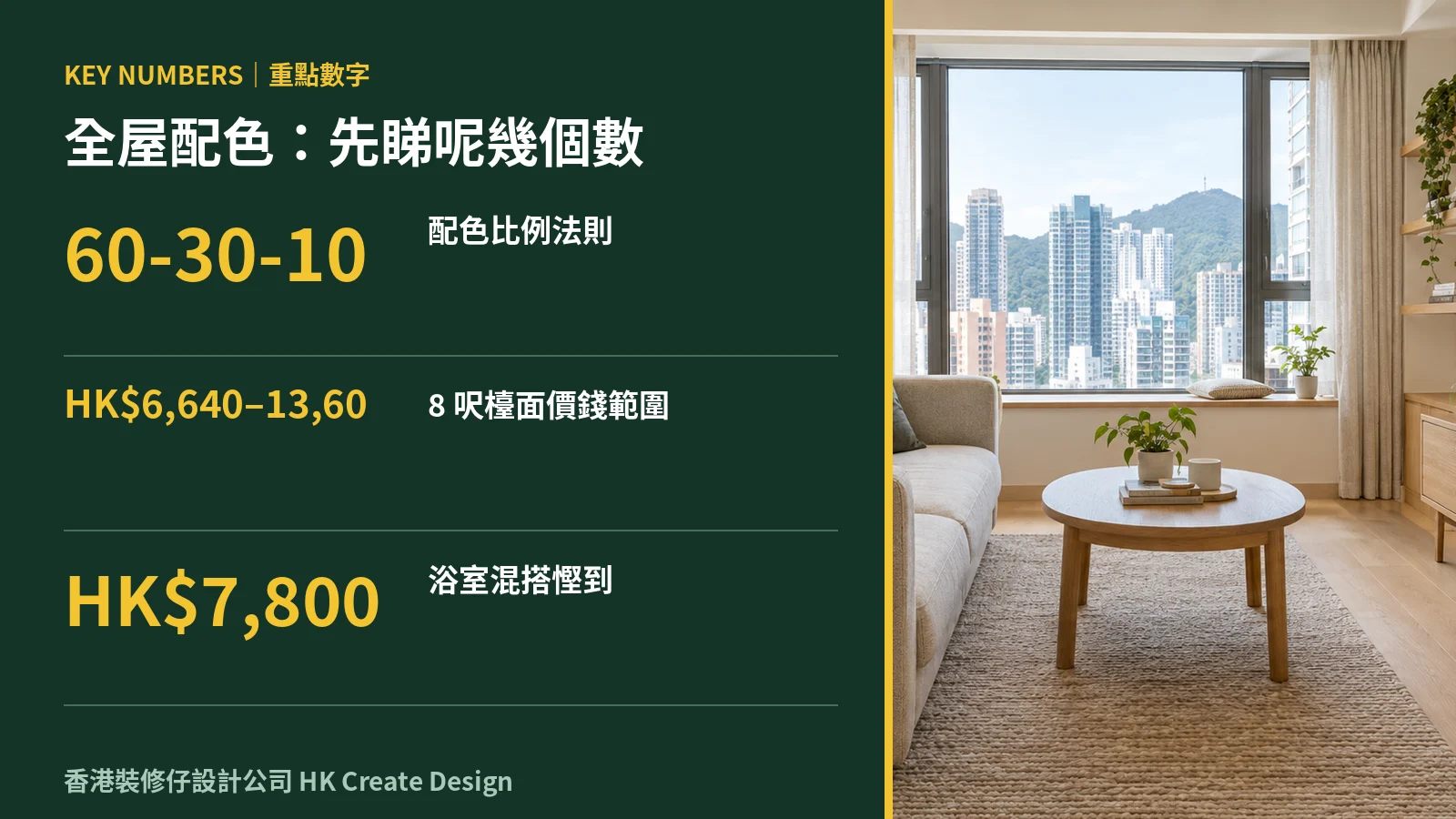
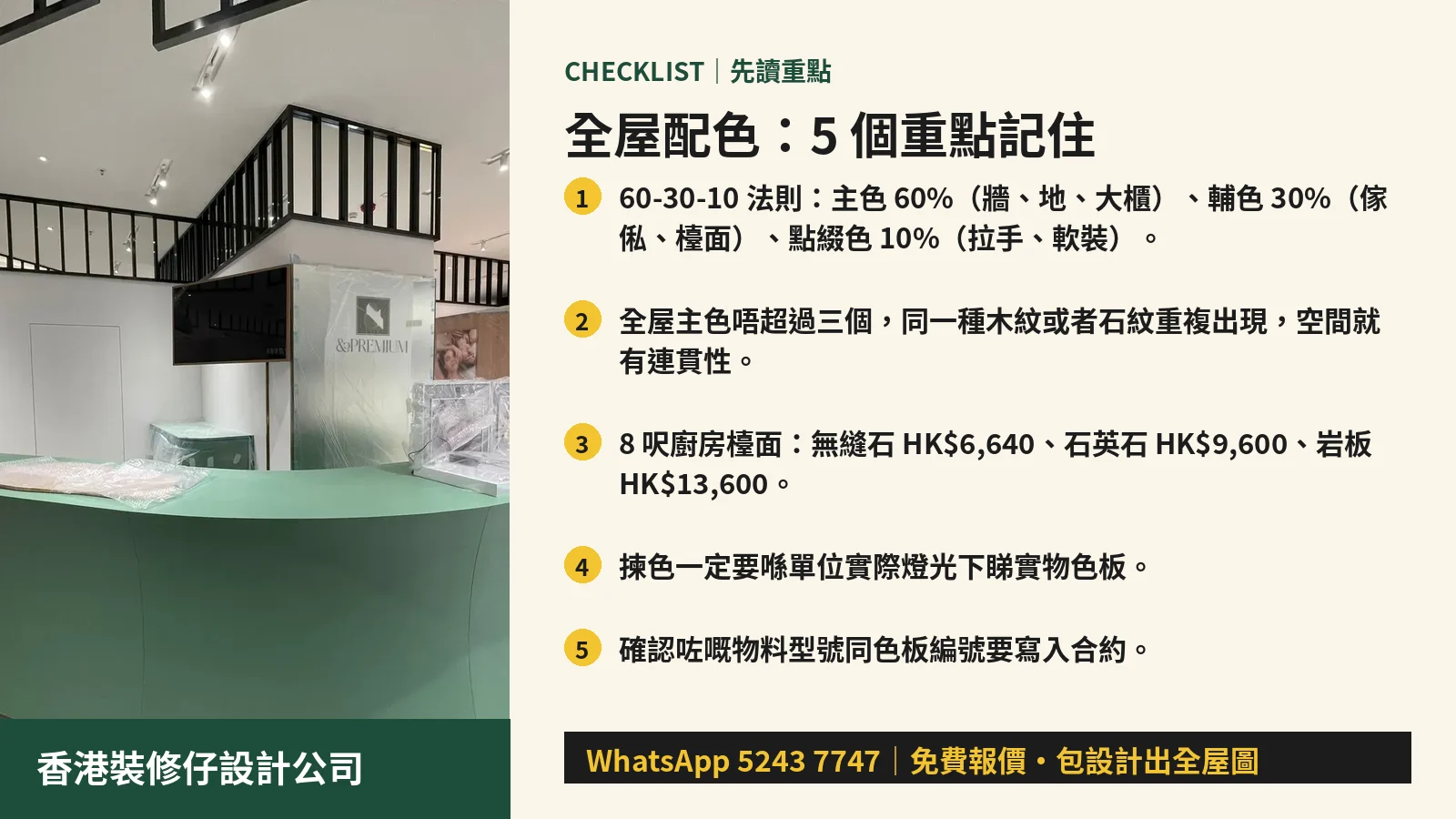
For an 8 ft kitchen worktop, FUR19 solid surface costs HK$830 per linear foot, HK$6,640 total. FUR20 quartz costs HK$1,200 per linear foot, HK$9,600 total. FUR21 sintered stone costs HK$1,700 per linear foot, HK$13,600 total[1]. All three include 1 sink cut-out and 1 hob cut-out[1].
Pale worktops look bright and benefit from a stain-resistant finish. Darker worktops show some stains less but can make the kitchen feel darker. Check vein direction and continuity at joints in stone-effect tops.
Plain large-format kitchen wall tiles have fewer joints and are easy to clean. For interest, limit patterned or small-format tiles to the splashback between the hob and sink.
- One focal point
- 8 ft solid surface — HK$6,640
- 8 ft quartz — HK$9,600
- 8 ft sintered stone — HK$13,600
06
Bathroom: tiles, vanity and hardware
Keep a small bathroom palette simple. Use related colours for wall and floor tiles, make the vanity the secondary colour and coordinate taps, shower fittings and towel rails as the accent.
For about 185 sq ft of wall and floor tiles: D01/D02 straight-lay tiles up to 600 × 600 mm at HK$78 per square foot total HK$14,430. D04 large tiles at HK$120 total HK$22,200. D06 small tiles or mosaics at HK$130 total HK$24,050[1].
Mixed scheme: 150 sq ft of D02 plain tiles costs HK$11,700, and 35 sq ft of D06 mosaic on the shower feature wall costs HK$4,550. Total HK$16,250[1], saving HK$7,800 against a fully mosaic bathroom while retaining a feature wall.
Hong Kong's average relative humidity is about 78%[4], bathroom grout can develop mould. Match pale tiles to light grout, or use D08 epoxy grout at HK$21 per square foot for mould resistance and easier cleaning[1].
- Coordinate floor and wall tile colours
- Coordinate hardware finishes
- Mixed tiles save HK$7,800
- Mould-resistant epoxy grout
Example: three choices for an 8 ft kitchen worktop
Assumptions
- 8 linear ft of worktop
- 600 mm deep
How to calculate quantities
- Solid surface: 8 × HK$830 = HK$6,640
- Quartz: 8 × HK$1,200 = HK$9,600
- Sintered stone: 8 × HK$1,700 = HK$13,600
- Sintered stone costs more than solid surface: 13,600 − 6,640 = HK$6,960
The largest difference between worktops is about HK$6,960.
Includes 1 sink and 1 hob cut-out. Confirm against site measurements and a written quotation. [1]
07
Matching floors and walls
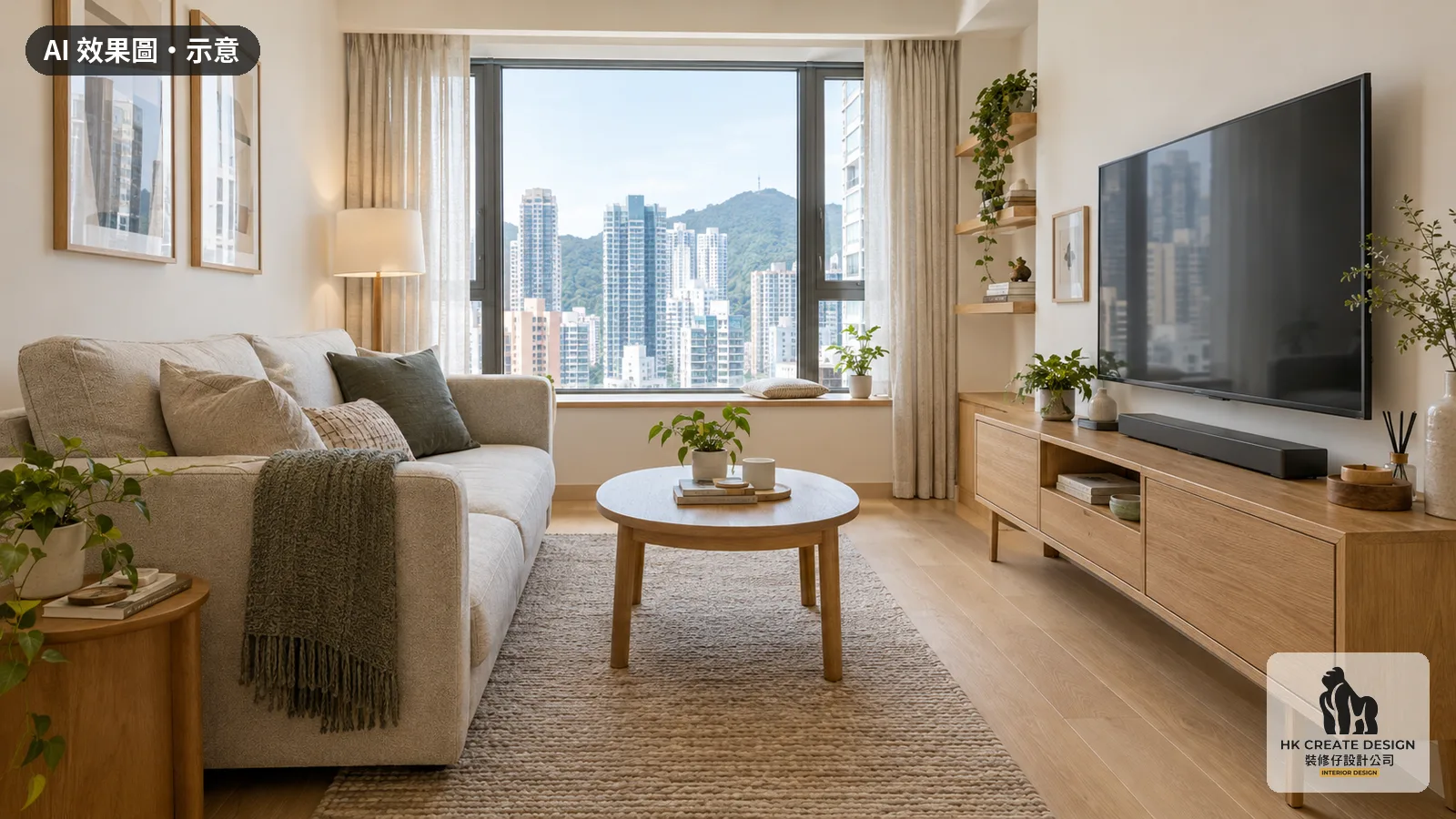
Floors and walls cover the largest areas. A floor one or two shades darker than the walls gives a grounded feel. Very pale flooring against dark walls can feel top-heavy.
Flooring per square foot: J01 SPC HK$60, J02 laminate HK$82, D03 wood-effect plank tiles HK$98 and D04 large-format tiles HK$120[1]. The Consumer Council compared flooring types and recommends choosing for water resistance, wear and maintenance needs[7].
Use paint on most walls, E02 at HK$21 per square foot. For a textured feature wall, E06 decorative paint costs HK$110 per square foot[1]. Changing dark paint to a light colour needs an extra coat. E03 adds HK$4 per square foot[1].
Skirting in the wall colour makes the wall look taller. Matching it to the floor makes the floor look wider. Avoid adding a third colour.
- Darker floor, lighter walls
- Choose flooring for water and wear resistance
- Decorative feature wall paint — HK$110
- Match skirting to the floor or wall
08
Hardware and accents: small details that shape the finish
Handles, taps, light fittings, curtain tracks and door handles form the accent colour. Carry one metal finish through the home, such as black or matt gold, for a consistent result.
FUR28 electroplated handles cost HK$70 each, FUR29 scratch- and fade-resistant PVD metal handles HK$250 each, and FUR30 push-to-open fittings HK$140 per door[1]. Hong Kong's humidity can discolour ordinary plated handles over time. Consider PVD for frequently used doors.
Coordinate cushions, rugs and curtains with lighter or darker shades of the main and secondary colours, then add one or two accent pieces. These are the easiest elements to change when refreshing a style.
- Coordinate metal finishes throughout
- Electroplated HK$70 or PVD HK$250
- Consider PVD in humid conditions
- Soft furnishings are easiest to change
You can swipe left or right on your phone to view the complete table.
| Countertop | per linear ft | 8 ft total | Features |
|---|---|---|---|
| FUR19 solid surface | HK$830 | HK$6,640 | Seamless and economical |
| FUR20 quartz | HK$1,200 | HK$9,600 | Scratch- and stain-resistant |
| FUR21 sintered stone | HK$1,700 | HK$13,600 | Heat-resistant with distinctive veining |
Includes 1 sink and 1 hob cut-out. HK Create Design published 2026 rates. [1]
- Floors and wallsLargest surfaces first
- Cabinet fronts and worktopsCompare against the floor
- Wall tilesKitchen and bathroom
- Hardware and light fittingsFinally
- View on siteDaylight and evening light
09
How to choose samples in sequence
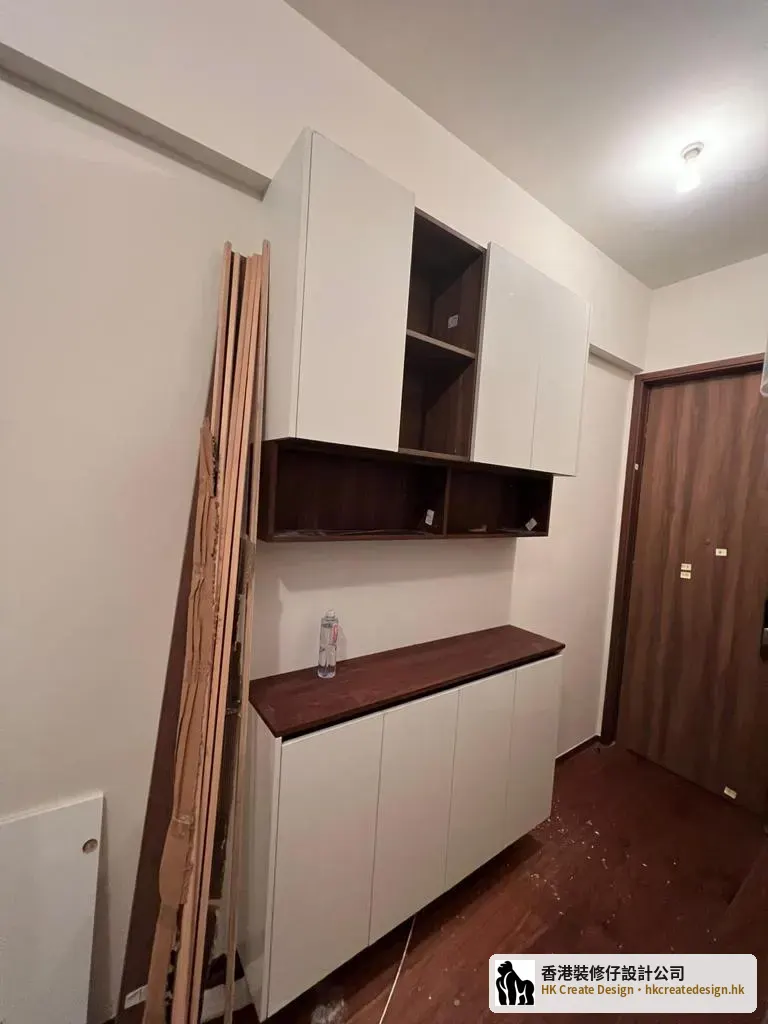
1. Start with the largest and hardest-to-change finishes: floors and walls. 2. Compare cabinet doors and worktops against the floor sample. 3. Choose wall tiles, especially in the kitchen and bathroom. 4. Pick handles, hardware and lighting last.
5. Take all the samples to the flat and view them together in daylight and under evening lighting. The same sample can look very different under white showroom lamps and warm home lighting.
6. Photograph the code on every sample. The Consumer Council's survey notes thatBespoke furnitureAfter the quotation is agreed, the contractor should provide drawings, detailed dimensions, material samples and colours for the owner to choose and sign off[2].
HK Create Design includes design, whole-home drawings and VR renderings with fitted furniture. Preview the colour scheme before work starts, then confirm it with physical samples.
- Choose the largest surfaces first
- Then choose cabinet fronts and worktops
- Then choose wall tiles
- Choose hardware last
- View under the actual lighting
- Record the sample codes
10
Record materials in the contract to avoid mismatches
In a renovation complaint handled by the Consumer Council, the imported floor tiles specified by the owner were replaced with another type[3]. Colours and materials are common sources of disputes during the middle and later stages of renovation.
The Consumer Council recommends clearly recording specific design or building material requirements in the contract[3]. Specify brands, models, sample codes and dimensions for every material in the quotation and contract. Attach photographs of the samples.
If a material is out of stock during works, inspect the proposed substitute and approve it in writing. The Consumer Council also recommends written confirmation of project changes[3].
- Specify brands, models and colour codes
- Attach sample photos
- Approve material substitutions in writing
- Approve after seeing the physical sample
11
How Hong Kong's climate affects finish colours
Hong Kong’s mean annual relative humidity is around 78%, reaching a monthly average of 83% in April and May[4]. Humidity affects the appearance of finishes: pale grout can darken, white silicone can develop mould and pale fabrics can show mildew spots.
In wet areas, consider mould-resistant or epoxy grout, replace mould-resistant silicone as needed and choose washable fabrics. HK Create Design uses ENF boards as standard, the strictest mainland Chinese formaldehyde emission grade for wood-based panels, limiting emissions to 0.025 mg/m³[5]. Use moisture-resistant board for wet-area cabinet carcasses.
Strong sun in a west-facing flat can fade dark finishes. Choose fade-resistant furniture fabrics and curtains near the window, or consider heat-control window film.
- Humidity can darken grout
- Mould-resistant grout and silicone
- ENF-grade boards as standard
- Prevent fading in west-facing flats
12
Common colour-matching mistakes
Mistake 1. A Scandinavian living room, luxury bedroom and industrial kitchen can feel disconnected. Allow variations between rooms while repeating the main colours and materials.
Mistake 2. Cool, warm, blue and green greys can look muddy when mixed unintentionally. Place all grey samples side by side to check their undertones.
Mistake 3. Cool white, warm white and cream are visibly different. Compare wall, cabinet and worktop whites together before committing.
Mistake 4. Online photographs may be colour-graded and professionally lit. View the physical samples.
Mistake 5. Following a trend for dark finishes throughout a small flat can make it feel enclosed and harder to restyle. Put darker colours in movable furniture or fabrics where changes are easier.
Mistake 6. Dark or busy ceilings appear lower. Light temperature also changes material colours: warm light can yellow whites or brown greys, while cool light can grey wood tones. Choose each room's light temperature and check the samples under comparable light.
Mistake 7. Choosing everything in a day encourages mismatches. Allow one to two weeks, start with the largest surfaces, then view each new selection alongside those already chosen.
- A different style in every room
- Clashing grey undertones
- Clashing whites
- Relying on online photos alone
- Dark colours throughout
Example: mixing tile styles in a bathroom
Assumptions
- About 185 sq ft of floor and wall tiles
- 35 sq ft shower feature wall
How to calculate quantities
- D02 plain tiles: 150 × HK$78 = HK$11,700
- D06 mosaic: 35 × HK$130 = HK$4,550
- Total HK$16,250
- All mosaic: 185 × HK$130 = HK$24,050
- Saving: 24,050 − 16,250 = HK$7,800
The mixed scheme saves HK$7,800 compared with all mosaic.
Tiles themselves excluded. Confirm against site measurements and a written quotation. [1]
13
Choose your palette within the same board grade
Colour and texture come from the surface finish, while the board core and adhesive determine the emissions grade. HK Create Design's entire sample range uses ENF boards as standard, so you can choose your preferred colour within the same grade.
The Environmental Protection Department notes that building materials, furniture and ventilation affect indoor air quality[6]. Paint, adhesives, silicone and textiles can all produce odours. Consider low-VOC paints and unpack fabric sofas and curtains to air before bringing them inside.
Government green renovation advice encourages owners to retain usable materials and reduce waste[8]. If the existing floor or doors are in good condition, use them as part of the main palette and match cabinet doors and walls to them. Keeping serviceable materials can reduce waste and cost.
Example: keep a well-maintained light brown timber floor, use ivory walls, light wood or white cabinet doors and matt gold handles for the ivory, medium wood and matt gold palette. Sanding or deep-cleaning the floor can refresh the entire scheme.
- Finish colour and board emissions grade are independent
- Same ENF grade across all colours
- Low-VOC paint
- Keep serviceable existing materials
- Use the existing floor as the main colour
14
Colour choices that make a small flat feel larger
1. A pale tone across walls, ceiling and large cabinet fronts helps the surfaces blend and makes a small room appear larger.
2. Match large cabinet doors to the walls, for example white with white or ivory with ivory. This makes tall wardrobes and TV units read as part of the wall.
3. Run the same flooring through the living room, bedrooms and corridor. Use water-resistant tiles in similar colours in kitchens and bathrooms for a softer transition. A flush threshold can also help.
4. Keep darker colours lower down. Try them on base cabinets,Platform bedsside panels or sofas, leaving ceilings and tall cabinets lighter. Darker colours low down and paler ones above can make the room feel taller.
5. Selective mirrored sliding doors or glossy fronts can reflect light. Large expanses of gloss can create glare and show fingerprints.
- Pale colours on large surfaces
- Match cabinet doors to the wall
- Continuous flooring throughout
- Use dark colours low down
- Use mirrors selectively
You can swipe left or right on your phone to view the complete table.
| practice | Per square foot | Total |
|---|---|---|
| D01/D02 straight-lay tiles | HK$78 | HK$14,430 |
| D04 Large-format tiles | HK$120 | HK$22,200 |
| D06 mosaic | HK$130 | HK$24,050 |
| Mixed layout: D02 for 150 sq ft and D06 for 35 sq ft | — | HK$16,250 |
HK Create Design’s published prices for 2026. [1]
15
Maintaining colours after renovation
Care helps preserve colour. Wipe woodgrain board doors with a damp cloth and avoid bleach, strong acids or alkaline cleaners that can fade or mark the finish.
Quartz and sintered stone resist stains, but wipe coffee, soy sauce or red wine promptly. Use a suitable cleaner on solid surface. A weekly clean with a soft brush helps prevent bathroom grout from darkening.
Curtains or solar-control film can help protect furniture and fabrics in direct sun. Mouldy white silicone normally needs replacing. Contact HK Create Design about workmanship issues within the one-year warranty period.
- Wipe cabinet doors with a damp cloth
- Wipe dark spills immediately
- Clean grout weekly
- Protect finishes near windows from sun
- One-year warranty
16
Choose colours with HK Create Design
HK Create Design has served Hong Kong homeowners since 2019. Fitted furniture includes design and whole-home drawings with VR renderings, so you can see the full palette before work starts. Bring floor or tile samples to the showroom to compare with our boards.
For two or more work items, complimentary site measurement is offered until 31 December 2026. Showroom: Shop 16, G/F, Fu Yau Building, 61 Po Kong Village Road, Wong Tai Sin, Kowloon. WhatsApp 5243 7747. HK Create Design offers a one-year warranty and has a HK$2,000 minimum charge.
- VR renderings
- Board samples in the showroom
- WhatsApp 5243 7747
Advice from our tradespeople
「I ask clients to put all the samples on the floor and look down at them together. It is much easier to see which one stands out or clashes than to judge them individually in different shops.」
「Photograph the colour sample code and keep the photo. When the order arrives, I check the code on every box. If it differs, I send it back before laying anything.」
FAQ
12 practical questions answered
01What is the 60–30–10 rule?
Use about 60% base colour for walls, floors and large cabinets, 30% secondary colour for furniture and counters, and 10% accents for handles and soft furnishings.
02How many wood tones can I use throughout the flat?
Use no more than two wood tones, one clearly lighter than the other, or keep a single tone throughout.
03Which kitchen worktop should I choose?
8 ft example: solid surface HK$6,640, quartz HK$9,600 or sintered stone HK$13,600[1]. Choose according to budget and use.
04Is using mosaic tiles in a bathroom expensive?
A whole 185 sq ft bathroom in mosaic costs about HK$24,050. Mixing tiles with a mosaic feature wall in the shower comes to about HK$16,250.[1].
05Which colour handles should I choose?
Coordinate metal finishes throughout. In humid Hong Kong, consider PVD handles at HK$250 each for frequently used doors.[1].
06How can I avoid choosing the wrong colour?
Place all the samples together and view them in the flat in daylight and under evening lighting.
07Should the materials be specified in the contract?
Yes. The Consumer Council recommends recording specified material requirements clearly in the contract[3]. Specify the brand, model and colour code.
08What colour should the skirting boards match?
Match the wall or the floor and avoid introducing a third colour.
09How do I choose greys that work together?
Place grey material samples together and select a consistent undertone, either warm grey or cool grey.
10Are fewer colours available in low-emission panels?
No. HK Create Design supplies ENF panels as standard. Every colour on the sample chart has the same emission grade.
11How can colour choices make a small flat look larger?
Use light colours on large areas, coordinate cabinet doors with walls, use consistent flooring throughout and place darker finishes lower down.
12Will dark cabinet doors make a small flat feel cramped?
Yes. Keep dark colours to about 30% or less, or use them on base cabinets and selected items only.
CHECK THE BASIS
Data and technical basis, sources can be verified
- [1]HK Create Design published 2026 rates and work item descriptions Accessed: 2026-11-03
- [2]Consumer Council, 16 November 2020 — survey of residential renovation quotes finds unclear scope and calls for better quotations Accessed: 2026-11-03
- [3]Consumer Council, 15 December 2020 — disputes over renovation quality and the value of detailed contracts and regular follow-up Accessed: 2026-11-03
- [4]Hong Kong Observatory climatological normals, 1991–2020 Accessed: 2026-11-03
- [5]STC: China Market Watch (August 2021) on the new formaldehyde emission grading standard for wood-based panels and finishing products Accessed: 2026-11-03
- [6]Environmental Protection Department: Indoor Air Quality Information Centre FAQs Accessed: 2026-11-03
- [7]Consumer Council guide to choosing flooring Accessed: 2026-11-03
- [8]Hong Kong GovHK: Environmentally Friendly Tips for Home Renovation Accessed: 2026-11-03