01
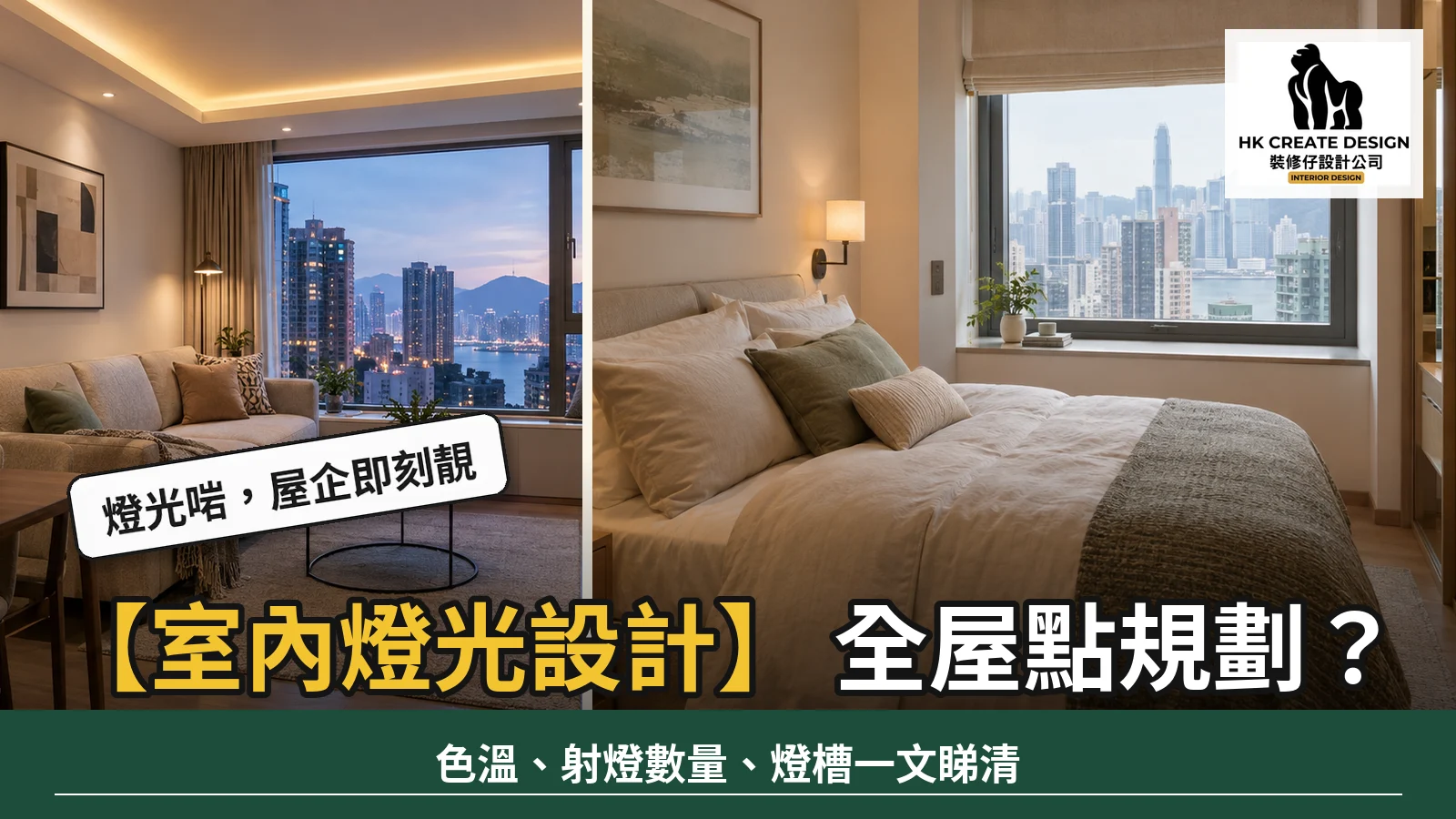
Why plan lighting before renovation?
Lighting needs space in walls and ceilings. Recessed fittings need cut-outs, coves need plasterboard details, and switch wiring needs chases before painting. Adding lights later may mean opening ceilings and walls, refilling and repainting. Finalise the drawing before the electrical and plumbing trades start so the wiring can be installed together.
Lighting depends on furniture placement. Bedside lights go by the bed, a desk light above the desk, and cabinet lights are built into the unit. HK Create Design shows lights, switches and furniture on the same services drawing so they can be coordinated.
The Electrical and Mechanical Services Department states that new electrical installations, additions and alterations must be undertaken by registered electrical contractors and registered electrical workers[4]. Lighting planning also involves electrical safety. Keep the electrical work completion certificate after handover for future insurance or property transactions.
- Concealed lighting points in walls and ceilings
- Adding lighting after completion costs more
- Plan lighting and furniture together
- Work carried out by a registered electrical contractor
- General lightingSpotlights and flush ceiling lights
- Task lightingUnder-cabinet and desk lights
- Accent lightingLED strips in lighting coves
02
Three layers: general, task and ambient lighting
Layer 1. General lighting gives even light for movement and daily activities. Options include ceiling lights, spotlights and downlights. HK Create Design H08 recessed spotlights cost HK$310 each supplied and fitted. H05 installation of an owner-supplied pendant or ceiling light costs HK$670 each[1].
Layer 2. Task lighting gives brighter local illumination for chopping, reading or applying make-up. Use under-cabinet lights, desk lamps or mirror lights. FUR40 cabinet strips at HK$150 per linear foot can light the kitchen worktop[1].
Layer 3. Ambient lighting gives depth through coves, strips, cabinet lights and wall lights. F03 cove costs HK$460 per linear foot, minimum 10 linear ft. H07 LED strip or T5 lamp costs HK$150 per linear foot[1].
Switch the three layers independently. Use the cove while watching TV, full kitchen lighting while cooking and only the corridor night light on the way to the bathroom. Clear grouping makes lighting easier to use and helps save electricity.
- General: spotlights and ceiling lights
- Task lighting: under-cabinet and desk lights
- Ambient: coves and strips
- Switch groups independently as needed
You can swipe left or right on your phone to view the complete table.
| Area | Main items | Amount |
|---|---|---|
| Living and dining room | Suspended ceiling, cove, LED strip, 8 spotlights and a pendant | HK$21,470 |
| Main bedroom | 4 spotlights, ceiling light and wardrobe strip | HK$2,810 |
| Small bedroom | Ceiling light and desk strip | HK$1,120 |
| kitchen | Aluminium ceiling with LEDs and under-cabinet lighting | HK$4,700 |
| bathroom | Aluminium ceiling with LEDs | HK$3,650 |
| Corridor and entrance | 3 spotlights | HK$930 |
| light switch | 6 switches | HK$2,580 |
| Total | — | HK$37,260 |
Owner-supplied fittings cost extra. Based on HK Create Design's published 2026 rates. [1]
- Warm white 2,700–3,000 KLiving room and bedroom, for relaxation
- Neutral white around 4,000 KKitchen and desk: visual clarity
03
Choosing warm, neutral or cool white
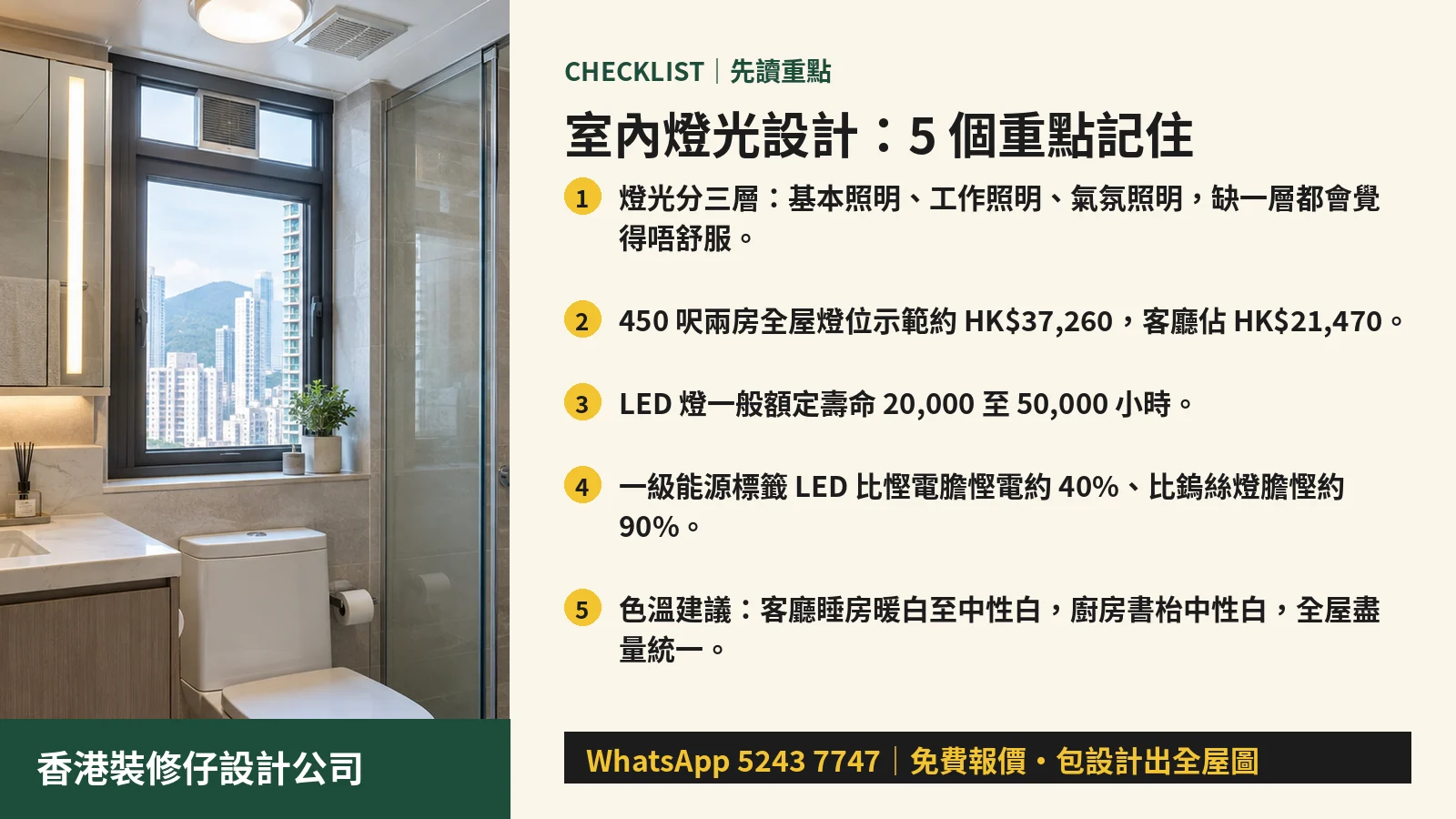
Colour temperature is measured in kelvins (K). Lower values appear warmer and more yellow, higher values cooler and more blue-white. Warm white at 2,700–3,000 K feels relaxing, neutral white around 4,000 K is clear and natural, and cool white from about 5,000 K feels brighter and cooler.
Warm to neutral white suits relaxing in living rooms and bedrooms. Neutral white gives clearer light at kitchen counters, desks and bathroom mirrors. Cool white is less common at home except in workrooms and storage spaces.
Coordinate colour temperatures across adjoining rooms. Warm light in one room and cool light in the corridor can fragment the view. For variation, consider adjustable colour temperature, or neutral general lighting with warmer ambient lighting.
View wall and furniture colours before choosing a colour temperature. Warm white accentuates cream and woodgrain, while neutral white gives grey and white finishes a crisper appearance. Ask to compare options in the VR renderings before work starts.
- 2,700–3,000 K warm white
- Neutral white around 4,000 K
- Cool white above 5,000 K
- Keep it consistent throughout the flat
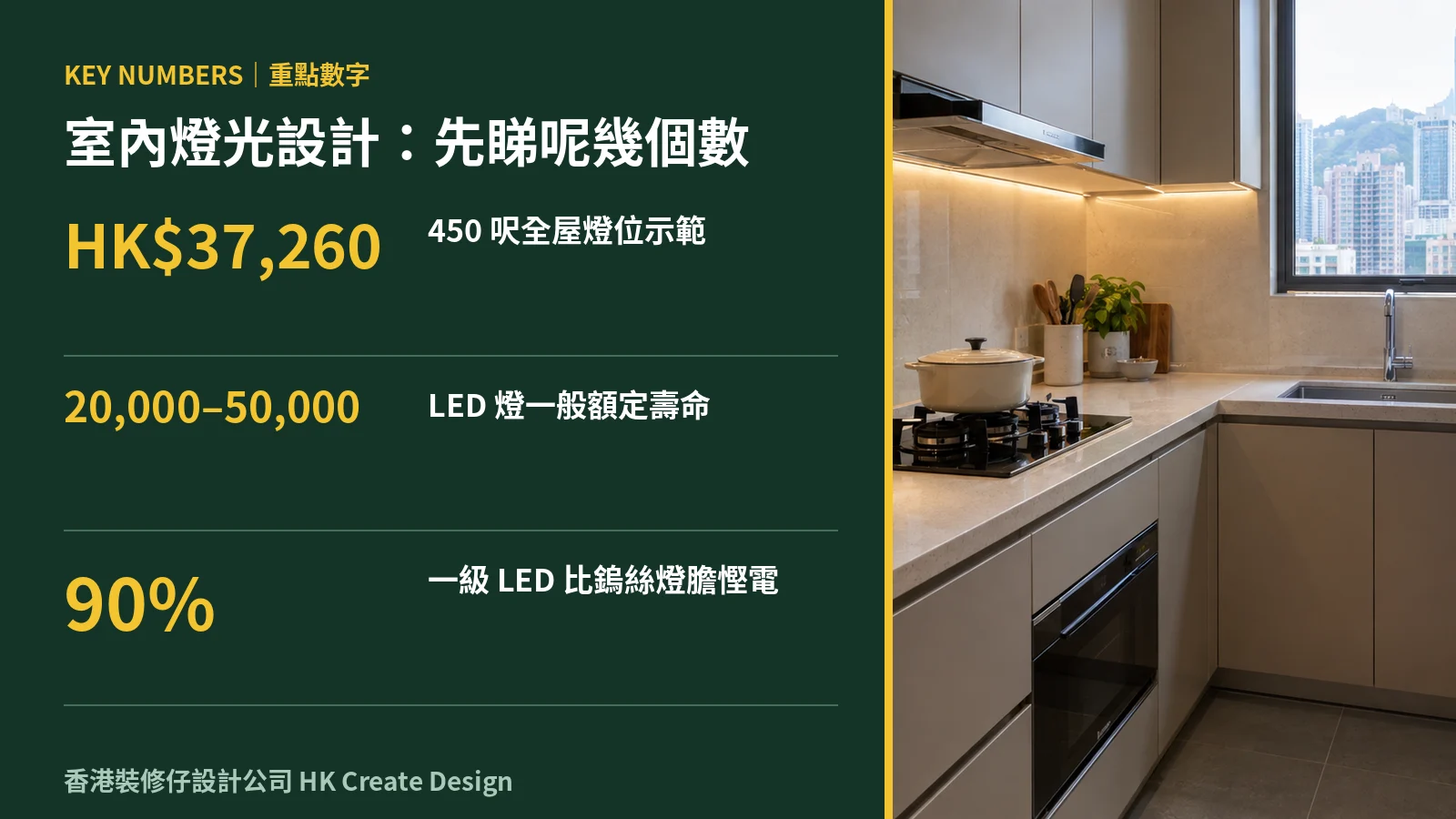
- $37,260Whole-home example450 sq ft
- 50,000 hoursLED service lifeMaximum
- Save 90%Grade 1 LEDCompared with incandescent lamps
HK Create Design worked example and Electrical and Mechanical Services Department data.
「I place the sofa, bed and dining table on the plan before drawing the lights. Then I can position spotlights to light the room without shining in anyone's eyes.」
04
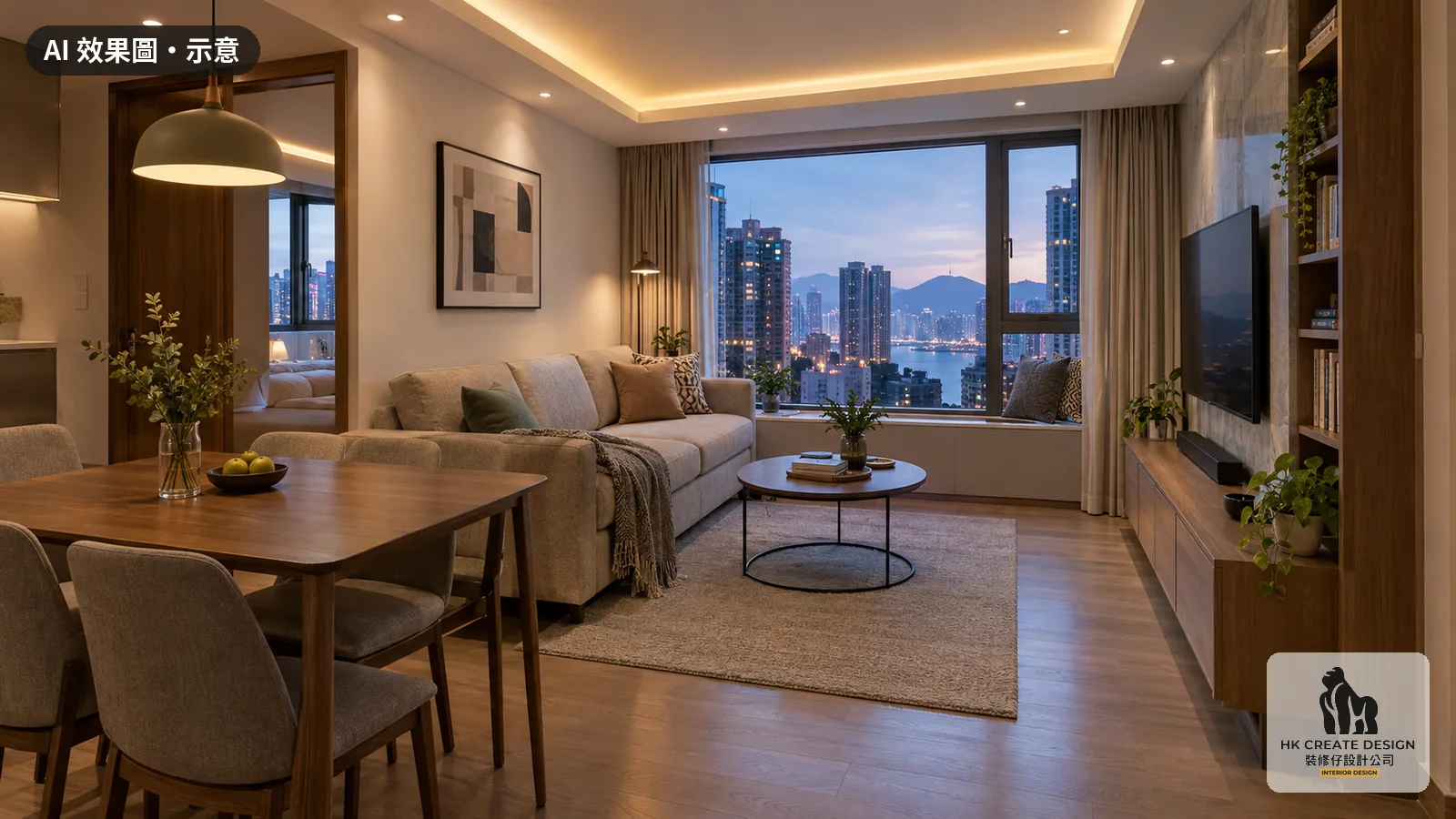
Living room: cove, spotlights and pendant
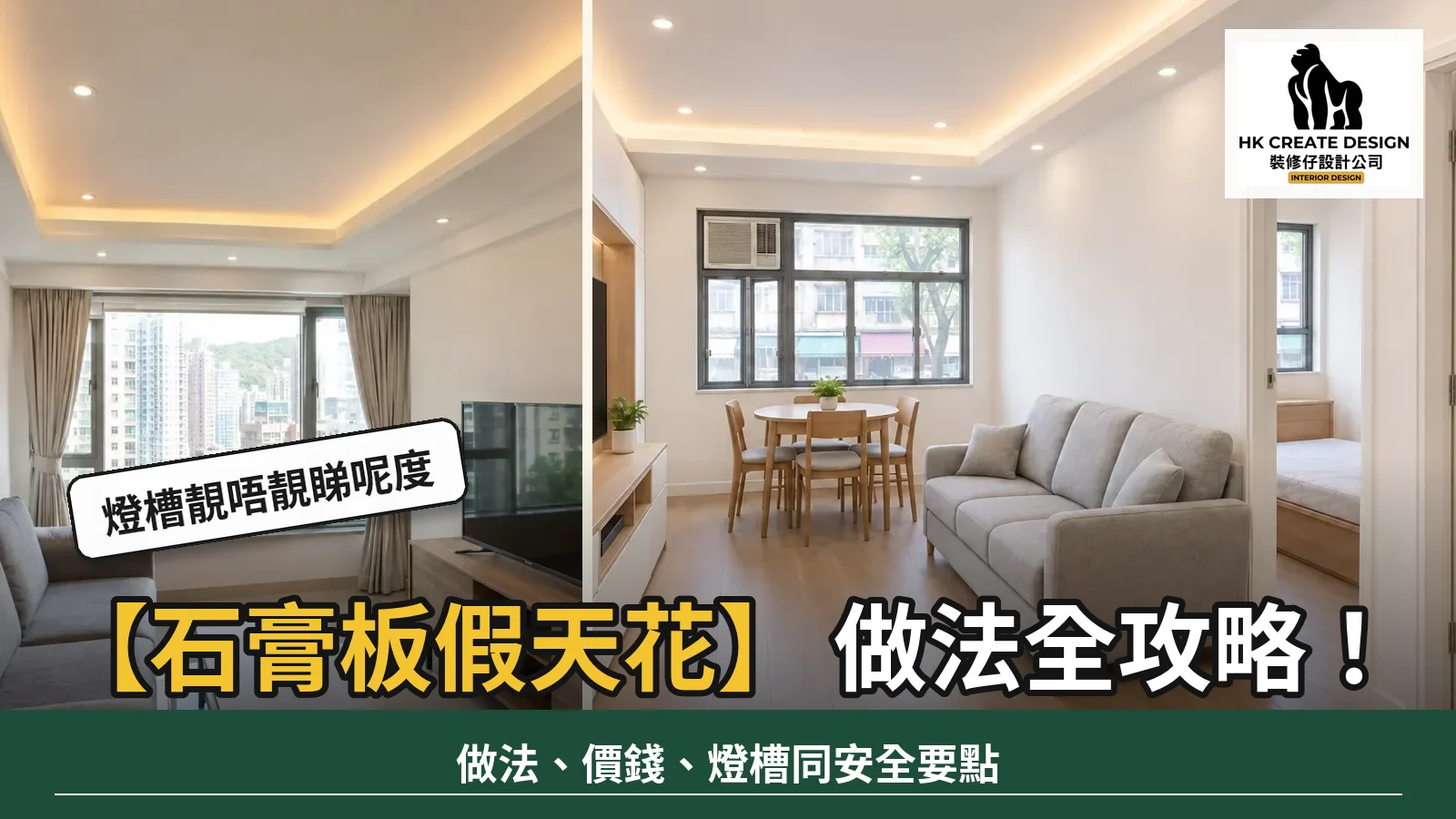
The living room typically has the most varied lighting. In a 450 sq ft two-bedroom flat, a partial ceiling conceals the living and dining room wiring. F01 metal-framed plasterboard ceiling: 120 sq ft × HK$51 = HK$6,120, minimum 100 sq ft[1].
Ambient lighting: 20 linear ft of F03 cove × HK$460 = HK$9,200, plus 20 linear ft of H07 strip × HK$150 = HK$3,000[1]. General lighting: 8 H08 spotlights × HK$310 = HK$2,480. Dining area: H05 installation of 1 owner-supplied pendant costs HK$670[1]. Living room total HK$21,470.
Keep spotlights away from directly above the sofa to avoid glare. Aim them along walls or at artwork. Keep strong light off the TV screen, and consider a warm strip behind it for more comfortable viewing.
A dining pendant typically hangs about 700–800 mm above the tabletop. Too high and it may give insufficient light, too low and it blocks sightlines. Centre it on the table. If the table may move, plan an extra point or use an adjustable pendant.
- Suspended ceiling for concealed wiring — HK$6,120
- Cove and strip — HK$12,200
- 8 spotlights — HK$2,480
- Living room total HK$21,470
05
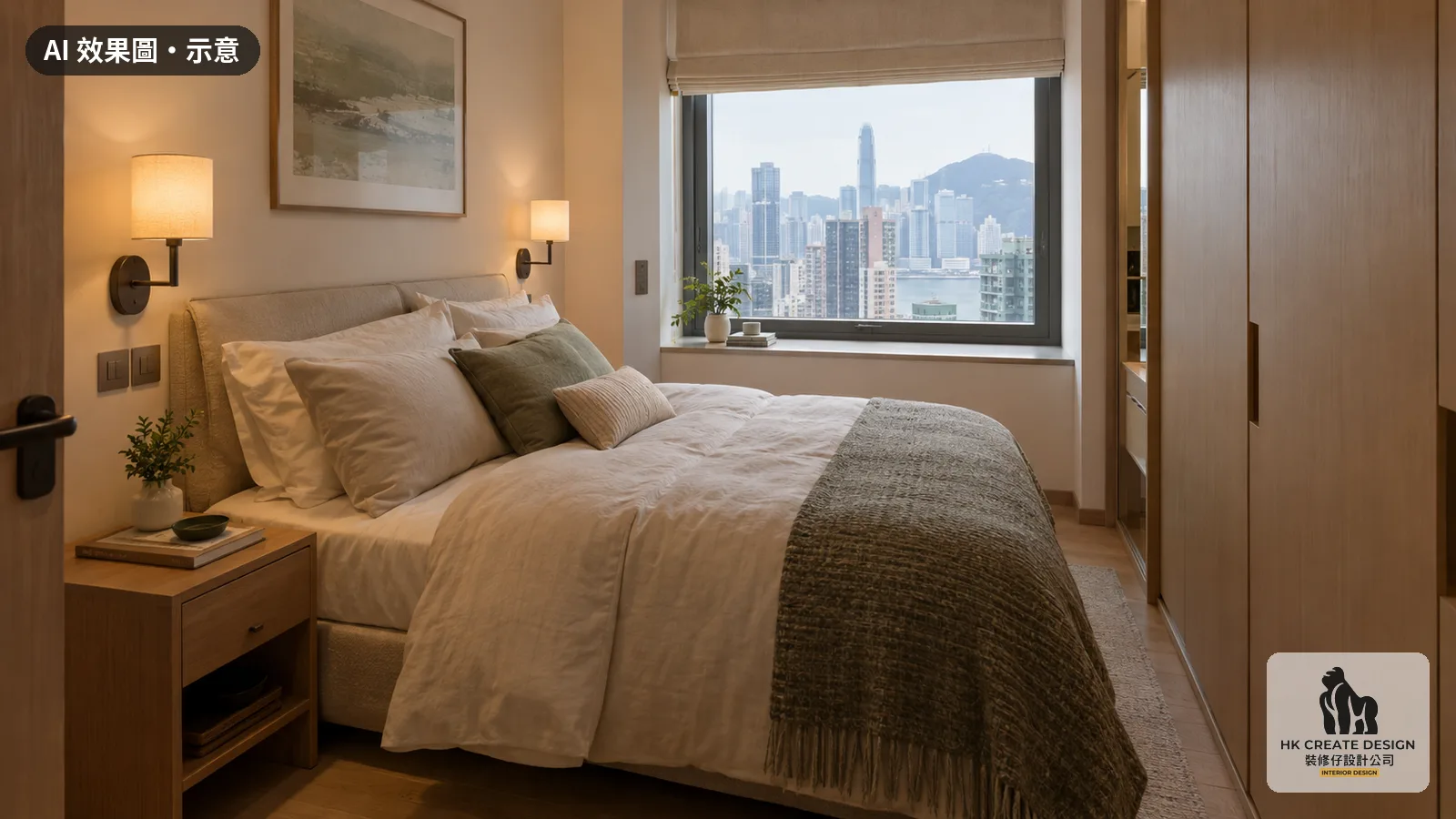
Bedroom: soft light and two-way bedside switches
Use softer light in bedrooms. Main bedroom example: 4 H08 spotlights × HK$310 = HK$1,240, H05 ceiling light installation HK$670 and 6 linear ft of FUR40 wardrobe lighting × HK$150 = HK$900. Total HK$2,810[1]. Small bedroom: H05 ceiling light installation HK$670 and 3 linear ft of FUR40 desk strip HK$450. Total HK$1,120[1].
Two-way switching lets you turn the light on at the bedroom door and off from bed. Avoid spotlights directly above the sleeper. Put them near the foot of the bed or wardrobe. Separate wall lights or strips on each side let one partner read while the other rests.
Sensor strips can light a wardrobe as the door opens, making dark clothes easier to tell apart. For homes withOlder residentsin the household, consider sensor night lights beside the bed and along the bathroom route. The Department of Health recommends adequate lighting at night to reduce fall risk[5].
- Main bedroom — HK$2,810
- Small bedroom — HK$1,120
- Two-way switching at the bed
- Sensor wardrobe lighting and night lights
06
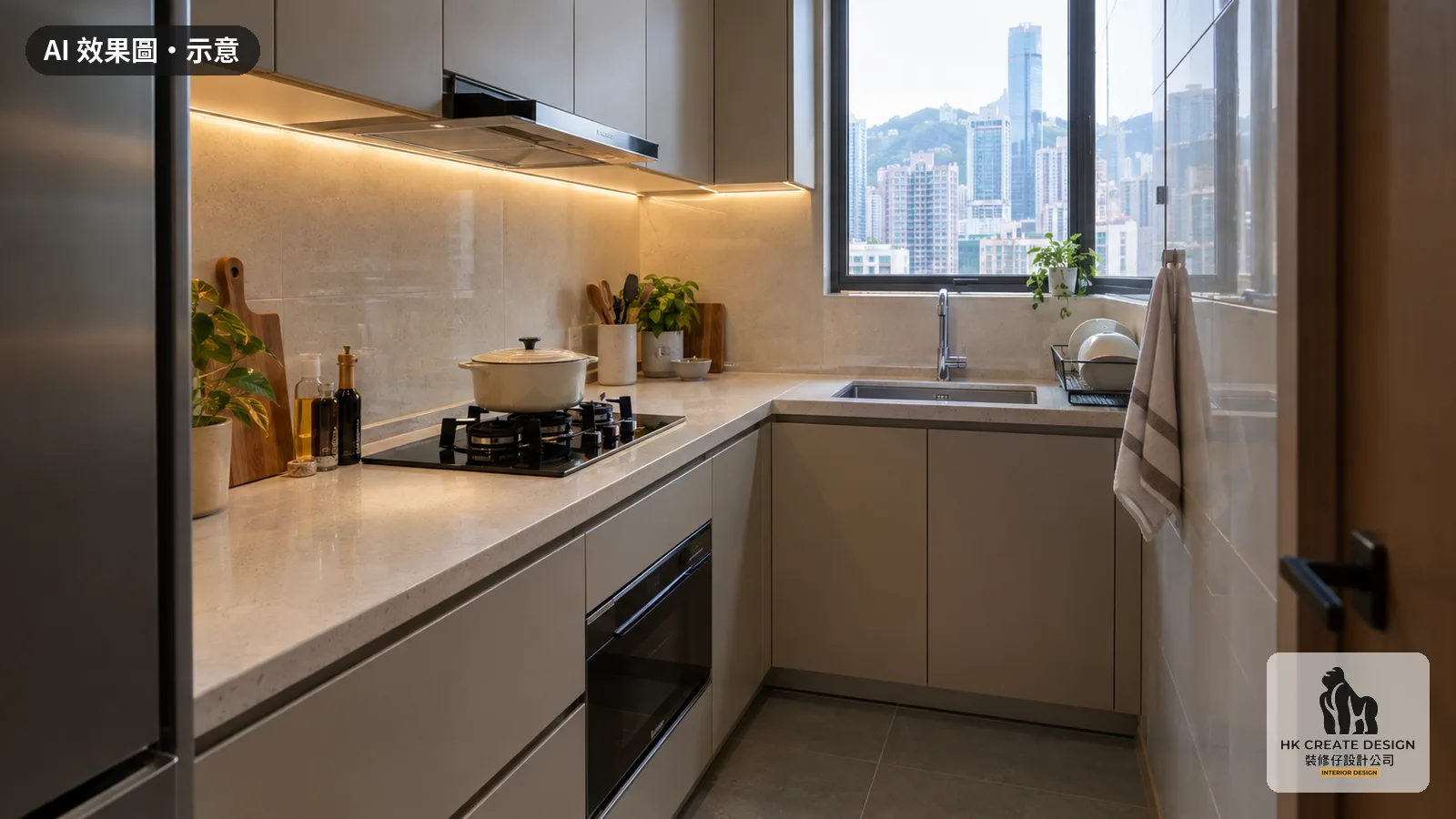
Kitchen: prioritise under-cabinet lighting
A ceiling light behind the cook casts a shadow over the worktop. Strips under the wall cabinets light the chopping area and recipes directly. Example: 7 linear ft of FUR40 × HK$150 = HK$1,050[1].
F05 aluminium kitchen or bathroom ceiling costs HK$3,650 per room, including clip-in panels, 2 LED lights and an access opening[1]. Kitchen total HK$4,700.
Neutral white helps food colours look accurate. Choose grease-resistant fittings that are easy to clean. An aluminium channel and diffuser conceal the individual LEDs under cabinets. The hood lamp mainly lights the hob, so the preparation area benefits from its own task light.
- Under-cabinet lighting reduces worktop shadows
- Under-cabinet lighting — HK$1,050
- Aluminium ceiling with LEDs — HK$3,650
- Neutral white, grease-resistant fitting
Example: living room lighting
Assumptions
- 450 sq ft, two bedrooms
- Partial suspended ceiling for the living and dining area
How to calculate quantities
- F01 suspended ceiling: 120 × HK$51 = HK$6,120
- F03 lighting cove: 20 × HK$460 = HK$9,200
- H07 LED strip: 20 × HK$150 = HK$3,000
- H08 spotlights: 8 × HK$310 = HK$2,480. H05 pendant installation HK$670
- Total HK$21,470
Living room lighting example — about HK$21,470.
Owner-supplied fittings cost extra. Confirm against site measurements and a written quotation. [1]
07
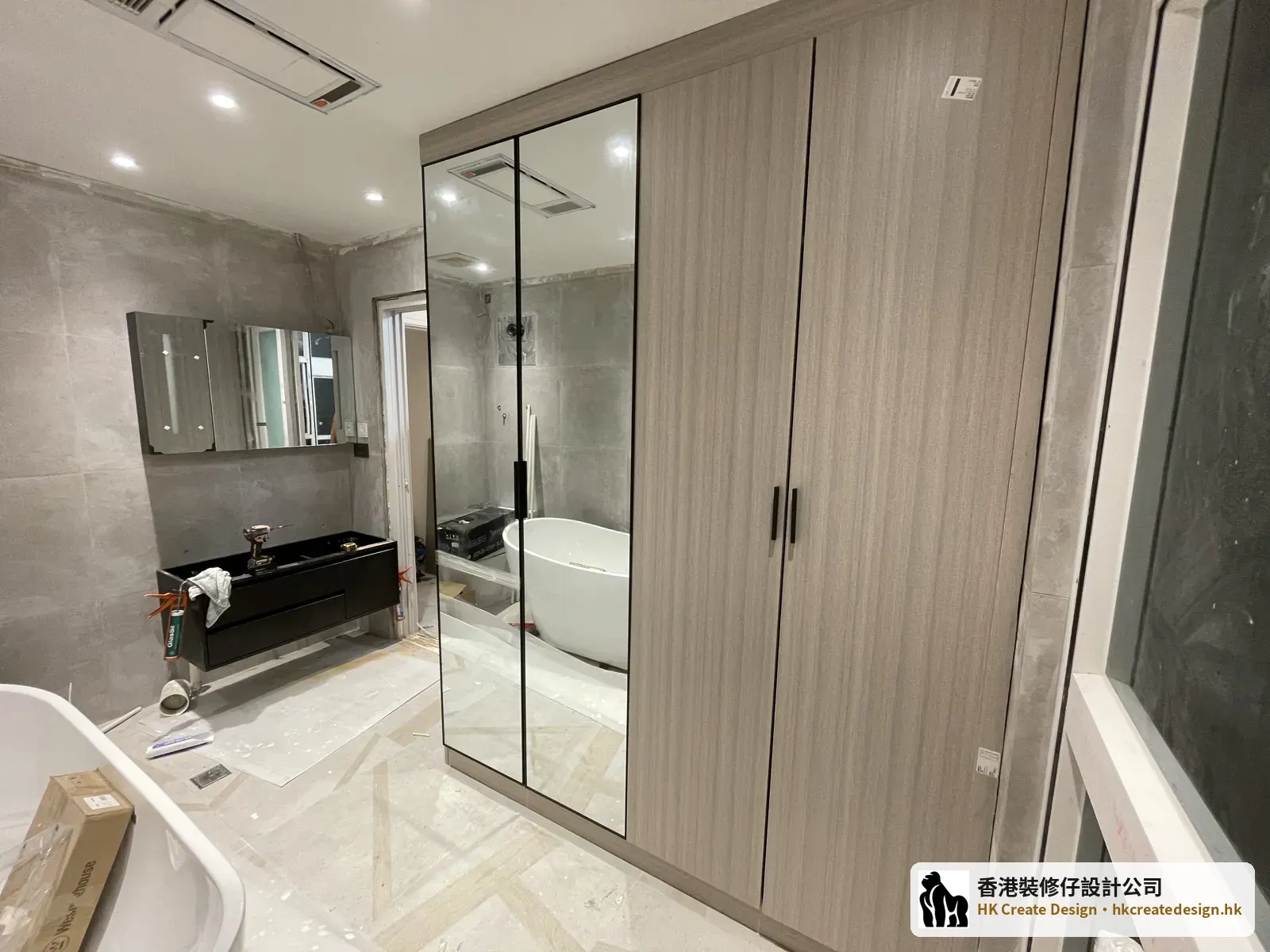
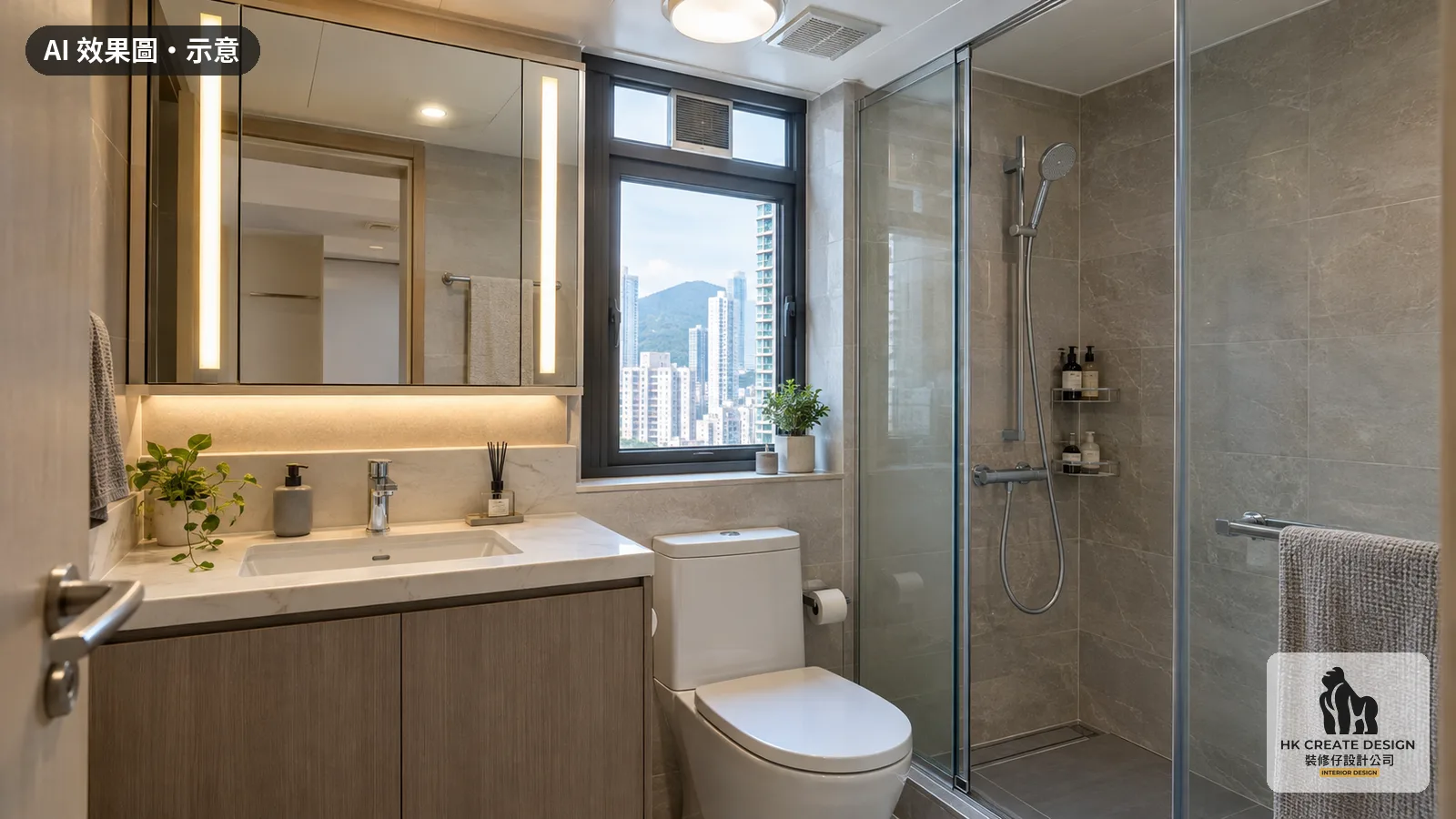
Bathroom: moisture protection and mirror lighting
Bathrooms are humid, and Hong Kong's average relative humidity is already about 78%[6], and bathroom humidity can be higher. Choose moisture-resistant fittings. Example: F05 aluminium kitchen or bathroom ceiling costs HK$3,650, including 2 LED lights[1].
Light the mirror evenly from the sides or above for make-up and shaving. Neutral white helps colours look closer to daylight, while an overhead light alone can cast facial shadows. FUR26 bathroom mirror cabinets cost HK$1,150 per linear foot. LED and anti-fog mirror options are extra[1].
Bathroom lights and sockets must suit the wet zone and be installed by a registered electrical contractor[4].
- Select moisture-resistant fittings
- Aluminium ceiling with LEDs — HK$3,650
- Light the mirror from the sides or above
- Electrical safety in wet areas
08
Corridor, entrance and switches
Corridor and entrance: 3 H08 spotlights × HK$310 = HK$930[1]. A sensor light can illuminate the entrance as you arrive. Two-way switching lets you turn the living room light on at the front door and off again from the living room.
Old switches can yellow or loosen. H04 replacement including connection costs HK$430 per switch. Replacing 6 in the example comes to HK$2,580[1]. Place switches on the opening side of a door at an accessible height. The Electrical and Mechanical Services Department also recommends putting switches within easy reach[3].
Whole-home lighting: living room HK$21,470, main bedroom HK$2,810, small bedroom HK$1,120, kitchen HK$4,700, bathroom HK$3,650, corridor HK$930 and switches HK$2,580. Total HK$37,260[1].
- Corridor spotlights — HK$930
- 6 switches — HK$2,580
- Place switches within easy reach
- Whole flat — HK$37,260
You can swipe left or right on your phone to view the complete table.
| Type | Typical service life | Remarks |
|---|---|---|
| LED lights | 20,000–50,000 hours | Grade 1 LEDs use about 40% less electricity than compact fluorescent bulbs |
| Compact fluorescent lamp | 6,000–8,000 hours | — |
| Incandescent bulb | about 1,000 hours | A Grade 1 LED uses about 90% less electricity than this lamp |
Electrical and Mechanical Services Department data. [3]
09
Choosing LEDs by their energy labels
Under the Electrical and Mechanical Services Department's Voluntary Energy Efficiency Labelling Scheme, LED lamps are graded 1 to 5, with Grade 1 the most efficient[2]. A Grade 1 LED bulb uses about 40% less electricity than a compact fluorescent bulb and about 90% less than an incandescent bulb[2].
The Electrical and Mechanical Services Department gives typical LED rated life as 20,000–50,000 hours, compact fluorescent lamps about 6,000–8,000 hours and incandescent lamps about 1,000 hours[3].
Check the energy label, lumens and colour temperature. Lumens indicate light output. LED and older bulbs of the same wattage can give very different brightness. Higher lumens per watt mean greater efficiency. For dimming, check that the lamp and dimmer are compatible to avoid flicker.
- Grades 1 to 5. Grade 1 is the most efficient.
- About 40% less electricity than a compact fluorescent lamp
- Service life 20,000–50,000 hours
- Check lumens for brightness
- Natural lightMake use of daylight.
- Sensor lightCorridor and entrance.
- Separate switching groupsSwitch on as needed.
- Light-coloured wallsReflects light well.
- Grade 1 labelMost energy-efficient.
- Clean regularlyMaintain brightness.
10
Energy-saving tips
The Electrical and Mechanical Services Department recommends daylight and task lighting, sufficient light without overlighting, accessible switches, turning lights off when leaving, automatic controls where useful, regular cleaning and light-coloured finishes that reduce the amount of lighting needed[3].
Try sensor lights at the entrance and corridor, door switches for wardrobes and separate living room groups for watching TV. Light walls reflect more, reducing the fittings needed for similar brightness. Sheers with blackout curtains allow soft daylight in by day.
Example: 10 LEDs at 7 W for 5 hours a day use about 127.75 kWh a year. Using the Electrical and Mechanical Services Department's approximate 90% saving against incandescent lamps, their equivalent would use about 1,277.5 kWh, a difference of about 1,149.75 kWh[2].
- Use daylight
- Sensor lights and separate switch groups
- Light walls reflect more light
- Grade 1 LEDs save about 90%
11
Common lighting design mistakes
Mistakes 1 and 2. A single central fixture leaves dark corners and shadows. Too many closely spaced spotlights create glare and waste electricity.
Mistakes 3 and 4. Different colour temperatures in adjoining rooms fragment the view. A switch behind the door or too far inside the room is inconvenient to reach.
Mistake 5. Forgetting sockets for floor and table lamps. These can provide ambient lighting if power points are planned. H02 new sockets cost HK$640 per set[1].
Mistake 6. A shallow or poorly detailed cove leaves the individual LEDs visible. Coordinate the depth and opening with a diffused strip to give an even line of light.
Mistake 7. Ordinary fittings may corrode or develop electrical faults in a damp bathroom. Choose fittings rated for the location and have qualified personnel install them.
- Only one main light
- Too many spotlights
- Inconsistent colour temperature
- Inconvenient switch position
- Missing sockets
- Visible LED points in a cove
12
How to divide the budget
Separate essentials from optional lighting. In the worked example, living room spotlights cost HK$2,480, two bedroom ceiling lights HK$1,340, kitchen HK$4,700, bathroom HK$3,650, corridor HK$930 and switches HK$2,580. Essential items total HK$15,680[1]. Optional items include coves, strips, cabinet lights and pendants. Choose them for ambience according to your budget and preferences.
If funds are limited, build the suspended ceiling and allow for the wiring now, with coves and strips fitted later. Plan the wiring before painting.
HK Create Design suggests total budget ÷ 1.2 for the works allowance. Keep the balance, equivalent to 20% of that allowance, as your own contingency. Owner-supplied pendants and ceiling lights need a separate budget. Set a range of styles and prices at design stage to keep costs under control.
- Essentials: general light, kitchen, bathroom and switches
- Optional: coves and LED strips
- Plan wiring before painting
- Owner-supplied fittings cost extra
Example: annual LED electricity use
Assumptions
- 10 × 7 W LEDs
- 5 hours per day
How to calculate quantities
- LED: 7 × 10 × 5 × 365 ÷ 1,000 = 127.75 kWh
- Incandescent bulbs (LED saves about 90%): 127.75 ÷ 0.1 = 1,277.5 kWh
- Difference: 1,277.5 − 127.75 = 1,149.75 kWh
A difference of about 1,150 kWh per year.
Simplified example. Actual figures depend on fittings, operating hours and electricity rates. [2]
13
Adapting lighting for open plans, small flats and older people
Switch an open kitchen and living room separately. Use neutral light for cooking, then turn the kitchen lights off and use a dining pendant and living room cove at mealtimes. Keep the adjoining colour temperatures coordinated.
Choose slim fittings in a small flat. Recessed spots and strips use less visual space than a large pendant. Wall-washing strips can add depth. In a 300–400 sq ft flat, a partial ceiling along a corridor or one living room wall can conceal wiring while preserving ceiling height elsewhere.
Provide bright, even light for older people and avoid sharp contrasts. Sensor night lights can mark the bedroom-to-bathroom route. Large switch plates with indicators are easier to find at night. The Department of Health advises adequate night lighting to reduce falls[5].
For children, provide even, flicker-free light on the desk. Place the lamp opposite the writing hand to avoid casting a shadow. Choose a gentle warm night light, possibly with a timer to switch off after the child falls asleep.
- Control open-plan lighting by zone
- Spotlights and strips for small flats
- Older people: even light and night lights
- Children: provide adequate desk light
14
Coordinating lighting with the renovation sequence
1. At design stage, show light points, switches, coves and switch groups on the services plans. 2. At the services stage, the electrician forms chases and runs wiring to the planned points.
3. At the ceiling stage, form the suspended ceiling and coves and allow for recessed fittings and strips. Test the light distribution before closing the cove. 4. Fit spotlight trims and other fittings after painting to avoid splashes.
5. At furniture installation, connect cabinet and under-cabinet strips to the wiring provided. 6. At handover, test each switch, group, colour temperature and any flicker. Record issues in the defects list and follow them through before making the final payment.
For owner-supplied fittings, provide model numbers and dimensions before ceiling work, especially where recessed fittings need accurate cut-outs.
- Design: draw the lighting points and switch groups
- Services stage: chasing and wiring
- Ceiling: test lights before closing up
- Install fittings after painting
- Test each fitting at handover
You can swipe left or right on your phone to view the complete table.
| space | Suggested colour temperature | Reason |
|---|---|---|
| Living room | Warm to neutral white | Relax |
| Bedroom | Warm white | Sleep support |
| kitchen | Neutral white | See food colours clearly |
| Desk | Neutral white | Clear light for reading |
| At the bathroom mirror | Neutral white | Accurate colours for make-up |
HK Create Design recommendation. [1]
15
Choosing light fitting types
Spotlights give focused light for walls, artwork and cabinet tops and can also provide general lighting. A narrow beam is more focused. Wider beams spread the light and reduce obvious circles on domestic walls.
Downlights spread light over a wider area and work for general lighting in corridors and living rooms. They usually produce less glare than focused spotlights, particularly useful under a low ceiling.
Surface-mounted lights are simple to install and suit low ceilings or a limited budget. Choose a slim fitting with a diffuser to keep the ceiling visually high and soften glare.
Pendants suit a dining area or living room with a higher ceiling. Choose a compact, suitably light fitting for a small flat. Track lights let you change heads and direction as furniture moves. Match the track to the ceiling if you want a minimalist room to feel uncluttered.
Use strips in coves, cabinets, under units or near a bedhead for soft indirect light. A diffuser conceals the individual LED points.
- Spotlights: focused lighting
- Downlights: lower glare
- Ceiling lights need no suspended ceiling
- Pendants: a visual focal point
- LED strips: indirect lighting
16
Plan your lighting with HK Create Design
HK Create Design has served Hong Kong homeowners since 2019,Bespoke furnitureDesign and whole-home drawings include services plans showing lights, switches and furniture together. Qualified personnel carry out electrical work.
For two or more work items, complimentary site measurement is offered until 31 December 2026. Showroom: Shop 16, G/F, Fu Yau Building, 61 Po Kong Village Road, Wong Tai Sin, Kowloon. WhatsApp 5243 7747. HK Create Design offers a one-year warranty and has a HK$2,000 minimum charge.
- Coordinated building services drawings
- Free site measurement for a limited time
- WhatsApp 5243 7747
Advice from our tradespeople
「I place the sofa, bed and dining table on the plan before drawing the lights. Then I can position spotlights to light the room without shining in anyone's eyes.」
「A cove's light opening needs careful detailing to hide the individual LEDs. We test the light before closing the plasterboard.」
FAQ
12 practical questions answered
01How much does whole-home lighting cost?
The 450 sq ft two-bedroom example costs about HK$37,260, including suspended ceilings, coves, spotlights, cabinet lights, aluminium ceilings in the kitchen and bathroom, and switches.[1].
02How much is one spotlight?
H08 recessed spotlight, supplied, fitted and connected — HK$310 each[1].
03How is a lighting cove priced?
F03 lighting cove costs HK$460 per linear foot, with a 10 linear ft minimum. H07 LED strip is separate at HK$150 per linear foot.[1].
04What colour temperature suits a living room?
Warm white around 2700–3000 K or neutral white around 4000 K. Keep the lighting consistent across the flat where possible.
05How long do LED lamps last?
The Electrical and Mechanical Services Department gives typical rated LED life as 20,000 to 50,000 hours[3].
06How do I read the energy label?
Grades 1–5, with Grade 1 the most efficient. A Grade 1 LED uses about 40% less electricity than a compact fluorescent lamp.[2].
07Why have lighting under the kitchen cabinets?
A ceiling light behind you casts a shadow across the counter. Under-cabinet lighting directly illuminates the chopping area.
08How should bedside light switches be arranged?
Use two-way switching so the light can be operated at the door and at the bedside.
09Can I supply my own light fittings?
Yes. H05 pendant or ceiling light installation costs HK$670 each, with the fitting supplied by the owner[1].
10Does a small flat need a false ceiling?
It need not cover a large area. A section in the corridor or along one side of the living room can conceal wiring while retaining ceiling height elsewhere.
11What lighting considerations apply to a household with older residents?
Provide bright, even lighting, sensor night lights on the bathroom route and large switches with indicator lights.[5].
12Can spotlights be added after renovation?
Yes, but it may need ceiling openings or wall chasing and can cost more and cause greater disruption. Plan it with the renovation where possible.
CHECK THE BASIS
Data and technical basis, sources can be verified
- [1]HK Create Design published 2026 rates and work item descriptions Accessed: 2026-11-03
- [2]Electrical and Mechanical Services Department: Voluntary Energy Efficiency Labelling Scheme — LED lamps (shopping guide poster) Accessed: 2026-11-03
- [3]Electrical and Mechanical Services Department: energy-efficient lighting tips Accessed: 2026-11-03
- [4]Electrical and Mechanical Services Department: Household Electrical Safety Handbook, new installations, additions and alterations Accessed: 2026-11-03
- [5]Department of Health Elderly Health Service: Fall Prevention Accessed: 2026-11-03
- [6]Hong Kong Observatory climatological normals, 1991–2020 Accessed: 2026-11-03