01
How the two designs work
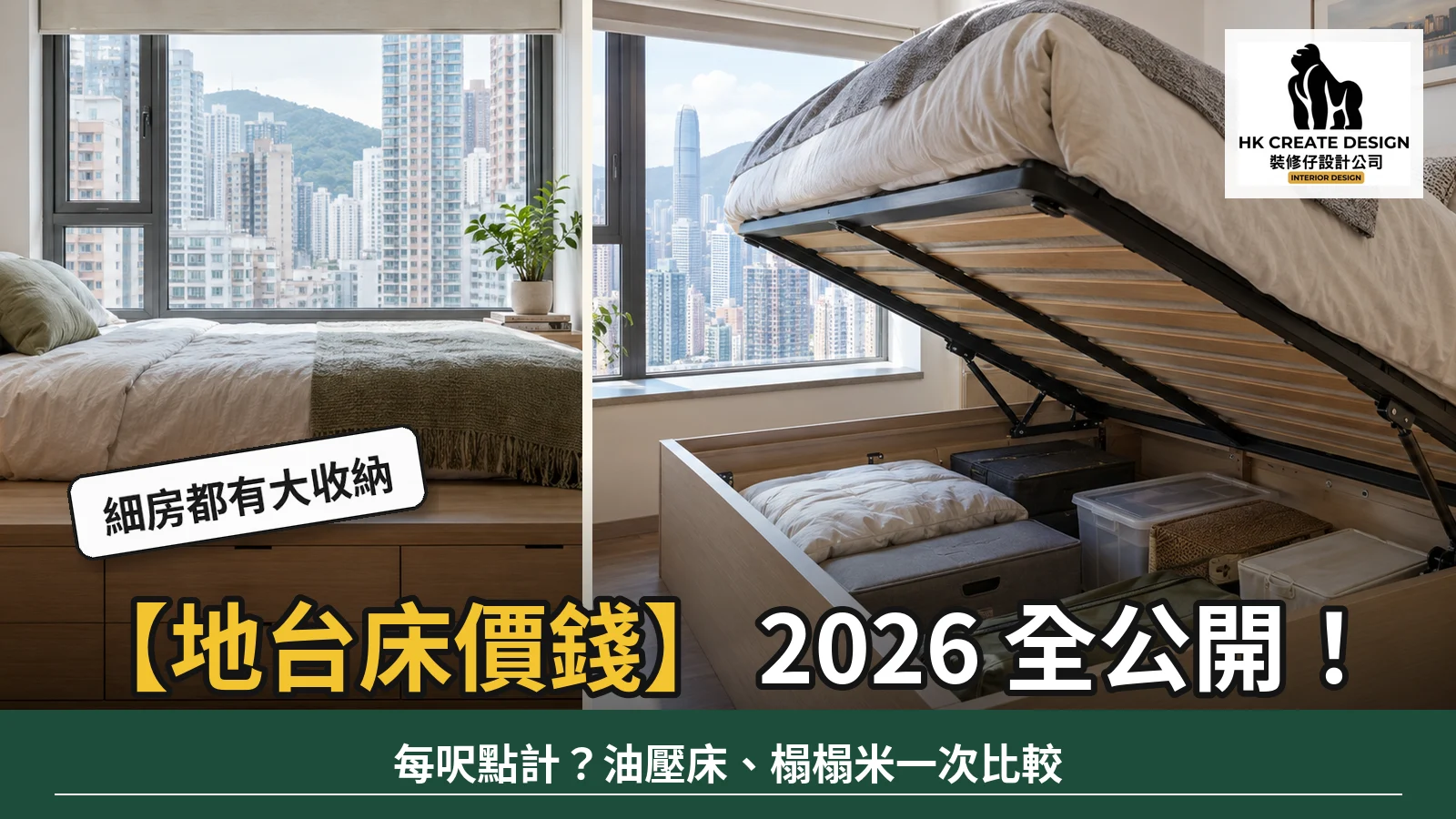
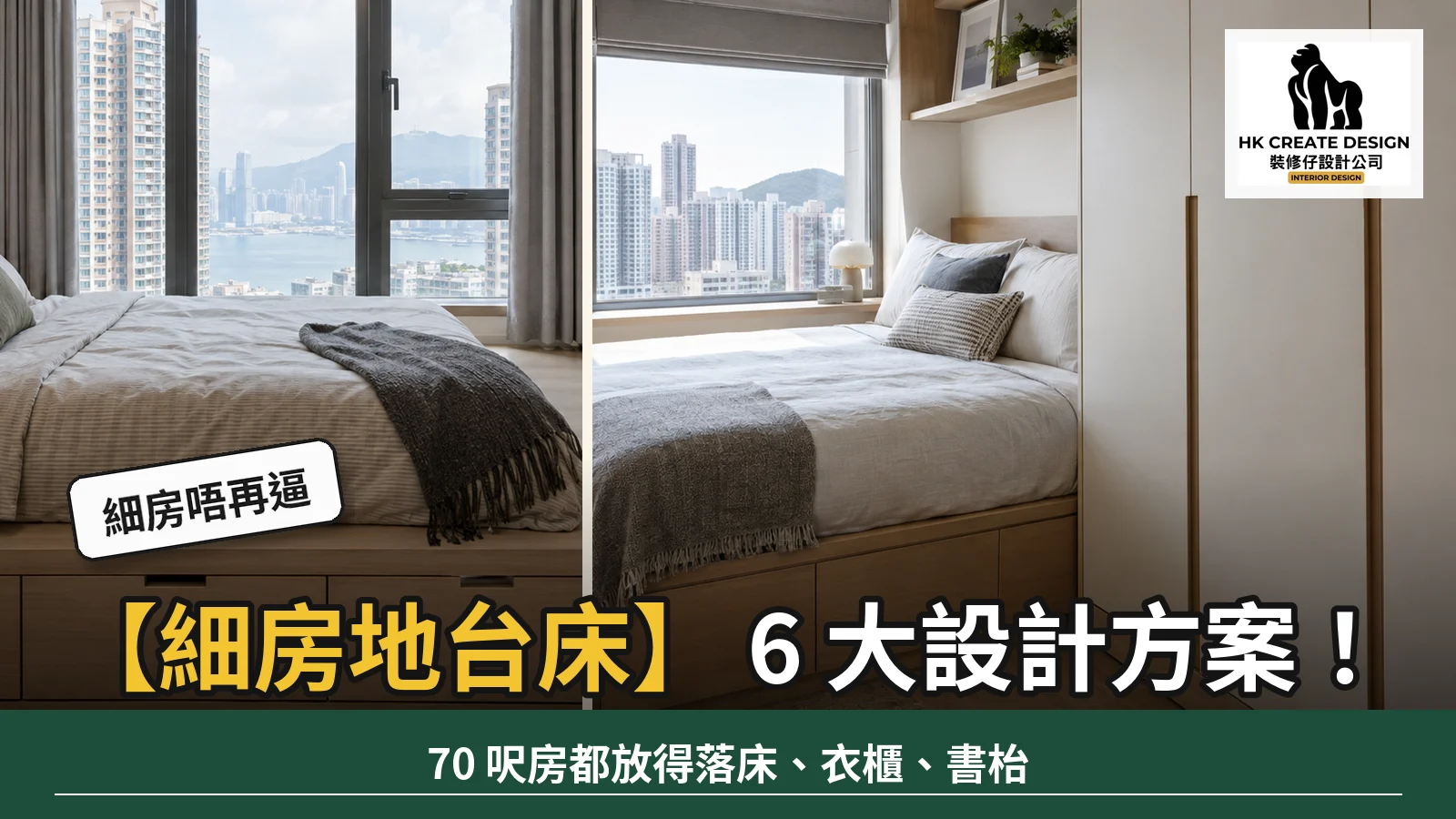
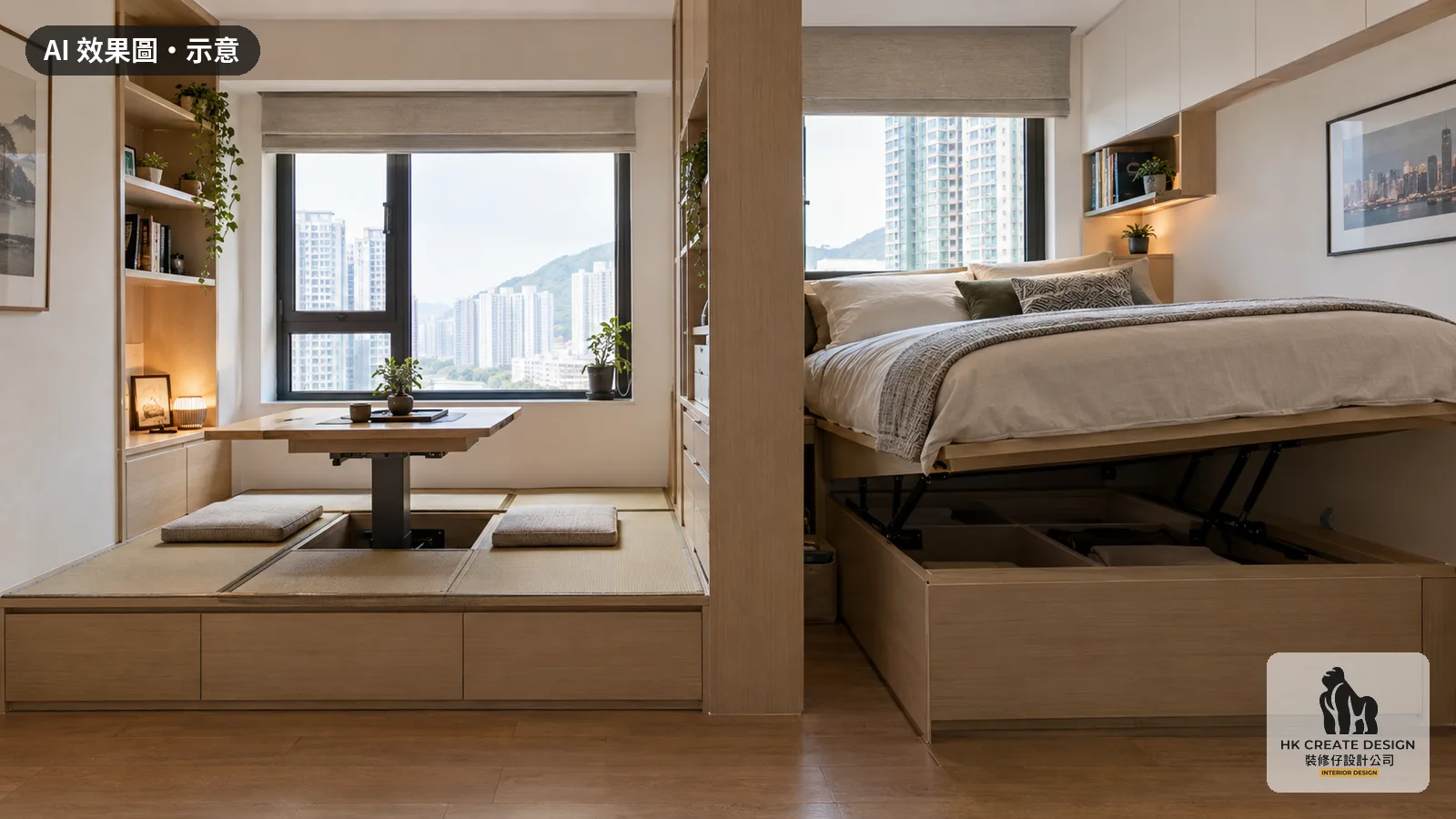
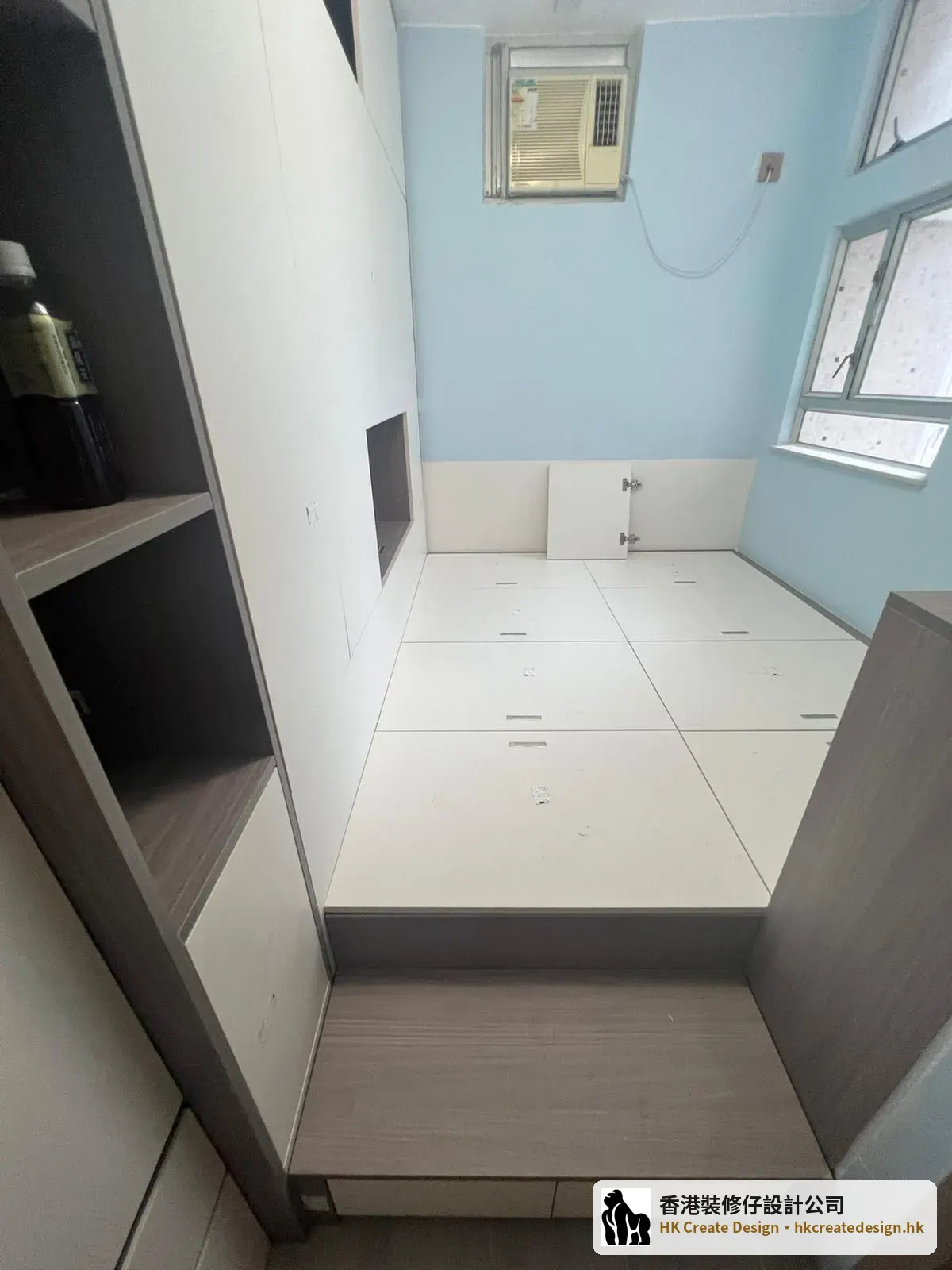
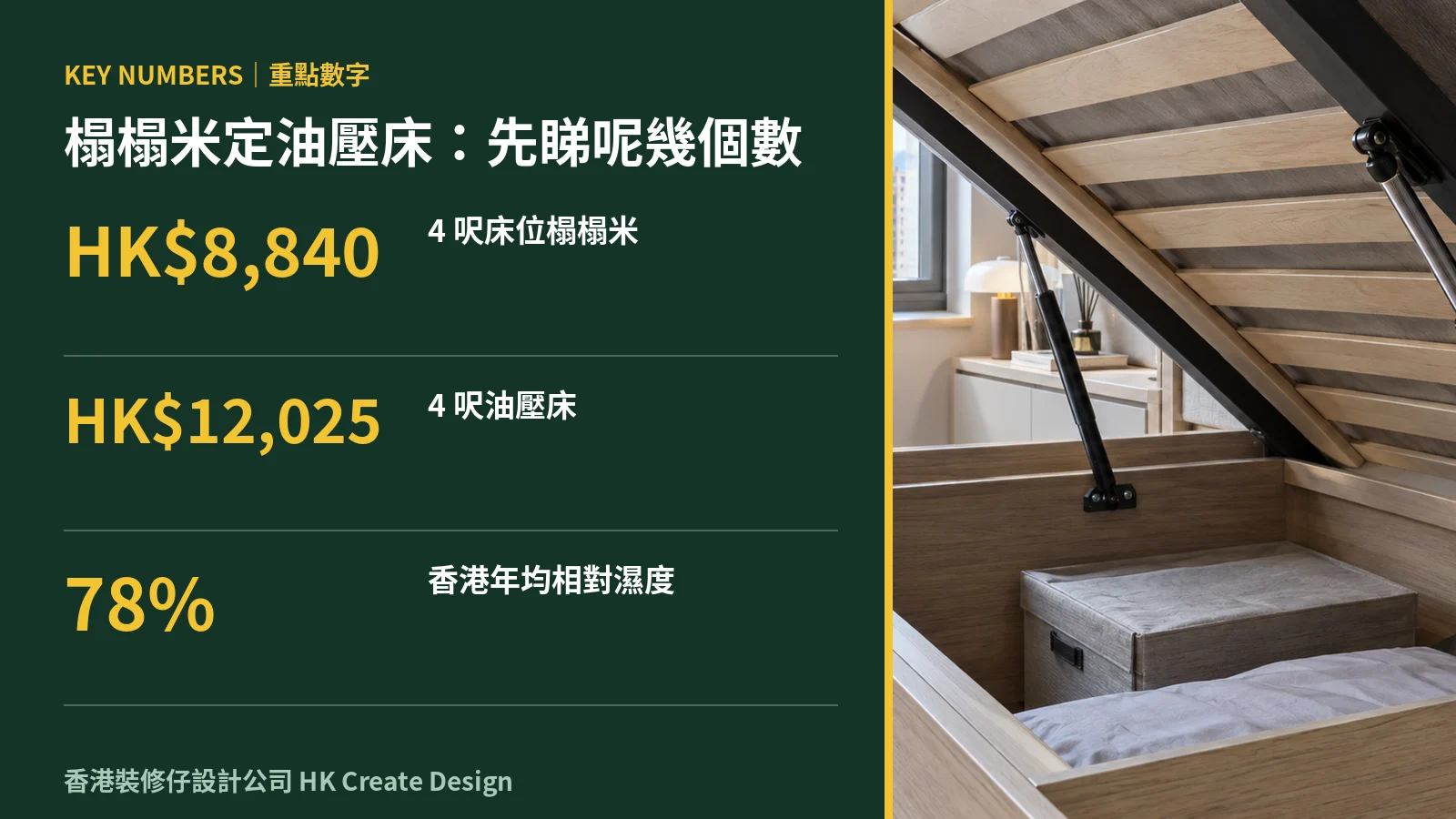
A tatami bed is essentially aPlatform bedsbuilt-in platform with storage below. Fit woven mats or a mattress on top and use lids or drawers underneath. A lift table is optional. The platform is usually low and common in Japanese-style rooms.
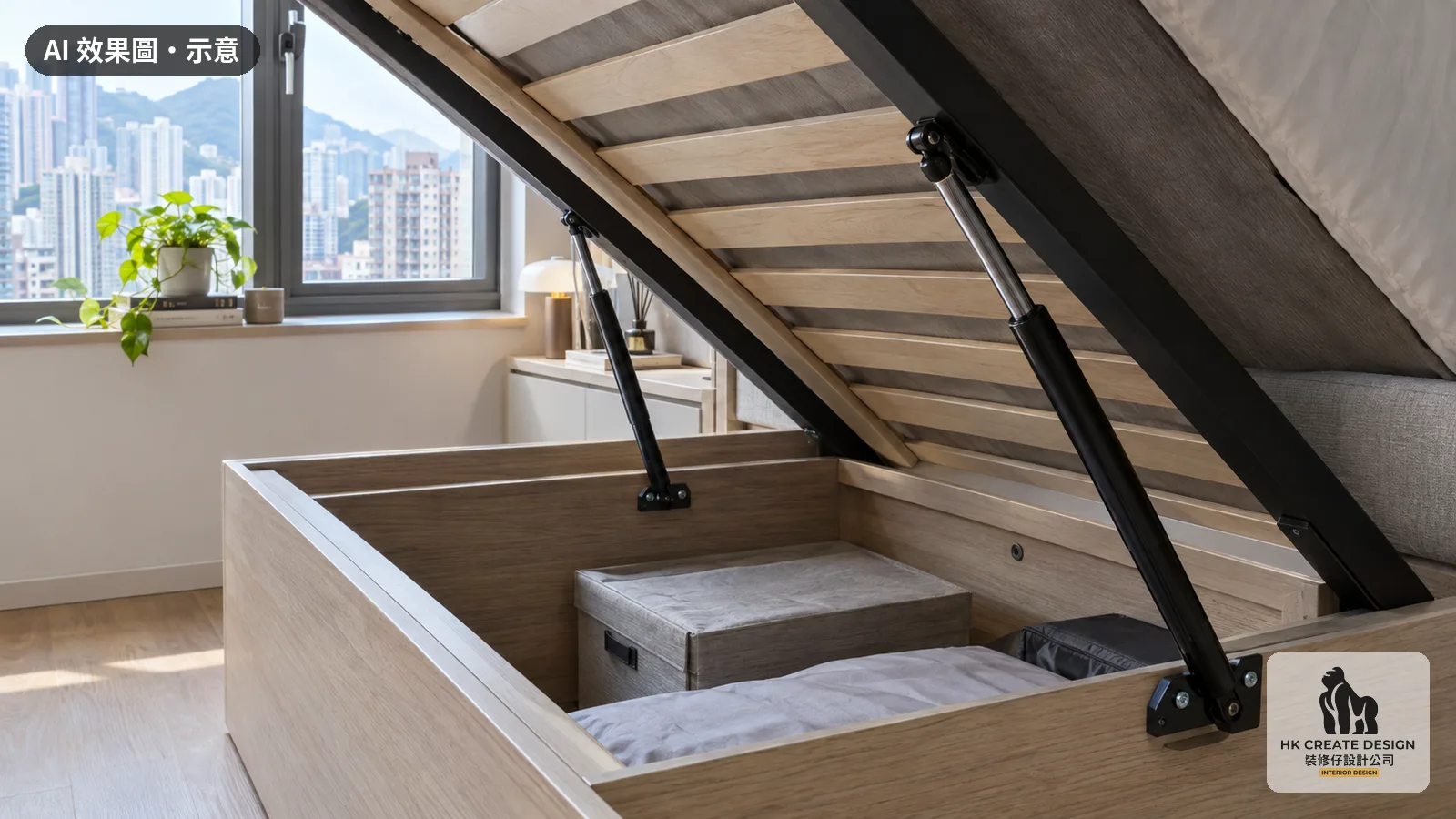
A lift-up bed has a self-contained base with struts supporting the deck. Opening it exposes the whole storage compartment. It looks like a conventional bed, with its base used for storage.
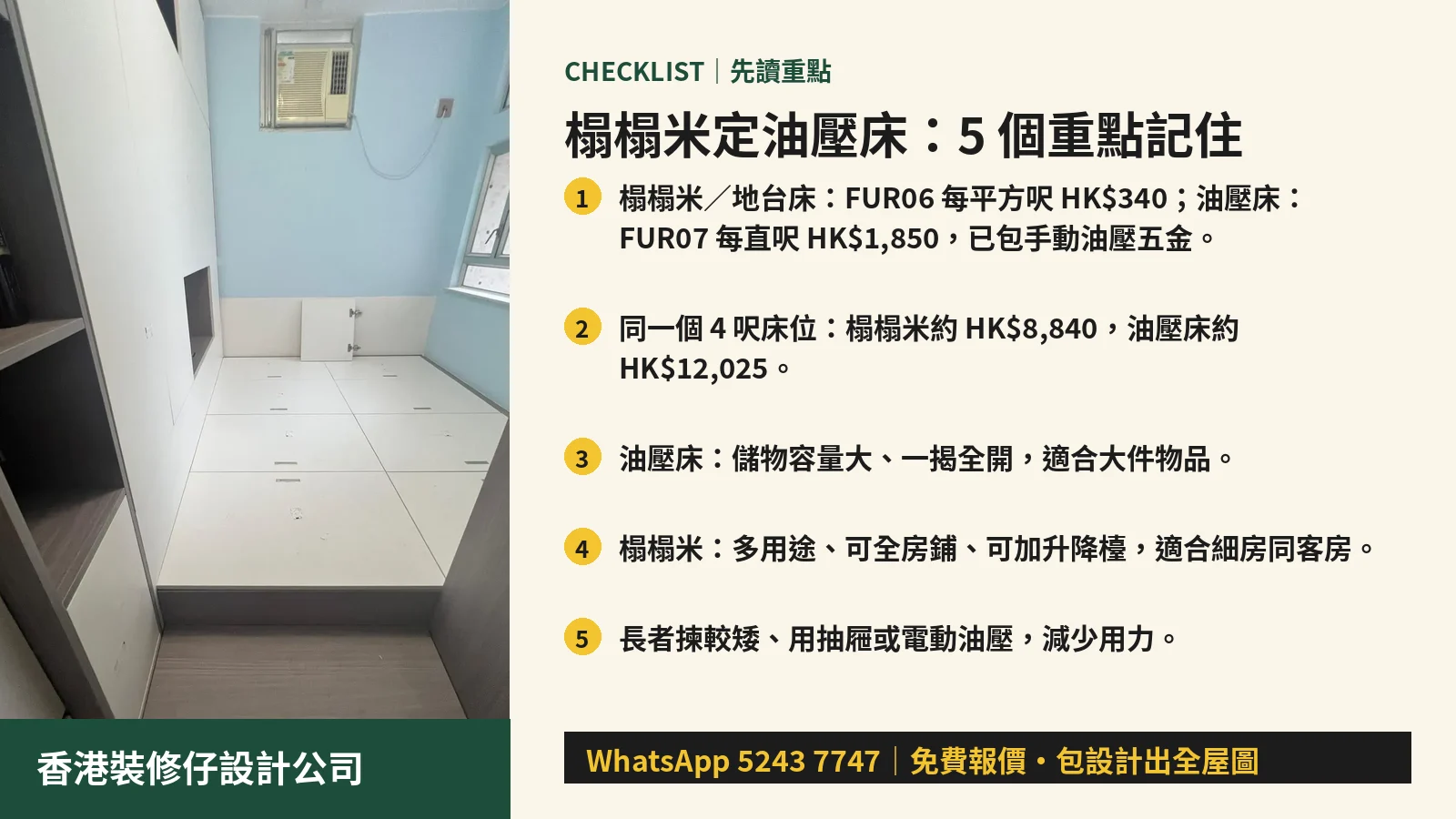
HK Create Design lists platform beds and tatami platforms under FUR06 at HK$340 per sq ft, including the frame, storage compartments and lift-up lids or drawers. Hydraulic storage beds are FUR07 at HK$1,850 per linear ft, including the bed box, bed board and manual hydraulic lift hardware[1].
- Tatami: a raised platform
- Lift-up bed: self-contained base
- FUR06: HK$340 per sq ft
- FUR07: HK$1,850 per linear ft
02
1. Storage capacity
The base has few or no dividers, making room for suitcases, bedding, seasonal clothes and large storage boxes. At the same bed footprint, its storage space tends to be less fragmented.
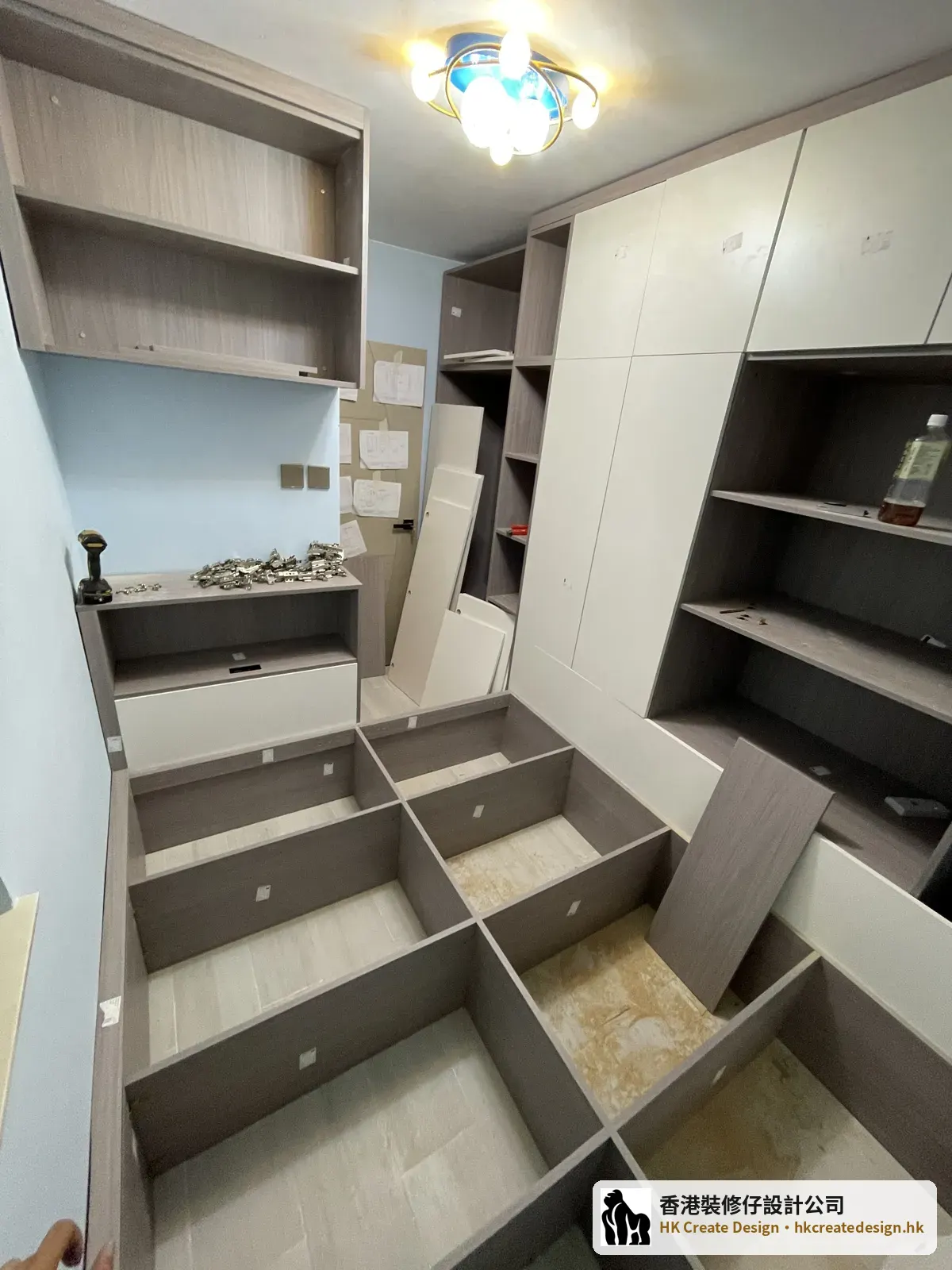
Tatami capacity depends on platform area and height. A full-room platform can hold a great deal, divided among compartments for sorting smaller items.
A lift-up bed suits bulky items. For compartmentalised storage or room-wide capacity, consider a tatami platform.
- Lift-up bed: one large compartment
- Tatami platform with divided storage
- A full-room tatami platform offers extensive storage
03
2. Accessing stored items
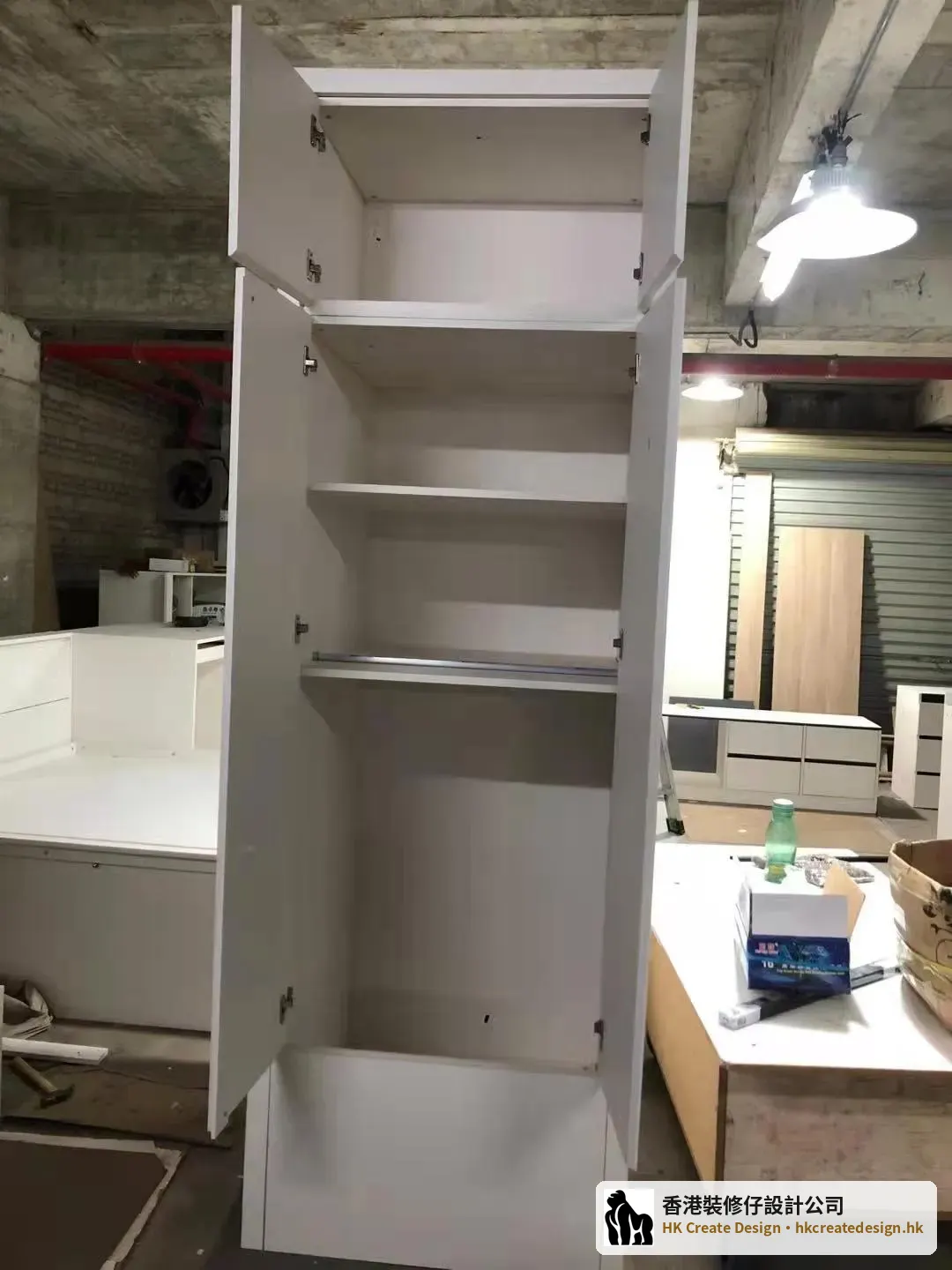
The struts help raise the deck and mattress together. As you need to stand beside the bed and open it each time, this storage suits less frequently used items.
Side drawers give access without moving the mattress. Use them at the front for daily essentials, with lift-up compartments at the back for bulky items.
For items you reach for regularly, a tatami platform with drawers is more convenient. A hydraulic storage bed is enough for seasonal items.
- Lift-up bed: lift the deck for access
- Tatami platform with optional drawers
- Drawers at the front, lift-up storage at the back
「“I ask how often people need what’s underneath. For things taken out once a year, choose a lift-up bed. For daily access, choose a tatami platform with drawers.”」
04
3. Bed height and access
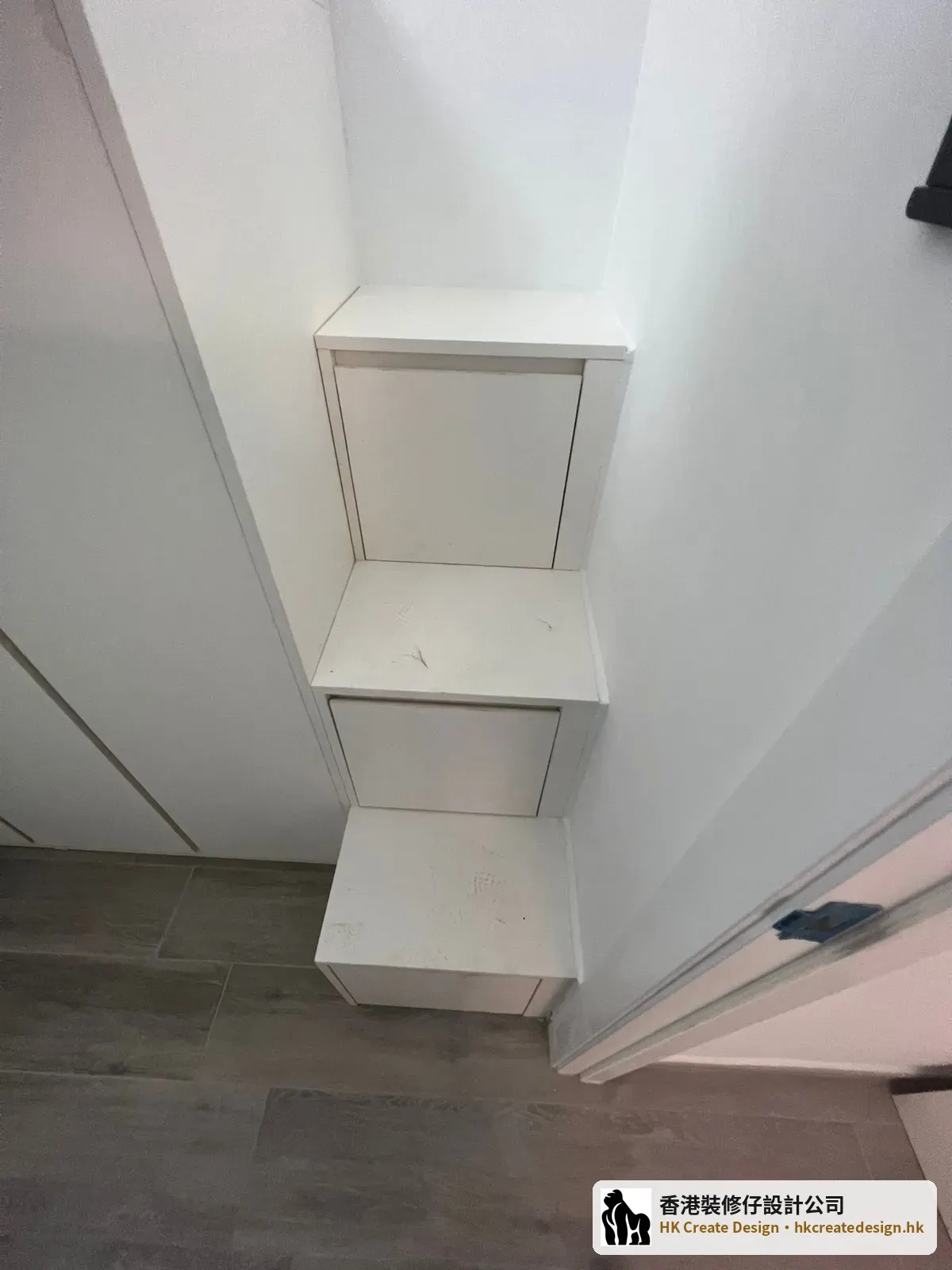
A conventional-height lift-up bed can be easier to get into or sit on with your feet on the floor. It suitsOlder residentsand people who prefer a conventional bed.
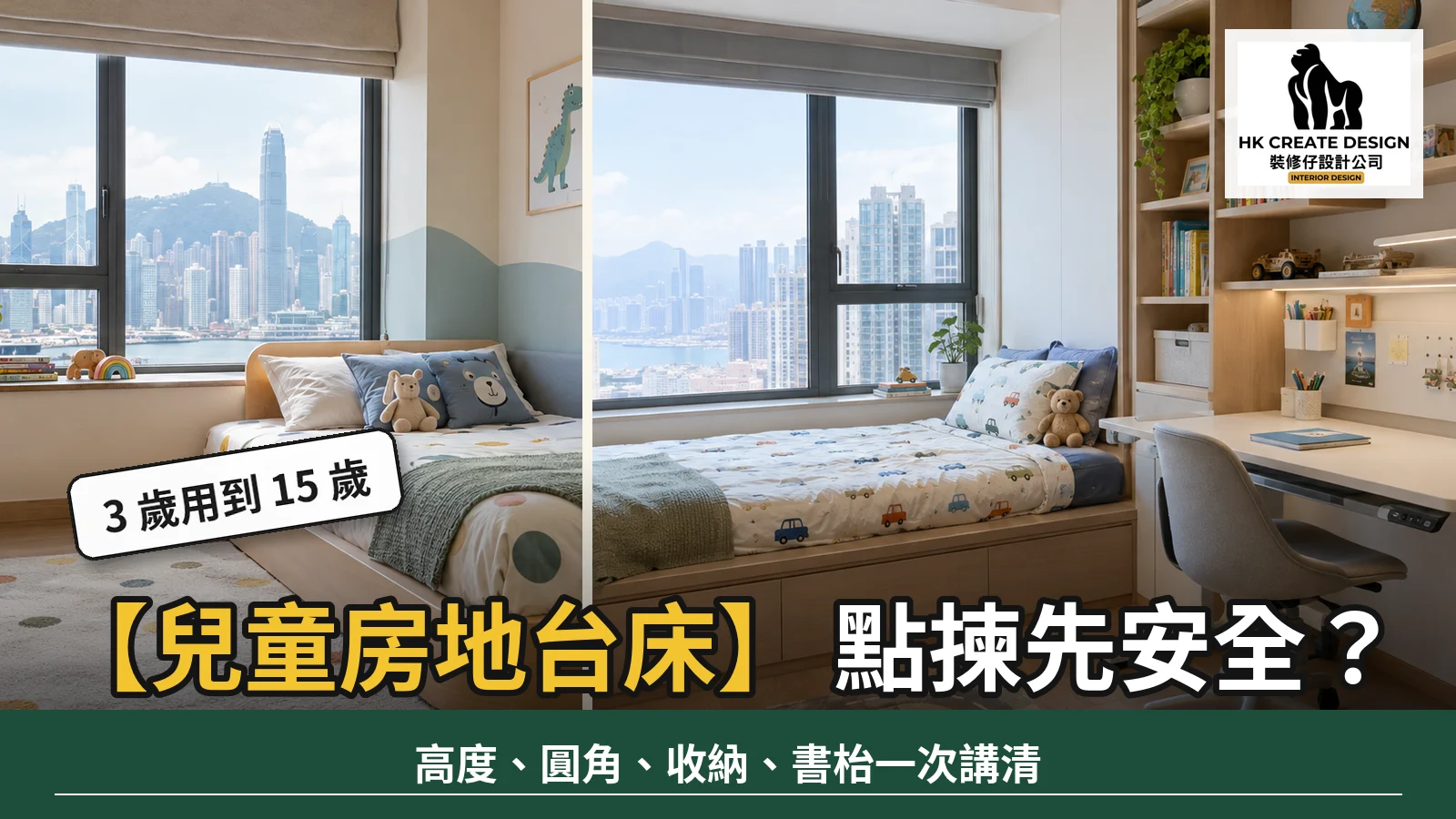
A lower tatami platform reduces fall height for a child, but the step can make access difficult for older users or anyone with knee problems. Platforms above 450 mm are quoted separately[1].
The Department of Health’s Elderly Health Service advises taking steps to prevent falls at home[5]. For an older user, choose a comfortable height without a step to cross, or a conventional-height lift-up bed with a bedside night-light.
- Lift-up bed: conventional height
- Tatami platform: lower height
- Fall prevention for older users
- Add a bedside night-light
You can swipe left or right on your phone to view the complete table.
| Points to compare | Tatami platform | Gas-lift storage bed |
|---|---|---|
| Storage capacity | Compartments for sorting | One uninterrupted compartment |
| Retrieve items | Optional drawers | Lift the bed deck for access |
| Getting in and out | Lower profile | Conventional bed height |
| Sense of space | Open layout | Conventional bedroom layout |
| Multipurpose | Optional lift table | Dedicated to sleeping and storage |
| Moisture resistance | Check moisture across a larger platform | Ventilate regularly |
| Price | 4 ft bed area: around HK$8,840 | 4 ft bed: around HK$12,025 |
| Warranty | Hinges and runners | Lift struts |
Compiled by HK Create Design. [1]
05
4. How open the room feels
A freestanding lift-up bed occupies the mattress footprint, with walkways around it much like a conventional bedroom.
A room-wide tatami platform has no separate bed frame. Put the bedding away during the day to create an open space for sitting or play.
Choose a tatami platform for an open, multipurpose room or a lift-up bed for a conventional bedroom layout.
- Lift-up bed: conventional layout
- Open tatami platform
- Daytime seating
06
5. Multiple uses
A tatami platform can change use throughout the day. Raise the table to work or have tea, lower it for play and lay out bedding at night. Depending on dimensions, it can also sleep two guests.
Lift-up beds mainly provide sleeping and storage space. Bedside cabinets and a unit at the foot can add further storage.
A tatami platform is flexible in a guest room, combined study-bedroom or child’s room. A lift-up bed often suits a main bedroom.
- Tatami platform: lift table
- Tatami: play area and guest bed
- Lift-up bed: sleeping and storage
- Tatami platformFlexible, open layout with optional drawers
- Gas-lift storage bedLarge storage space, easy access and conventional layout
07
6. Moisture control
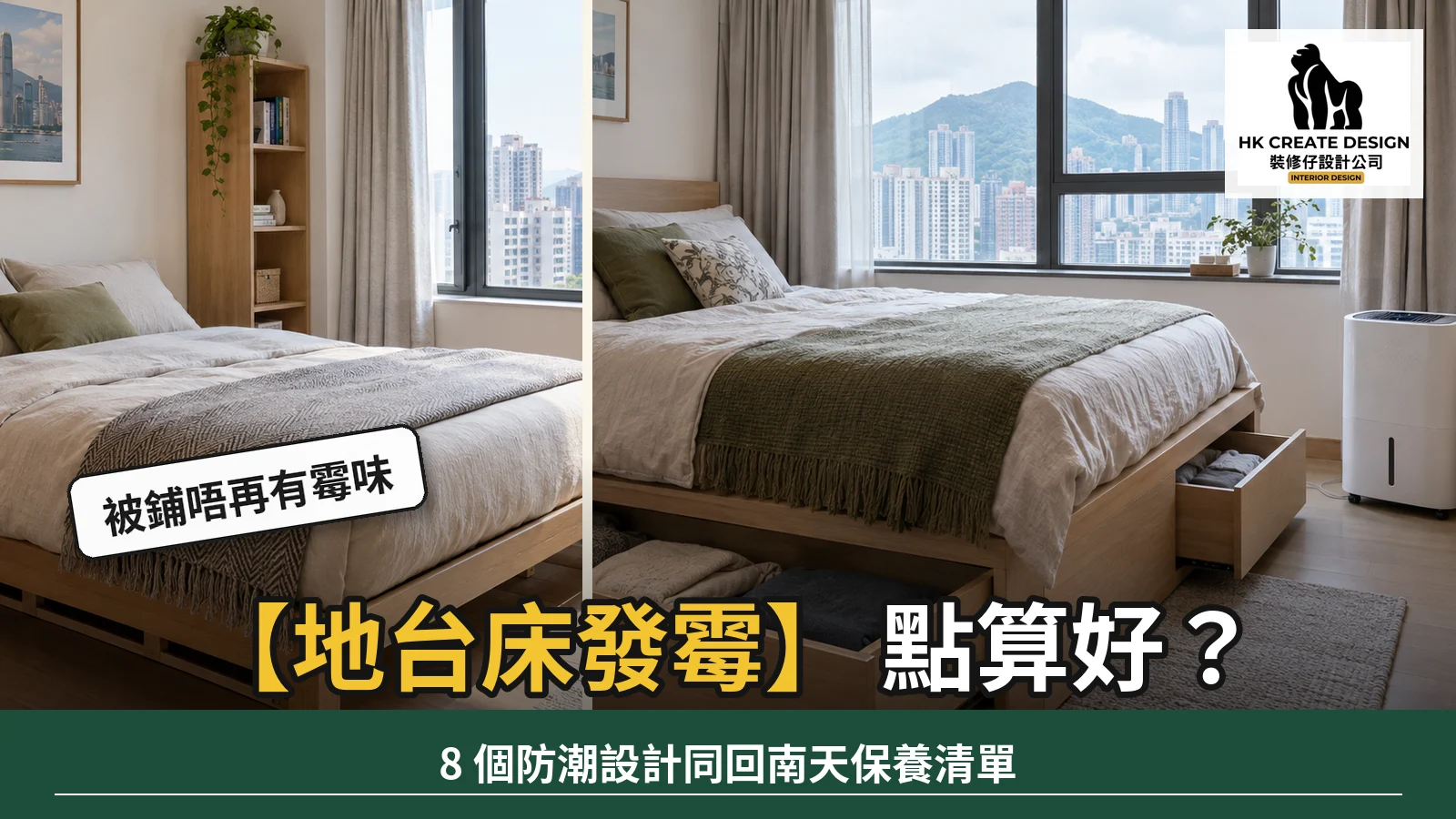
Both designs sit close to the floor and need moisture control. Hong Kong’s average annual relative humidity is about 78%, rising to a monthly average of 83% in April and May[3].
A closed bed base has limited airflow. Open it regularly and use moisture absorbers to prevent clothes or bedding developing a musty smell.
A broad platform covers more floor area and can trap moisture. Mats also need protection from mould. Provide ventilation beneath the platform, put moisture absorbers in storage compartments and use a dehumidifier in humid weather.
HK Create Design uses ENF-grade board as standard. ENF is the most stringent formaldehyde-emission grade under GB/T 39600-2021[4].
- Both need moisture control
- Open the lift-up bed regularly for ventilation
- Allow ventilation beneath the tatami platform
- ENF-grade boards
- HK$8,840Tatami platform26 sq. ft.
- HK$9,840Add lift assistanceManual lift hardware
- HK$12,025Gas-lift storage bed6.5 linear ft
HK Create Design’s published prices for 2026.
08
7. Price
For the same 4 ft bed space (about 4 ft × 6.5 ft): a tatami or raised platform costs 26 sq ft × HK$340 = HK$8,840. A hydraulic storage bed costs 6.5 linear ft × HK$1,850 = HK$12,025[1]. The lift-up bed costs about HK$3,185 more and includes its base, deck and lift mechanism.
For a larger lid, add an FUR36 manual lift mechanism at HK$1,000 per set. The example then totals HK$9,840[1].
The optional FUR37 electric lift mechanism costs HK$2,050 per set[1]. The written quote confirms the difference. A room-wide platform covers more area and therefore costs more. A 42 sq ft example is around HK$14,280[1].
- 4 ft tatami bed area: HK$8,840
- 4 ft lift-up storage bed: HK$12,025
- Lift mechanism: HK$1,000
- Electric lift hardware: HK$2,050
09
8. Maintenance and durability
The struts are the main service item. Replace weakened struts that no longer support the deck, selecting a rating that matches the mattress weight.
Check lid hinges and drawer runners. If you use woven mats, clean and air them regularly and take extra care with mould during the humid season.
Both types areBespoke furniture. HK Create Design offers a one-year warranty and can follow up on workmanship or installation problems.
- Lift-up bed: replacement struts
- Tatami platform: hinges and runners
- Air and dry woven mats
- One-year warranty
10
Eight differences at a glance
Lift-up beds offer one large space. Tatami platforms divide items into compartments and can provide drawers for easy access. A conventional-height lift-up bed is easier to get into, while a platform can make a room feel more open.
Versatility: the tatami platform wins. Moisture: both designs need attention, especially the larger surface of a tatami platform. Price: a tatami platform is cheaper for the same bed space. Maintenance: check the hydraulic struts on a lift-up bed.
Choose according to the room, who will use it and what you want to store.
- Bulky storage: lift-up bed
- Daily access: tatami platform with drawers
- Easier access: lift-up bed
- Multiple uses: tatami platform
- Lower price: tatami platform
- CoupleGas-lift storage bed.
- ChildrenTatami platform.
- Older residentsLift-up or low-profile bed.
- Guest bedroomTatami platform with lift table.
11
Choosing for different households
For a couple’s main bedroom, a conventional-looking lift-up bed with bedside cabinets stores bedding and suitcases. In a child’s room, a lower tatami platform can serve as a play area by day and bed at night.
For an older person, consider a hydraulic storage bed or a low design that requires no step-over. An electric lift reduces effort, and drawers make storage easier to reach. For a guest room that doubles as a study, consider a tatami platform with a lift-up table or a fold-down bed.
For a family of three in a small flat, a lift-up bed in the main bedroom and tatami platform in the smaller one can meet different needs.
- Couples: lift-up bed
- Children: tatami platform
- Older users: lift-up or low-profile bed
- Guest room: tatami platform with lift table
12
Details to specify in the quote
The Consumer Council recommends that, once the quote is agreed, contractors provide drawings, detailed dimensions, material samples and colours for the owner to select and sign off[6].
A tatami quote should specify platform dimensions, height, number of compartments, lids or drawers, and any lift table or lift hardware. A lift-up bed quote should specify bed dimensions, base height, manual or electric lift, and deck material.
Specify the board grade and colour for either design.
- Drawings, dimensions and materials
- Tatami platform: compartments and lift table
- Lift-up bed: manual or electric operation
- Board colours
Example: two options for a 4 ft bed space
Assumptions
- Bed area approximately 4 × 6.5 ft
How to calculate quantities
- Tatami platform: 4 × 6.5 ft = 26 sq ft
- 26 × HK$340 = HK$8,840
- Lift-up bed: 6.5 × HK$1,850 = HK$12,025
- Difference: HK$3,185
The tatami example costs around HK$3,185 less.
Subject to final dimensions and written quotation. [1]
13
A third option: platform bed with lift assistance
A hybrid is also possible. Build a platform across the room and fit a large lift-up panel under the mattress with an FUR36 manual lift mechanism at HK$1,000 per set[1], with drawers and open shelves beyond the bed area.
The hybrid combines a lift-up bed’s large compartment with a platform’s open layout and flexible use. The supported lid makes the mattress section easier to raise.
Example: a 39 sq ft platform costs HK$13,260. Add one manual lift mechanism at HK$1,000 for a total of HK$14,260[1]. Compared with a lift-up bed alone, the wider platform adds seating and storage beyond the mattress.
- Platform with lift mechanism
- Large storage space and open layout
- 39 sq ft: about HK$14,260
14
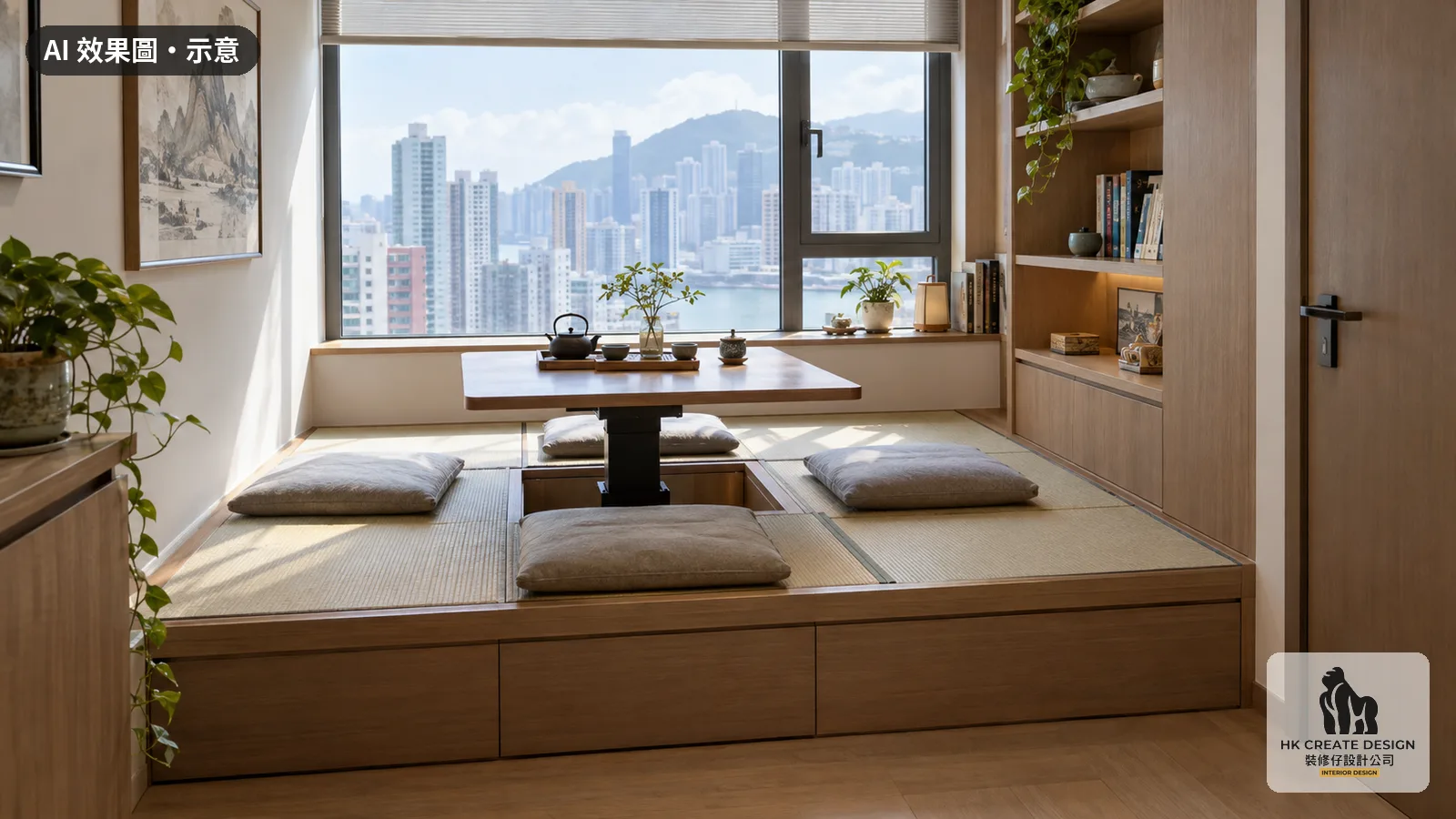
Lift tables for tatami platforms
When lowered, a lift table sits flush with the tatami platform. Raise it to create a desk, coffee table or dining table.
Children can use a lift table for homework or play, adults for tea or a computer, and guests for seating. The recess below the raised table provides legroom while people sit on the platform.
Check that the raised table is stable, that its top suits the room and that the mechanism fits your budget and frequency of use. Both manual and electric versions are available, priced by model.
A folding low table stored inside a platform compartment is an alternative to a built-in lift table.
- Lowers flush with the platform
- Raises to form a desk
- Recess for comfortable seating
- Check stability
- Quoted by model
15
Choosing struts for a lift-up bed
Strut force matters. Weak struts may fail to support the deck and allow it to fall. Oversized struts make closing the bed difficult.
Match the struts to the mattress weight and deck size. Tell the designer at the survey whether you have a sprung or latex mattress, as their weights can differ considerably. A replacement mattress may require different struts.
Keep children away from the open bed base. Check that people and hands are clear before lowering the deck. Arrange prompt replacement if the struts weaken.
A powered mechanism raises or lowers the deck at the press of a button. It can suit older users or an especially heavy mattress. FUR37 costs HK$2,050 per set[1].
- Match the lift mechanism to the mattress weight
- Recheck the struts when changing the mattress
- Keep children out of the bed base
- Electric operation can suit older users
You can swipe left or right on your phone to view the complete table.
| Item | Unit of measure | Price |
|---|---|---|
| FUR06 Platform bed/Tatami | sq ft | HK$340 |
| FUR07 Gas-lift storage bed | linear ft | HK$1,850 |
| FUR36 manual lift mechanism | set | HK$1,000 |
| FUR37 electric lift mechanism | set | HK$2,050 |
HK Create Design’s published prices for 2026. [1]
16
Tatami mats or a mattress directly on the platform?
Traditional woven rush mats have a natural grassy scent and a cool surface in summer. In Hong Kong’s humid climate they absorb moisture and need regular airing, drying and humidity control to avoid mould.
Many Hong Kong households place the mattress directly on the platform for easy upkeep. A floor mat or cushions can turn it into daytime seating.
Choose removable, cleanable or mould-resistant mats. Leave room for air between the mat and the platform and lift the mat for airing weekly in humid weather.
- Protect woven mats from mould
- A mattress directly on the platform simplifies upkeep
- Choose mould-resistant mats
- Lift and air in humid weather
17
Choosing for public housing, private flats and village houses
Public rental flats: Housing Authority figures show that 13.3% measured less than 20 m² internally and 23.9% measured 20–29.9 m²[2], and bedrooms are often small. A tatami or storage platform can use the whole smaller room, while a main room with sufficient space can take a lift-up bed.
In newer two-bedroom private flats, the smaller room often pairs a tatami platform with a window-ledge desk, while the main room has a lift-up bed and bedside units.
Larger bedrooms in village houses and older buildings can suit either type. If the ground floor is damp, provide ventilation underneath the platform or choose a raised bed base.
- Small bedroom in public housing: tatami platform
- Main bedroom in public housing: lift-up bed
- New flats: tatami platform and desk
- Village houses: check for damp
18
Common misunderstandings
A lift-up bed does not necessarily offer more storage: a room-wide platform can have greater total capacity. Woven mats are optional, and you can place a mattress directly on the platform.
Lift struts are replaceable wear parts. Adults can use tatami platforms comfortably when the height and mattress suit them.
You can combine a platform with lift hardware, or use a lift-up bed in the main bedroom and a tatami platform in a smaller room.
- A lift-up bed does not always hold more
- Woven mats are optional
- Replaceable struts
- Suitable for adults too
- Combine both designs
19
Storage layout by item
Under a lift-up bed, put seldom-used decorations and documents near the head, bedding and seasonal clothes in the middle, and more frequently used cases near the foot. Two or three dividers keep items organised.
For a tatami platform, place drawers for daily clothes, towels and toys beside the walkway. Use lift-up compartments along the wall for bedding and cases, and open corner shelves for books.
Either design can include bedside cabinets or headboard storage. Leave clearance for the deck to open on a lift-up bed. A tatami platform can use the window ledge or wall shelves at the head.
Both designs can use FUR40 LED lighting at HK$150 per linear foot[1]. A sensor light inside a lift-up bed turns on when opened. LED strips under a tatami platform provide night lighting and a floating effect.
- Lift-up bed: everyday items near the foot
- Lift-up bed: dividers
- Tatami platform: front drawers, rear lift-up compartments
- Keep bedside furniture clear of the opening deck
- Sensor lights and LED strips
Example: tatami platform with hydraulic lift hardware
Assumptions
- 26 sq ft tatami platform
- Large lid with manual lift assistance
How to calculate quantities
- Tatami platform: HK$8,840
- FUR36:HK$1,000
- Total: HK$9,840
About HK$9,840.
Subject to the final design and written quotation. [1]
20
Installation and handover checks
With the intended mattress on the bed, test opening and closing several times. The struts should support the deck and control its descent. Check that the corners of the base are stable and the frame does not rock.
Walk across the platform and listen for noise or check for deflection. Test every lid and drawer and raise and lower the lift table several times to check its stability.
For either design, check the edge banding, match colours against samples and quantities against the drawings. Photograph and list any defects and send the list to the contractor.
- Test the hydraulic bed with the mattress in place
- Walk across the tatami platform to test it
- Test the table throughout its travel
- Inspect the edge banding and colour
- List defects for follow-up
21
Six questions before choosing
What will you store and how often will you need it? A lift-up bed suits suitcases and bedding taken out a few times a year. For daily clothes and toys, drawers in a tatami platform give easier access.
Who will sleep here, and how big is the room? Older users may need easier access and children a low platform. Room-wide tatami makes use of a small room, while a larger room can take a freestanding lift-up bed.
Will it also be a study, play area or guest room, and what is the budget? A tatami platform with a lift table is flexible. For the same sleeping footprint, the tatami example costs less. The lift-up bed includes the lift hardware.
Use these six questions to identify a suitable design. If you are still unsure, a designer from HK Create Design can measure the room and discuss your needs on site.
- What will it hold?
- How often will you need access?
- Who will sleep here?
- How big is the room?
- Will the room have a second use?
- What is the budget?
22
Care and cleaning
Every six months, clean the base and inspect the struts. Have weakening or noisy struts checked and replaced where necessary. Store only dry clothing and bedding to prevent mould.
Open lids and drawers each season and use moisture absorbers in humid weather. Wipe the platform with a slightly damp cloth and avoid soaking panel joints. Hong Kong’s mean annual relative humidity is around 78%, reaching 83% in April and May[3], so moisture protection is essential.
Repair lifting edge banding promptly to keep moisture out of joints. Photograph problems within the warranty period and notify the contractor in writing.
- Check lift-up beds every six months
- Keep damp items out of the bed base
- Air tatami storage each season
- Use a well-wrung mop
- Repair lifting edge banding promptly
23
Order a custom design from HK Create Design
HK Create Design has worked with Hong Kong homeowners since 2019. Its designers and tradespeople with over 15 years’ experience provide floor plans, furniture drawings, VR renderings and production drawings. ENF-grade board is standard.
For two or more work items, complimentary site measurement is offered until 31 December 2026. Showroom: Shop 16, G/F, Fu Yau Building, 61 Po Kong Village Road, Wong Tai Sin, Kowloon. WhatsApp 5243 7747. HK Create Design offers a one-year warranty and has a HK$2,000 minimum charge.
- VR renderings
- ENF-grade boards as standard
- WhatsApp 5243 7747
Advice from our tradespeople
「“I ask how often people need what’s underneath. For things taken out once a year, choose a lift-up bed. For daily access, choose a tatami platform with drawers.”」
「“The struts must suit the load. A heavy mattress needs appropriately rated struts, or the deck can drop while you’re lifting it.”」
FAQ
15 practical questions answered
01Which costs less, a tatami platform or a hydraulic lift bed?
For the same 4 ft bed area, the tatami platform costs around HK$8,840 and the lift-up bed around HK$12,025[1].
02Which option has greater storage capacity?
A hydraulic lift bed has one large unobstructed storage space beneath the bed. A room-wide tatami platform can also offer substantial total capacity.
03Which option suits older people?
Consider a hydraulic lift bed or a low design without a step to climb over. An electric lift and storage drawers are options.
04Which option suits a child's room?
A low tatami platform can suit children and double as a play area during the day.
05Does the hydraulic lift bed include its hardware?
FUR07 includes the manual hydraulic lift hardware. There is no need to select FUR36 separately.[1].
06Can a lift-up table be added to a tatami platform?
Yes. A lift-up table is priced for the selected model.
07Can either option develop mould?
Both need moisture control. Air the lift-up bed regularly, provide ventilation beneath the tatami platform and use a dehumidifier in humid weather[3].
08What if a hydraulic lift strut fails?
Use replacement lift struts rated for the mattress weight. Contact the installer about installation-related faults within the warranty period.
09Does a tatami platform need tatami mats?
No. You can place a mattress directly on the platform.
10Can the two options be combined?
Yes. A 39 sq ft platform bed with an FUR36 manual lift mechanism costs about HK$14,260[1].
11Is a lift-up table essential?
Not necessarily. A folding low table can be stored inside the platform instead.
12Are there mattress restrictions for a hydraulic lift bed?
Mattress weight affects the force required from the lift struts. Give the mattress model and thickness at measurement and check strut suitability again if replacing it.
13Can a tatami platform be made the same width as the mattress?
Yes. The platform is made to fit the room. Reserve a standard mattress footprint and use the remaining space for storage and seating.
14How long does the work take?
Production generally takes two to four weeks from approval of production drawings, followed by site installation. Confirm actual timing in the quotation and schedule.
15Which panels do you use?
HK Create Design uses ENF-grade board as standard[4].
CHECK THE BASIS
Data and technical basis, sources can be verified
- [1]HK Create Design published 2026 rates and work item descriptions Accessed: 2026-11-03
- [2]Housing Bureau: Housing in Figures 2026 Accessed: 2026-11-03
- [3]Hong Kong Observatory climatological normals, 1991–2020 Accessed: 2026-11-03
- [4]STC: China Market Watch (August 2021) on the new formaldehyde emission grading standard for wood-based panels and finishing products Accessed: 2026-11-03
- [5]Department of Health Elderly Health Service: Fall Prevention Accessed: 2026-11-03
- [6]Consumer Council, 16 November 2020 — survey of residential renovation quotes finds unclear scope and calls for better quotations Accessed: 2026-11-03