01
Step 1. Take a clothing inventory
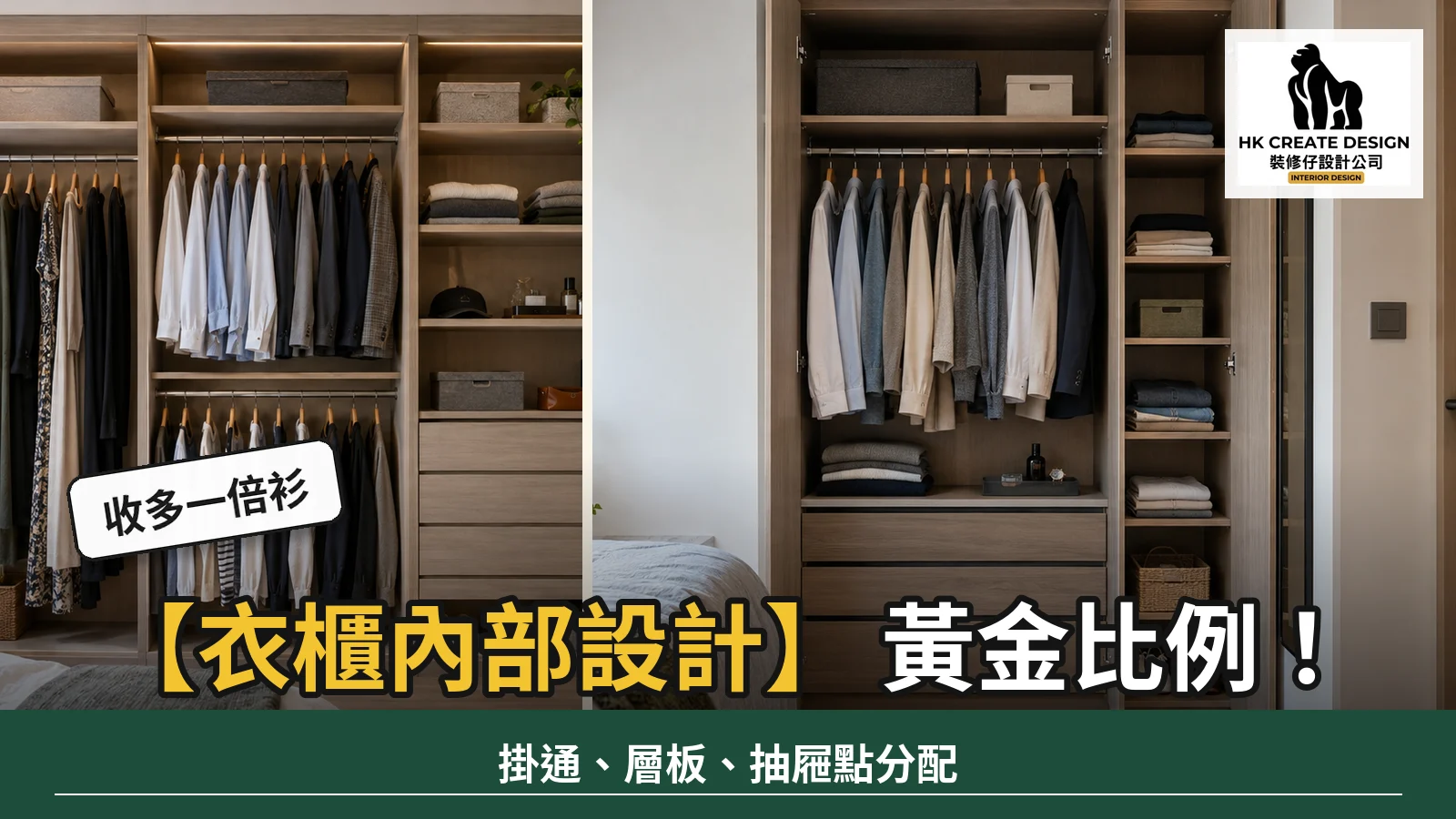
Before designing the interior, open your old wardrobe and count what you own. Start by separating clothes that need hangers from those you can fold.
Hang coats, suits, shirts, dresses, tailored trousers and anything that creases easily. Separate long items such as coats and long dresses from shorter shirts, jackets and skirts. Fold T-shirts, jumpers, jeans, sportswear, underwear, socks and towels.
Allow space for handbags, hats, scarves, ties, belts, suitcases, bedding and out-of-season clothes. Otherwise they tend to pile up above the wardrobe or below the bed.
While counting, consider donating or discarding items you have not worn for a year. Size the wardrobe for clothes you expect to use now and over the next few years.
Make a rough count and write it down, for example: 10 long hanging items, 30 short hanging items, 40 folded items and 6 handbags. Give the list to the designer at the site measurement so the storage layout reflects what you own.
- Sort hanging and folded clothes
- Separate long and short hanging
- Count other belongings too
- Sort out old clothes at the same time
- Give the designer a written inventory
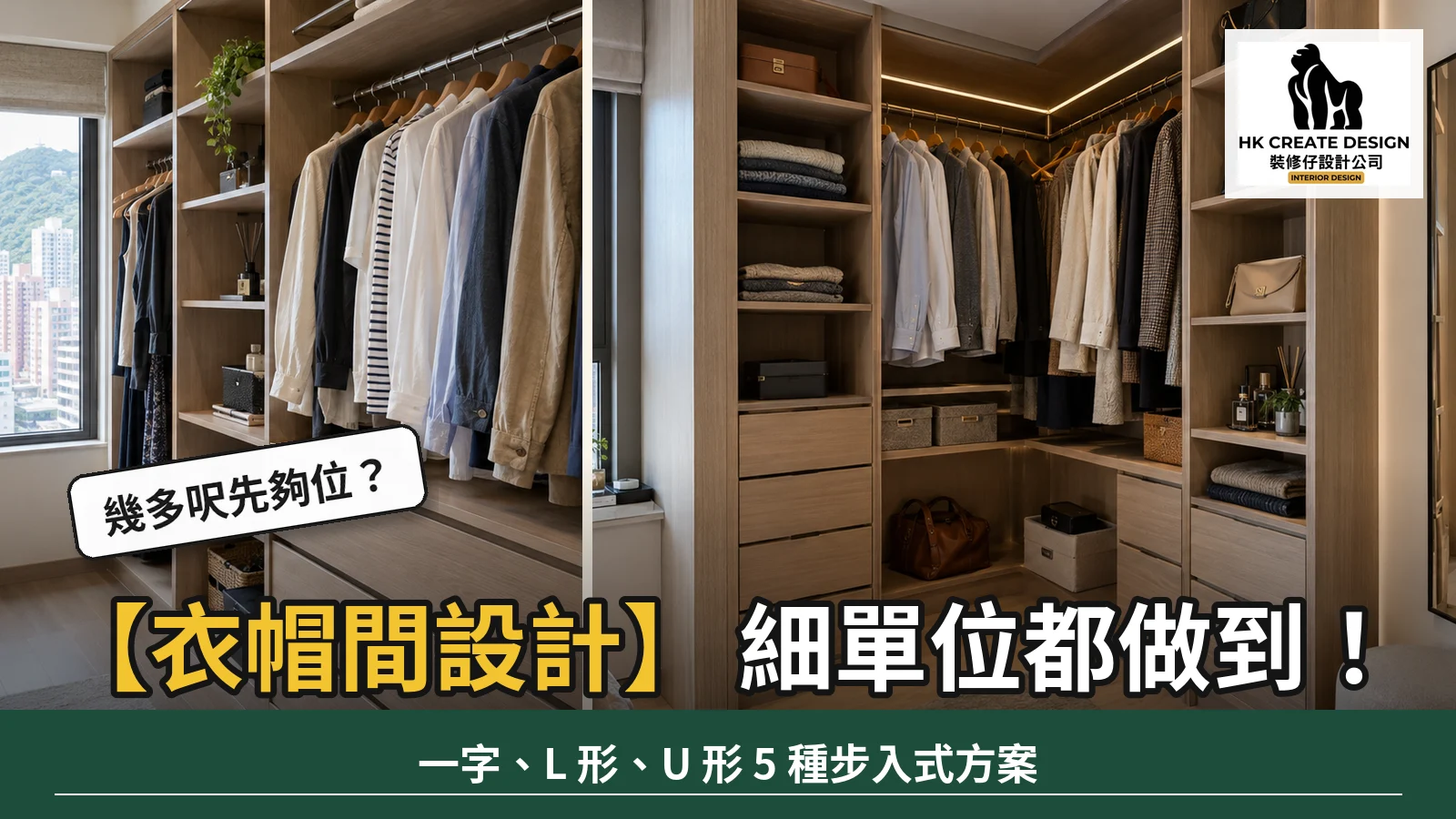
- Long-garment sectionCoats and long dresses.
- Double hangingTwice the capacity.
- Shelving sectionFolded clothes and handbags.
- Drawer sectionSmall accessories.
02
Four zones in a wardrobe
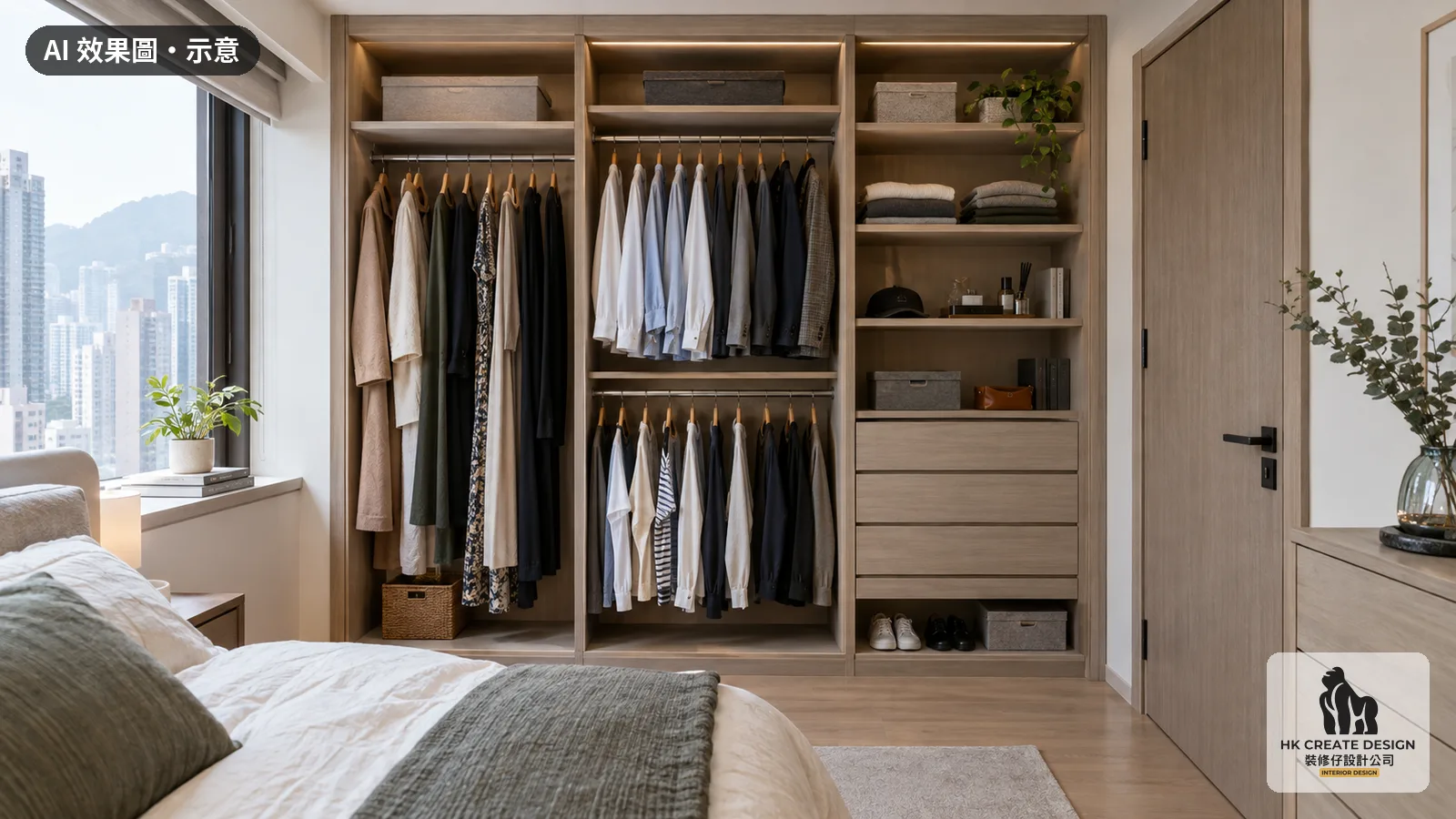
Coats, long dresses and overcoats need enough height to hang clear of the base. Most wardrobes include one long-hanging bay. Size its width to the number of long garments you own.
Use the upper rail for shirts and jackets and the lower one for trousers and skirts. Two rails in the same compartment provide roughly twice the hanging capacity of one, especially useful in a small wardrobe.
Use shelves for folded jumpers, T-shirts, jeans and handbags. Keep clothing shelves close enough together that pulling out the bottom item will not topple a tall stack.
Keep underwear, socks, ties, belts and small accessories in drawers. Position them in the lower half of the wardrobe for a clear view inside.
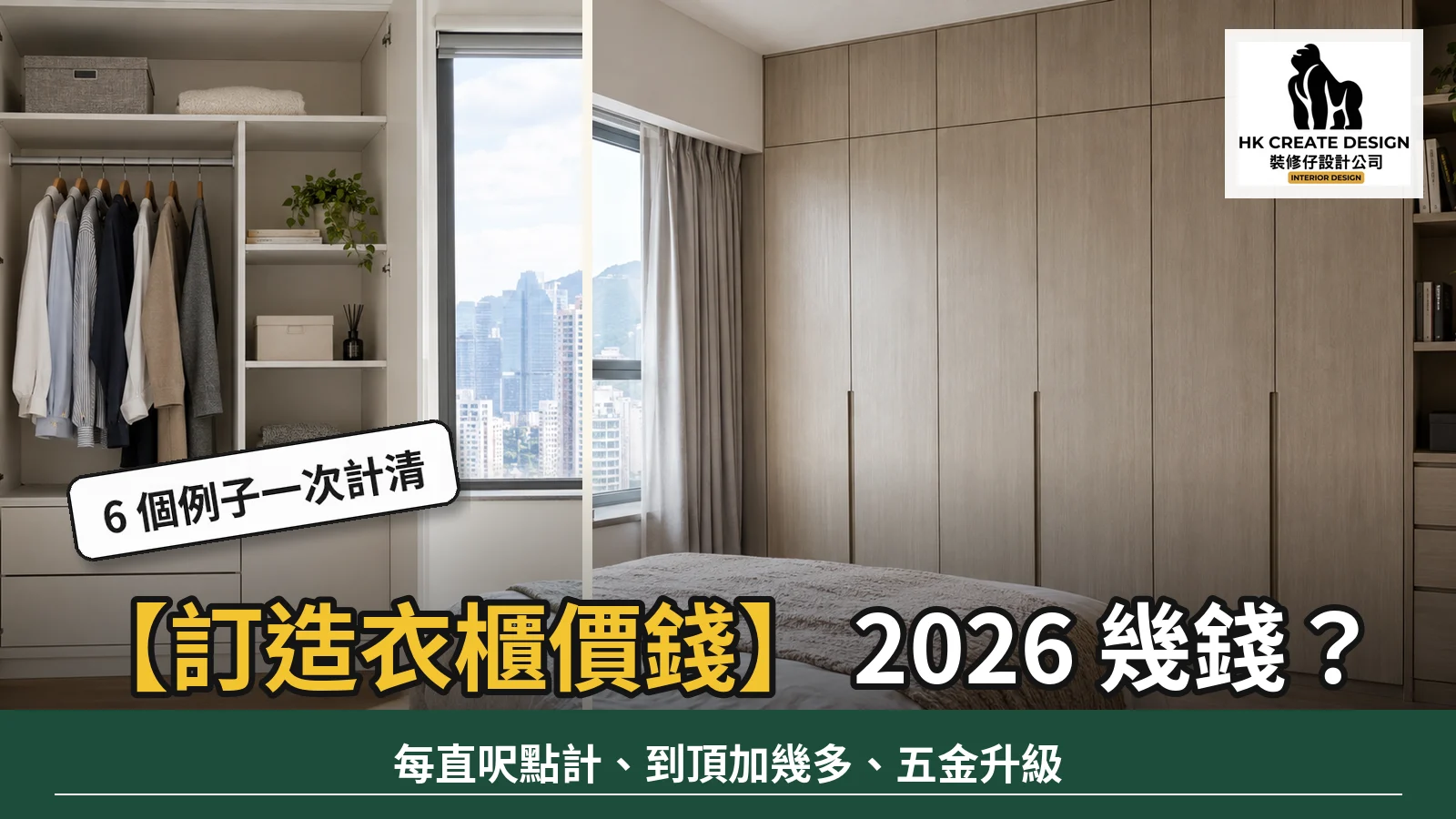
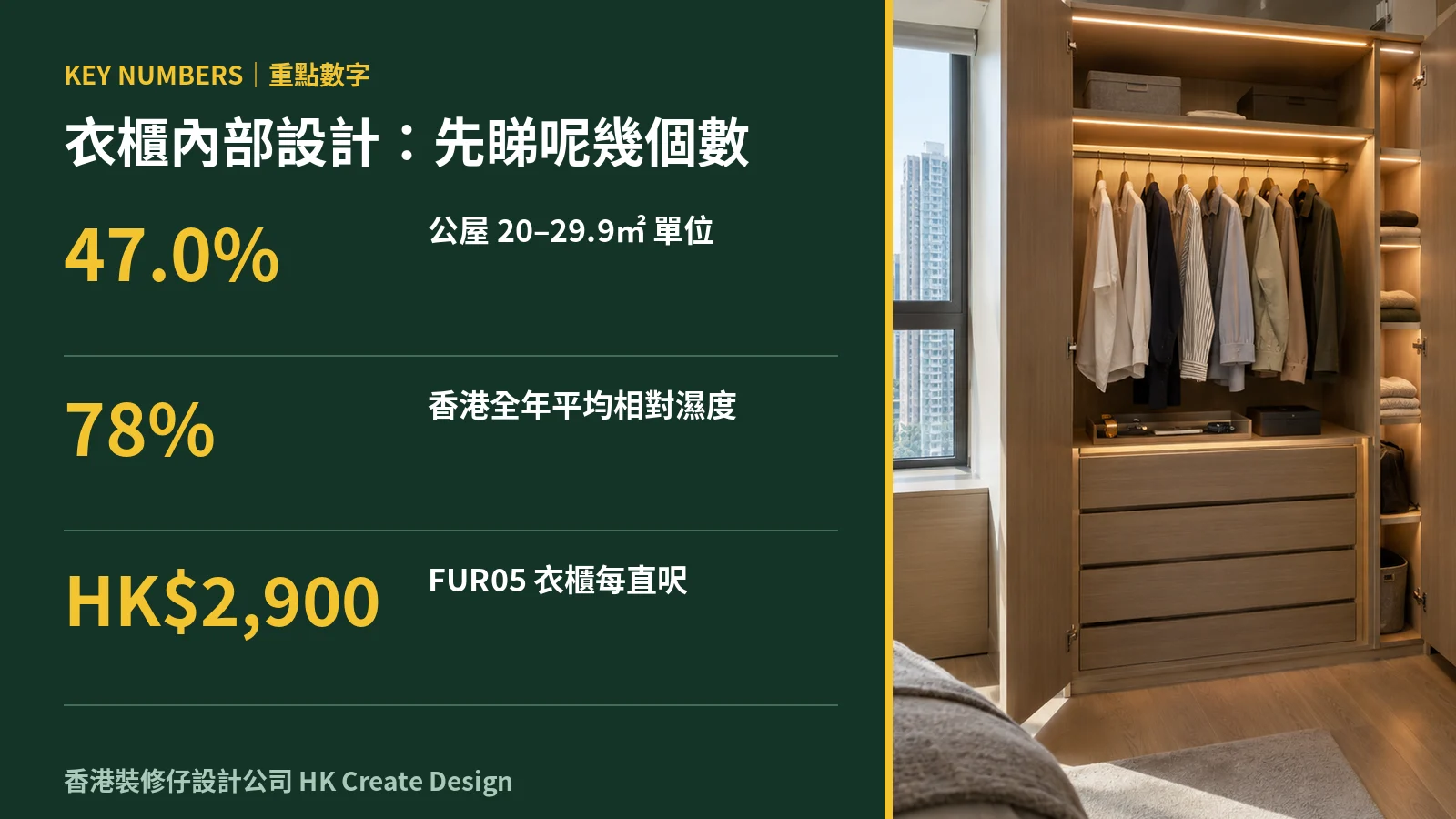
FUR05 wardrobes cost HK$2,900 per linear foot, including 1 hanging rail, 3 shelves and 2 drawers.[1]. Extra rails or drawers are priced against the design and itemised in the quotation.
- Long-hanging section
- Double short-hanging section
- Shelving section
- Drawer section
- Adapt the standard fittings to your needs
- More hanging spaceGive more space to hanging
- More folded storageAllow more shelves and drawers
03
How to divide wardrobe space
There is no single ideal ratio. If you wear suits and shirts to work, give more room to rails. If you mostly wear T-shirts and casual clothes, allow more shelves and drawers.
If you hang most clothes, allow 15–20% for long hanging, 40–50% for double short hanging and 30–40% for shelves and drawers. If you fold most clothes, allow about 15% for long hanging, 20–30% for short hanging and over 50% for shelves and drawers.
Give each person a side with a rail and drawers. Separate sections keep clothes organised and make the division of space clear.
Short children's clothes can fit on two or even three tiers of rails. Adjustable shelves let you change heights as the child grows.
- Mostly hanging: prioritise rails
- Mostly folded clothing: prioritise shelves and drawers
- Give each person one side
- Multiple rails for children's clothes
- Adjustable shelves
You can swipe left or right on your phone to view the complete table.
| Zoning | What will it hold? | Design considerations |
|---|---|---|
| Long-hanging section | Coats and long dresses | Allow enough vertical clearance |
| Double short-hanging section | Shirts and trousers | Keep the upper rail within reach |
| Shelving section | Jumpers, T-shirts and handbags | Keep shelf openings within reach |
| Drawer section | Underwear, socks and accessories | Below waist height |
Compiled by HK Create Design. [1]
- Take an inventorySort hanging and folded clothes
- ZoningFour main zones
- ProportionDo you hang or fold more?
- ConfigurationArrange by width
「When I visit to measure up, I ask customers to open their current wardrobe. Seeing how much they hang and fold tells me how to divide up the new one.」
04
4 ft wardrobe layout for a small public housing bedroom
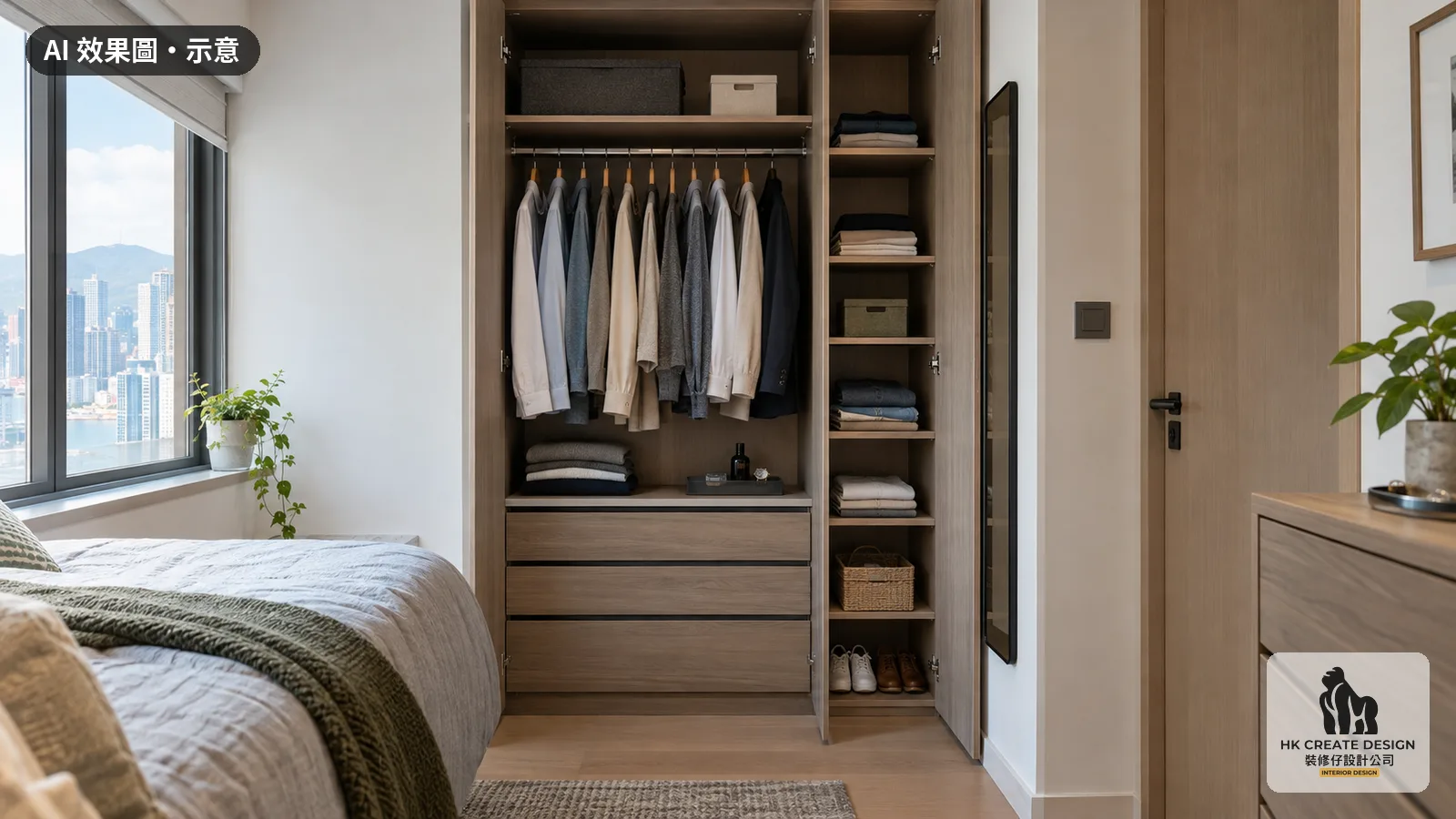
A 4 ft wardrobe (about 1,200 mm wide) is a common size for small public housing bedrooms and children's rooms. 4 × HK$2,900 = HK$11,600[1].
Use the left 2 ft for long hanging with a shelf above. Give the right 2 ft a short-hanging rail and 2 drawers below. If you fold most of your clothes, fit shelves and drawers on the right instead.
Keep drawers outside the overlap of sliding doors or they cannot pull out. Align each bank of drawers with a clear door opening on the drawing.
Upgrade the drawers with 2 FUR32 TANDEMBOX sets at HK$1,500 each for a total of HK$14,600[1].
- 4 ft — HK$11,600
- Long hanging on the left, short hanging on the right
- Drawers below
- Keep drawers clear of sliding-door overlaps
- With TANDEMBOX — HK$14,600
05
6 ft wardrobe layout for a main bedroom or one person
A 6 ft wardrobe (about 1,800 mm wide) is common in private flats' main bedrooms. It gives one person ample space and can work for two with careful planning. 6 × HK$2,900 = HK$17,400[1].
For one person, divide the width into three 2 ft sections: long hanging on the left, double short hanging in the middle and shelves above drawers on the right. For two people, allow 3 ft on each side, with rails above drawers, and share a central long-hanging compartment.
Example: a 6 ft wardrobe, 2 TANDEMBOX sets at HK$3,000 and 2 FUR41 internal spotlights at HK$620 come to HK$21,020[1]. Spotlights above long- and short-hanging sections light your clothes when the doors open, helping you see the colours as you choose an outfit.
- 6 ft: HK$17,400
- One person: three sections
- Two people: one side each
- With upgrades — HK$21,020
- Spotlights to illuminate clothes
- HK$11,6004 sq ftSmall public housing bedroom
- HK$17,4006 sq ftMain bedroom
- HK$23,2008 sq ftFor two people
HK Create Design’s published prices for 2026.
06
8 ft wardrobe layout for two people
An 8 ft wardrobe (about 2,400 mm wide) suits two people. 8 × HK$2,900 = HK$23,200[1].
Allow a shared 2 ft long-hanging section at the centre and 3 ft on each side with double rails above drawers and shelves. In a floor-to-ceiling wardrobe, use the top tier for suitcases and seasonal bedding.
FUR40 sensor lighting costs HK$150 per linear foot. An 8 ft strip adds about HK$1,200, bringing the total to HK$24,400[1]. Sensor strips switch on when you open the door and off when you close it. No switch is needed.
Hinged doors give a view of the whole interior if the room has enough clearance. Sliding doors suit a narrow aisle. Both FUR05 options cost the same[1].
- 8 ft — HK$23,200
- Shared long-hanging section in the centre
- 3 ft on each side
- With LED strip — HK$24,400
- Hinged and sliding doors cost the same
07
Rail heights and shelf spacing
Set the rail for the person using it. A high rail is hard to reach and a low one leaves garments brushing the base. Tell the designer the user's height and the length of their longest garment at the site visit.
Keep the upper rail within reach and allow enough height below for trousers or skirts. Reserve the higher rail for less frequently worn clothes such as formal suits.
Space clothing shelves for small stacks that stay upright when you take something out. Leave more height for handbags so they can stand without deforming.
A row of shelf-pin holes lets you adjust the shelves yourself as your needs change. A wardrobe can stay in use for a decade, so that flexibility is worth building in.
- Match the rail height to the user
- Keep the top rail within reach
- Keep clothing shelf openings shallow
- Leave taller shelf openings for handbags
- Adjustable shelves
08
How to design usable drawers
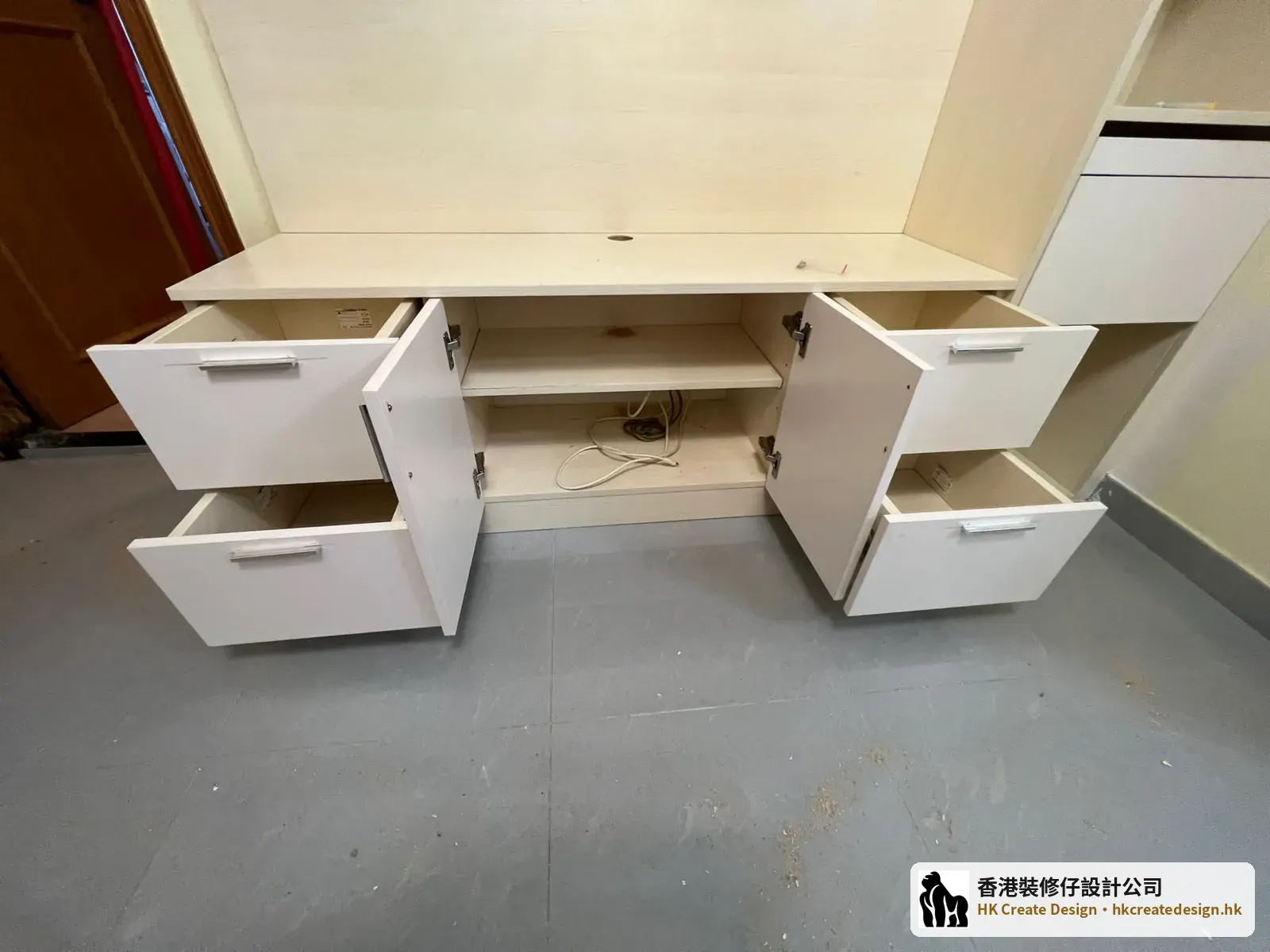
Position drawers below waist height so you can see inside when they open. High drawers are difficult to see into, while very low ones make you crouch.
Shallow drawers suit underwear and socks. Deeper ones accommodate T-shirts and jumpers. A mix of shallow and deep drawers handles both.
Standard drawers include runners. For smoother full extension, FUR32 Blum TANDEMBOX costs HK$1,500 per set or FUR33 LEGRABOX HK$2,250 per set[1]. Blum hardware undergoes repeated opening and closing tests[2], suitable for drawers you use every day.
Simple dividers keep underwear, socks and ties in separate compartments that are easy to find. Off-the-shelf organisers work well.
- Below waist height
- One shallow and one deep
- TANDEMBOX HK$1,500
- Drawer organisers
09
Which specialist fittings are worth adding?
A pull-out trouser rack hangs several pairs neatly and minimises creasing. Consider one if you wear tailored trousers to work.
A tie and belt rack on the wardrobe side panel keeps small accessories in their own place.
A pull-down rail makes the top of a floor-to-ceiling wardrobe accessible without a stepladder. Use it for seasonal clothes.
In a small bedroom, mount a full-length mirror inside the wardrobe door or on a side panel to free the floor space a standing mirror would occupy.
Prices vary by fitting. Plan the basic zones first, then add the accessories you know you will use.
- Trouser rack
- Tie and belt rack
- Pull-down rail
- Full-length mirror
- Add accessories as needed
- BreathableLeave ventilation openings.
- Distance from the wallKeep the back panel away from leaking walls.
- DehumidifyUse a moisture absorber.
10
Keeping a wardrobe dry and mould-free
Hong Kong's average annual relative humidity is about 78%, reaching 83% in April and May[3]. Air moves slowly in a closed wardrobe, making clothes and leather goods more susceptible to mould.
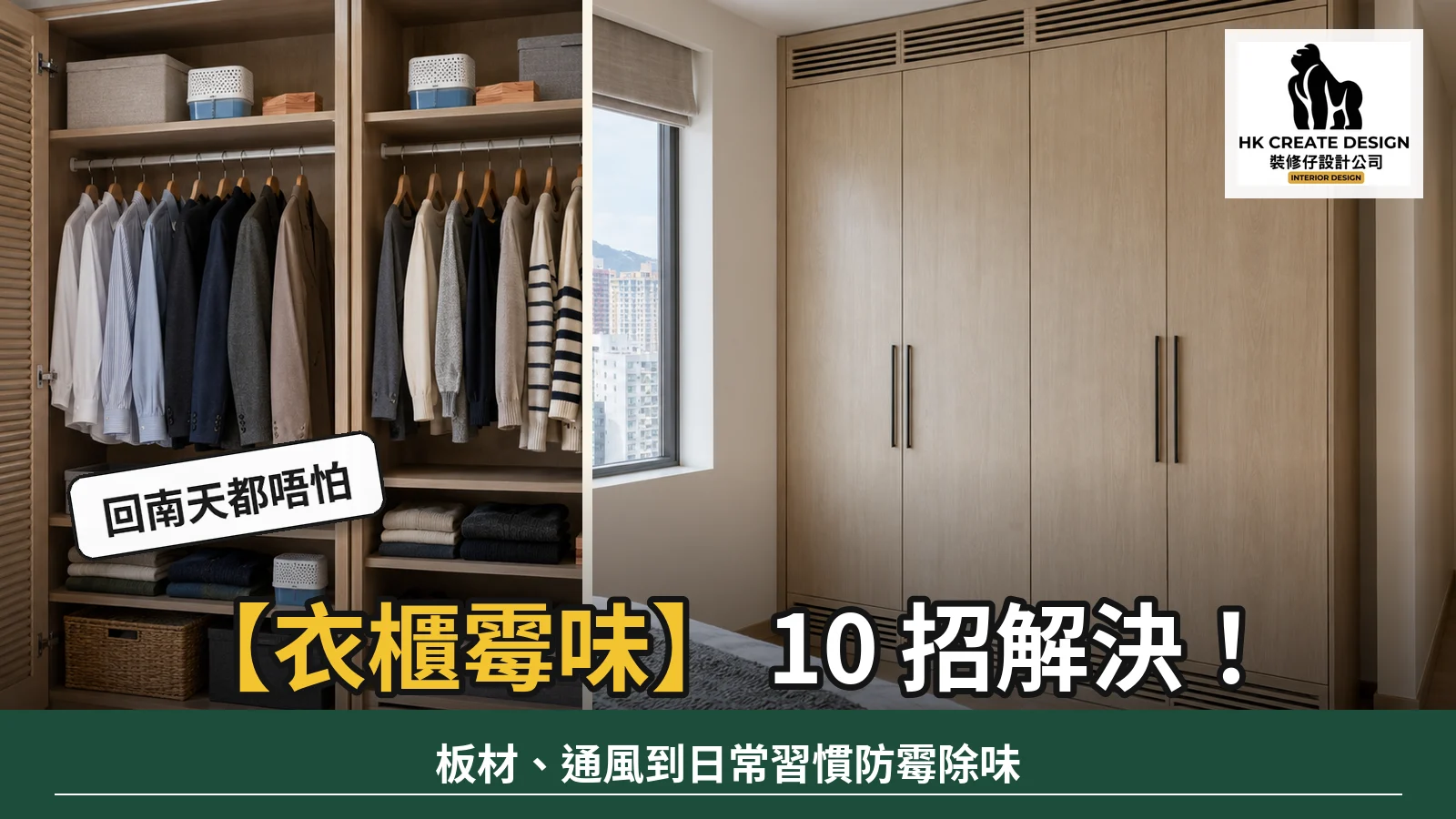
Allow a little airflow through a vent at the top or base. Keep the back panel clear of an external wall with seepage, and avoid storing leather or suede at the very back.
Keep moisture absorbers in the wardrobe and replace them regularly. Air worn clothes until dry before putting them away. During humid spring weather, close the windows and run a dehumidifier.
HK Create Design supplies ENF boards as standard. ENF limits formaldehyde emissions to ≤0.025 mg/m³[6]. ENF measures formaldehyde emissions. Ventilation and humidity control are still necessary to prevent mould.
- Annual average humidity: 78%
- Provide ventilation openings
- Keep the back panel away from leaking walls
- Add a moisture absorber
- ENF is an emissions grade; mould resistance is a separate property
Example: 6 ft wardrobe with upgrades
Assumptions
- 6 ft wardrobe
- 2 TANDEMBOX sets
- 2 internal spotlights
How to calculate quantities
- Wardrobe — 6 × HK$2,900 = HK$17,400
- TANDEMBOX:2 × HK$1,500 = HK$3,000
- Spotlights: 2 × HK$310 = HK$620
- Total HK$21,020
About HK$21,020.
Delivery is excluded. Final pricing is subject to site measurement and a written quote. [1]
11
Lighting that comes on when the door opens
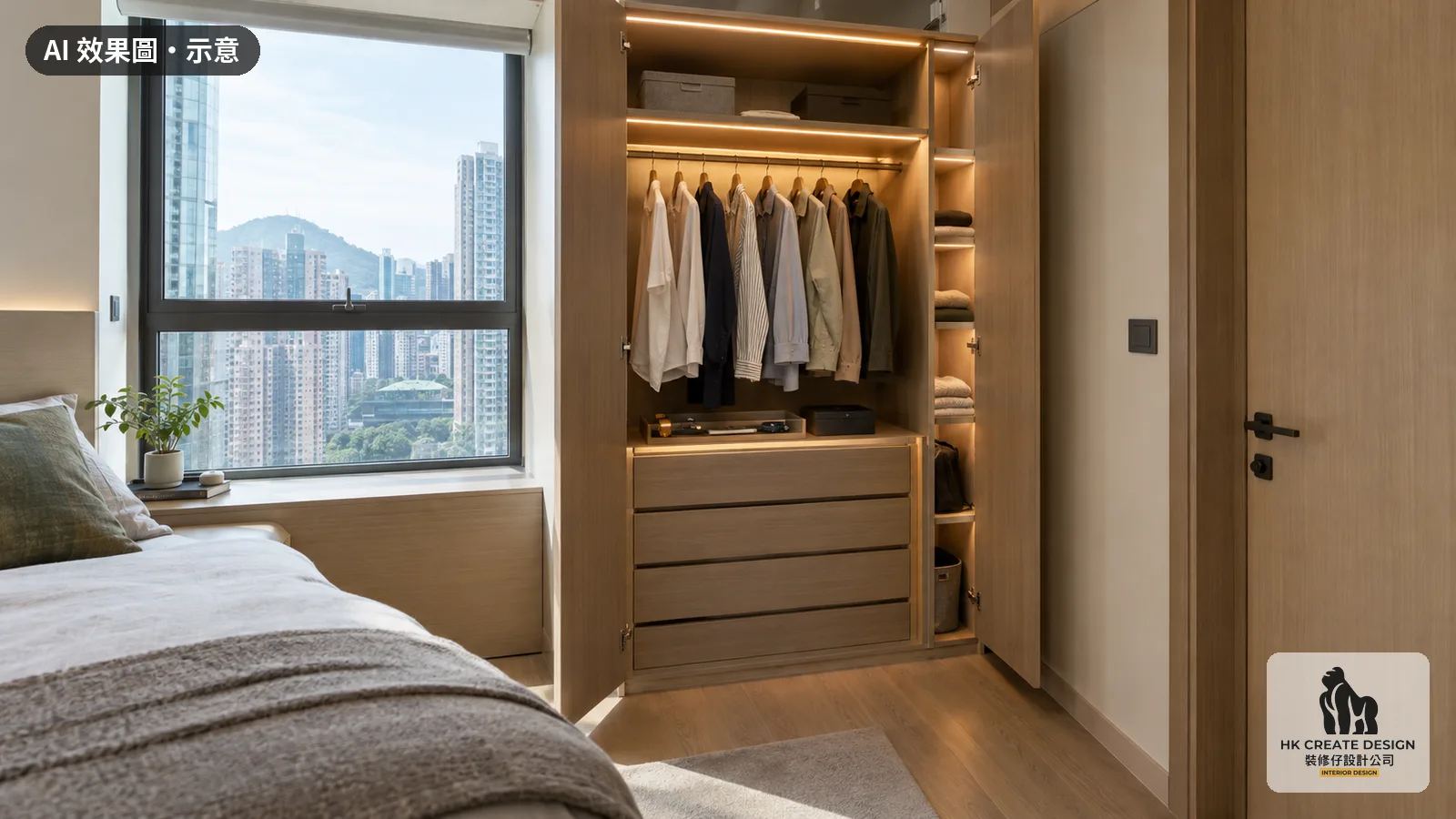
Without internal lighting, a person standing in front of the wardrobe blocks the room light. Built-in lights make it easier to tell dark colours apart and find what you need.
FUR40 sensor lighting costs HK$150 per linear foot. Fit it by the hanging rail or at the front of a shelf to light up when the door opens[1]. FUR41 internal spotlights cost HK$310 each. Fit them at the top to illuminate long clothes or handbags[1].
Choose a colour temperature close to daylight to see clothing colours more accurately. Plan wiring and power points before furniture installation.
- Sensor strip — HK$150/ft
- Spotlights: HK$310 per fitting
- Close to daylight
- Plan the power supply first
12
Common wardrobe layout mistakes
Mistakes 1 and 2. A wardrobe full of rails leaves little space for folded clothes and overloads the few shelves. Excessively tall shelf openings encourage stacks that collapse when the bottom item is removed.
Mistakes 3 and 4. Drawers set too high are hard to see into and tend to go unused. Drawers behind a sliding-door overlap cannot open.
Mistakes 5 and 6. Without a suitcase compartment, luggage ends up on the floor or under the bed. Children grow, work clothes change and more people may share the wardrobe. Adjustable shelves make it easier to adapt.
- Allow space for more than hanging rails
- Avoid excessively tall shelf openings
- Keep drawers within sight
- Avoid the sliding-door overlap
- Allow space for suitcases
- Allow for future needs
13
Checking the interior at handover
Check each compartment after installation. Hang several coats to see whether the rail flexes. Compare shelf count and positions against the drawings, open each drawer to check for sticking, and test the spotlights and strips.
Test each drawer with the sliding doors in the positions needed to access it. For hinged doors, test the soft-close action.
The Consumer Council recommends recording requirements in the contract, keeping design drawings, listing defects and documenting changes in writing[4]. Photograph any issues immediately and send the contractor a written list to follow up.
- Test the rail with heavy coats
- Check the shelf count against the drawing
- Test every drawer
- Lighting test
- Written follow-up
You can swipe left or right on your phone to view the complete table.
| Width | suitable for | Zoning | Price |
|---|---|---|---|
| 4 sq ft | Small public housing rooms and children | Long hanging, short hanging and drawers | HK$11,600 |
| 6 sq ft | Main bedroom for one | Three separate sections | HK$17,400 |
| 8 sq ft | For two people | Long garments in the middle, 3 ft on each side | HK$23,200 |
HK Create Design’s published prices for 2026. [1]
14
Making use of the top and bottom compartments
The top of a floor-to-ceiling wardrobe is usually above reach. Use it for suitcases, winter bedding or Christmas decorations that come out only a few times a year. Independent upper doors allow the rest of the wardrobe to open without disturbing this section.
It is hard to see into drawers above eye level. Fit deep shelving for luggage instead. Measure large suitcases at the site visit so the designer can allow enough height.
The bottom compartment is hardest to reach. Use it for shoe boxes, sports equipment or storage bins. A large pull-out drawer gives access without crouching into the cupboard.
The bottom compartment is more exposed to damp. Use it for plastic boxes and keep leather shoes and bags elsewhere.
- Luggage on the top shelf
- Separate upper doors
- Keep drawers out of the top tier
- Use large drawers at the bottom
- Store plastic boxes at the bottom
15
Seasonal storage for one wardrobe
Hong Kong's seasons have relatively small temperature differences, but bulky winter coats, jumpers and bedding need different storage from numerous thin summer clothes. Plan how the wardrobe will change over the year.
1. Divide the wardrobe by season. Keep current clothes in the easiest-to-reach middle section and off-season clothing at the top or bottom. Swap their positions when the season changes.
2. Vacuum bags can reduce bulky winter coats and bedding by more than half for storage at the top or under the bed. Avoid compressing down and wool for long periods because it affects their loft.
3. Use adjustable shelves and rails. Add shelves for summer T-shirts and free up hanging space for winter coats. Adjustable fittings make the wardrobe easier to reorganise.
- In-season and off-season sections
- Swap the zones each season
- Save space with vacuum bags
- Avoid prolonged compression of down
- Reposition adjustable shelves
16
Storing handbags, shoes and accessories
Handbags can lose their shape under pressure and grow mould in damp conditions. Stand them on shelves with a little space between bags. Use dust bags for designer pieces and allow more shelf height than for folded clothes.
Shoes bring moisture and odour into a wardrobe. An entrance shoe cabinet is preferable. If shoes must share the wardrobe, keep them in boxes or breathable bags in the lowest section.
Hang scarves and accessories on hooks inside a door or side panel. Stack hats on a shelf. Use small drawer organisers, with one compartment for each type of accessory.
Jewellery can scratch easily. A shallow drawer with velvet-lined compartments keeps a larger collection separated and protected.
- Stand handbags upright
- Keep shoes near the entrance
- Use hooks for accessories
- Shallow jewellery drawer
Example: 8 ft wardrobe with sensor strip lighting
Assumptions
- 8 ft wardrobe
- 8 ft of sensor lighting
How to calculate quantities
- Wardrobe: 8 × HK$2,900 = HK$23,200
- Strip lighting: 8 × HK$150 = HK$1,200
- Total HK$24,400
About HK$24,400.
Delivery is excluded. Final pricing is subject to site measurement and a written quote. [1]
17
Planning for an older family member or someone with limited mobility
Older residentsReaching overhead or squatting can be difficult. Store frequently worn clothes between waist and shoulder height to make them easy to reach while standing normally.
Fit rails a little lower and choose full-extension drawers so the contents at the back are visible. FUR32 TANDEMBOX costs HK$1,500 per set[1], an option for full-extension drawers.
Choose lightweight hinged doors or smooth sliding doors with easy-grip handles. Push latches can be difficult for someone with limited hand strength. Keep enough clear floor space to stand and turn.
Provide enough light to see clothes clearly. Sensor strips switch on when the door opens, making items easier to find[1].
- Keep everyday items between waist and shoulder height
- Lower the hanging rail
- Full-extension drawers
- Choose easy-grip handles
- Sensor light
18
Finding more storage in a small bedroom
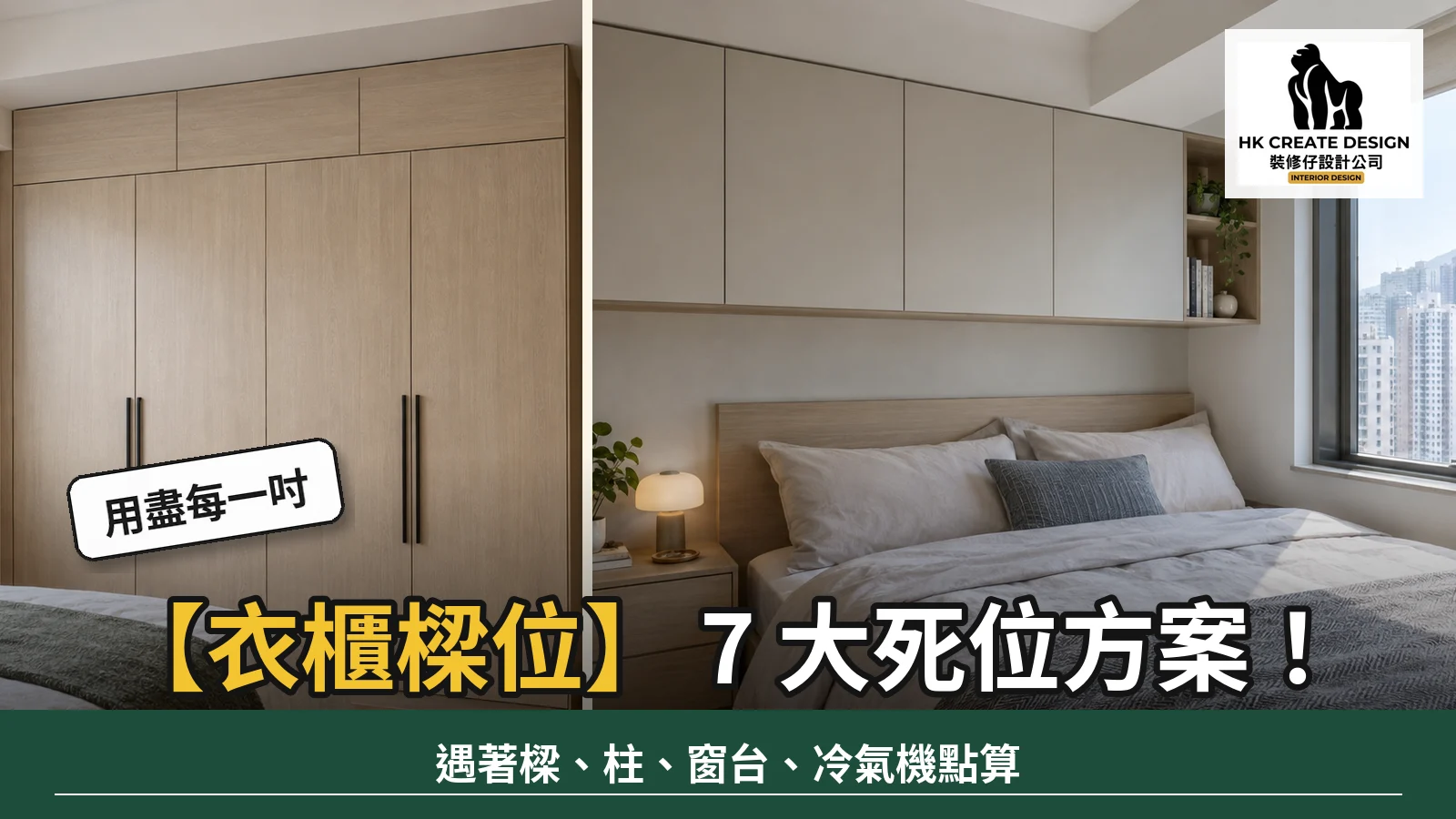
If a small room can only fit a 3 to 4 ft wardrobe, start by building to the ceiling for an extra tier of seasonal storage. Above 2,400 mm, add HK$100 per linear foot for every 100 mm[1].
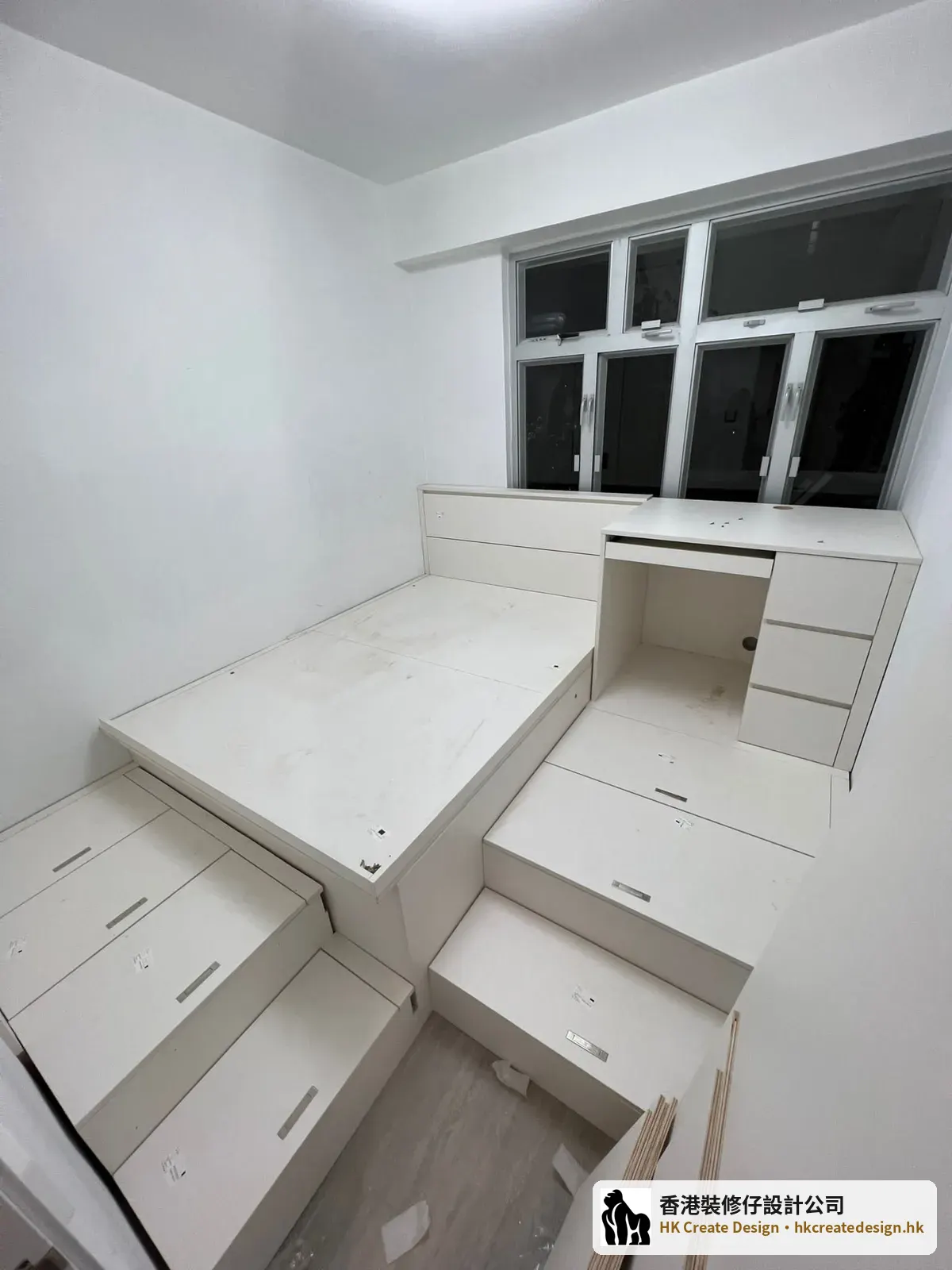
Second, combine it with aPlatform beds. Keep bedding and out-of-season clothes under the bed and reserve the wardrobe for the current season. Third, fit a wall cabinet above the bedhead or door for seldom-used items.
Fourth, use door backs and walls. Hang bags and jackets on door hooks and hats and scarves on wall racks. Fifth, sort clothes regularly. Review anything you have not worn in a year to keep the wardrobe from filling up.
- Full-height wardrobe
- Combine with a platform bed
- wall cabinets
- Hooks behind the door
- Sort clothes regularly
19
Plan a wardrobe with HK Create Design
Since 2019, HK Create Design has helped Hong Kong families design andBespoke furniture, with designers and tradespeople with over 15 years of experience. We provide whole-home layouts, ventilation, fire services, plumbing and electrical plans, furniture drawings, VR renderings and production drawings. The wardrobe drawing identifies every compartment.
ENF-grade panels are standard, and furniture comes with a one-year warranty. View panel and colour samples at Shop 16, G/F, Fu Yau Building, 61 Po Kong Village Road, Wong Tai Sin, Kowloon. On-site measurement is free for two or more work items through 31 December 2026. Otherwise it costs HK$500, credited against an order.
WhatsApp 5243 7747 with your room dimensions and an estimate of how many clothes you have. A designer can suggest an internal layout. The final price depends on site measurement and a written quotation.
- Since 2019
- Show each compartment on the drawing
- ENF-grade boards as standard
- One-year warranty
- WhatsApp 5243 7747
Advice from our tradespeople
「When I visit to measure up, I ask customers to open their current wardrobe. Seeing how much they hang and fold tells me how to divide up the new one.」
「Drawers blocked by sliding doors are a common problem. I line them up with the openings on the drawing and double-check the alignment before installation.」
FAQ
19 practical questions answered
01How should I divide the inside of a wardrobe?
Use four zones: long hanging, double rails for shorter items, shelves and drawers. Allocate space according to how much you hang and fold.
02What are the benefits of double hanging rails?
Double hanging rails provide roughly twice the capacity in one bay. Hang shirts and jackets above, trousers and skirts below.
03Is a 4 ft wardrobe big enough?
Generally sufficient for one person or a child. 4 × HK$2,900 = HK$11,600[1].
04How should two people divide a shared wardrobe?
Give each person one side. A central long-hanging area can be shared.
05Which fittings come with a standard wardrobe?
FUR05 includes 1 hanging rail, 3 shelves and 2 drawers.[1].
06Where is the best place for drawers?
Position drawers below the waist so the contents are visible when open. In a sliding wardrobe, keep drawers clear of door overlap.
07Should I add wardrobe lighting?
Lighting is recommended. Sensor strips cost HK$150 per linear foot and spotlights HK$310 each.[1].
08How can I prevent mould in a wardrobe?
Allow airflow, use moisture absorbers and run a dehumidifier during humid spring weather. Hong Kong's average relative humidity is about 78%[3].
09Should the shelves be adjustable?
Yes. Adjustable shelves allow changes in height as clothing and storage needs change.
10Are trouser racks and pull-down hanging rails worth adding?
Choose by need. Trouser racks may suit work trousers, while pull-down rails can help in taller wardrobes. Prices depend on the model.
11Where should suitcases be stored?
The upper section of a full-height wardrobe is useful for suitcases and bedding.
12What belongs on the top shelf of a wardrobe?
Store infrequently used items such as suitcases and winter bedding there. The top compartment can have its own doors.
13How should I rearrange my wardrobe between seasons?
Separate current and off-season clothes and swap their positions seasonally. Vacuum bags can hold coats and bedding, but avoid compressing down for long periods.
14How should a wardrobe for an older person be designed?
Keep everyday clothes between waist and shoulder height. Lower the hanging rail, use full-extension drawer runners and add sensor lighting.
15What if the wardrobe in a small room lacks space?
Build wardrobes to the ceiling, combine them with platform storage, add wall cabinets and hooks behind doors, and review clothing regularly.
16How should handbags be stored to keep their shape?
Stand bags upright on shelves, with room between them. Keep designer bags in their dust bags.
17Can shoes be stored in a wardrobe?
Prefer a shoe cabinet at the entrance to keep moisture and odours away from clothes. If shoes must go in the wardrobe, store them in boxes on the lowest shelf.
18Can I view panel samples in your showroom?
Yes. Panel samples are available at Shop 16, G/F, Fu Yau Building, 61 Po Kong Village Road, Wong Tai Sin.
19How long does a wardrobe take to make?
Production generally takes 2 to 4 weeks after you approve the production drawings. Installation is arranged afterwards, subject to scheduling.
CHECK THE BASIS
Data and technical basis, sources can be verified
- [1]HK Create Design published 2026 rates and work item descriptions Accessed: 2026-11-03
- [2]Blum: CLIP top BLUMOTION hinge system Accessed: 2026-11-03
- [3]Hong Kong Observatory climatological normals, 1991–2020 Accessed: 2026-11-03
- [4]Consumer Council, 15 December 2020 — disputes over renovation quality and the value of detailed contracts and regular follow-up Accessed: 2026-11-03
- [5]Housing Bureau: Housing in Figures 2026 Accessed: 2026-11-03
- [6]STC: China Market Watch (August 2021) on the new formaldehyde emission grading standard for wood-based panels and finishing products Accessed: 2026-11-03