01
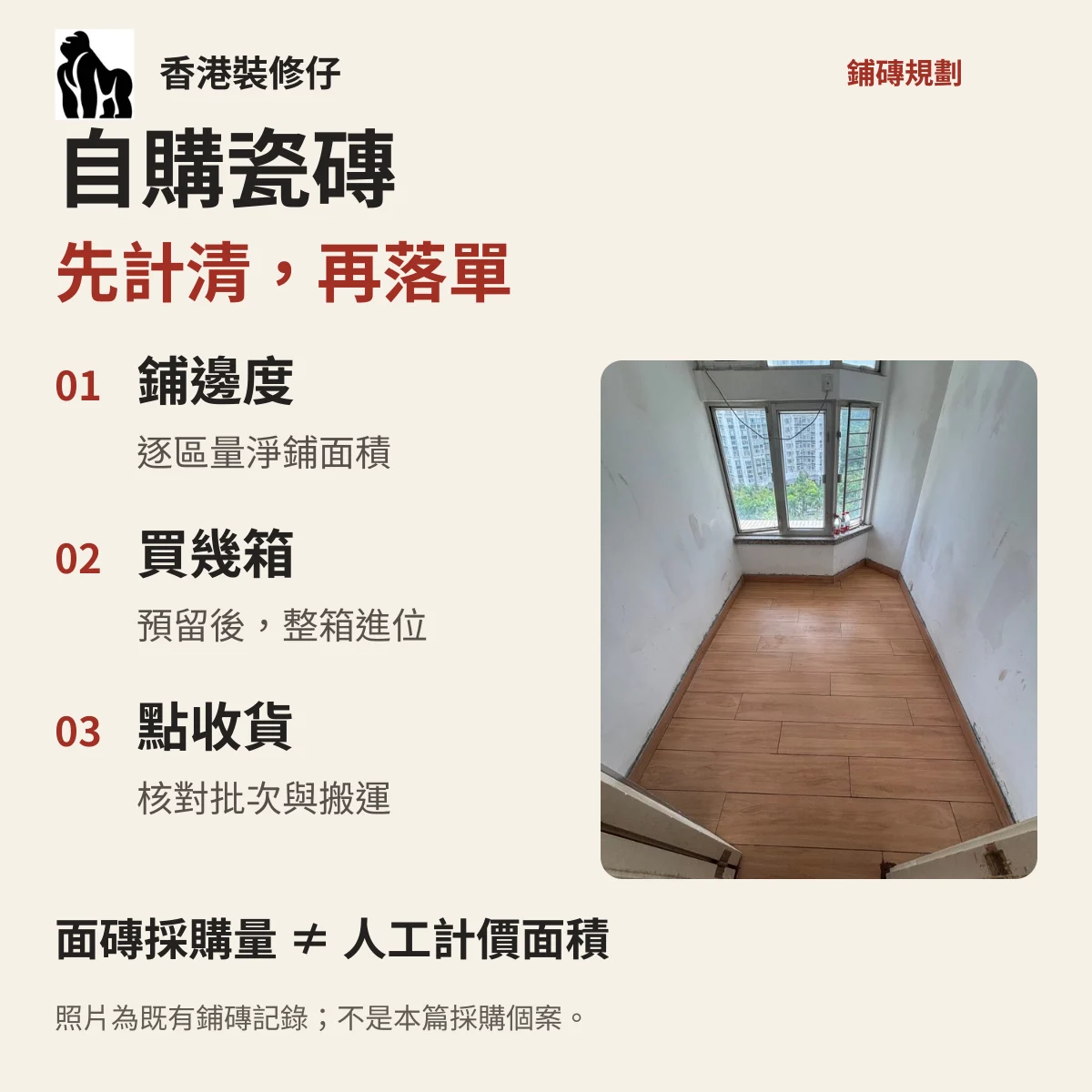
1. Mark the areas to tile before buying. Floor area alone does not give the order quantity
A flat may retain timber floors in some rooms, use different tiles in the kitchen and bathroom, and have walls, skirtings or thresholds to count separately. Mark each tile's location on a simple plan. List lengths, widths and separate items, and identify preliminary measurements and those the installer has verified.
For fixed cabinets, columns and irregular corners, confirm the actual installation limits before deducting any areas. The following checklist is an editorial purchasing worksheet, separate from construction drawings.
- List the model, floor or wall application and net tiled area for each zone.
- Record skirtings, thresholds, openings and any special pattern-matching requirements.
- Have the installer check quantities before confirming a non-returnable order.
You can swipe left or right on your phone to view the complete table.
| Item | Details to confirm | Who to check with |
|---|---|---|
| Installation scope | Location, net area and laying pattern for each tile model | Installer |
| Supply specifications | Model, dimensions, area per box and shade | Supplier |
| Allowances and spares | Cutting allowance, spare quantity and whole-box rounding | Installer and supplier |
| Delivery and bringing tiles inside | Date, delivery point, handling and recipient | Carrier and site coordinator |
Editorial handover checklist. Confirm actual company services separately.
02
2. Set the allowance from the tile layout. It varies by project
Cuts, breakage replacements and future repair spares serve different purposes. Record them separately. The Australian Tile Council recommends allowing for cuts, wastage and spares when confirming quantities. Complex layouts may need a larger allowance.[1]
An allowance used in a friend's flat may not suit yours. Straight, diagonal and herringbone layouts, edge shapes and sharing tiles between rooms all affect quantities. This article sets no company-wide wastage rate. Ask the installer to explain the allowance for your layout.
If the laying pattern is undecided, ask how long stock can be held, whether replenishment is from the same batch and what returns terms apply. Confirm the hold before relying on it.
03
3. Convert square metres to boxes, then round up at the end
Use the same units for the installer's measured area and the coverage shown per box. Use coverage confirmed by the supplier. Nominal tile dimensions alone cannot tell you how many pieces a box holds.
Record the allowance, box coverage and whole-box rounding separately
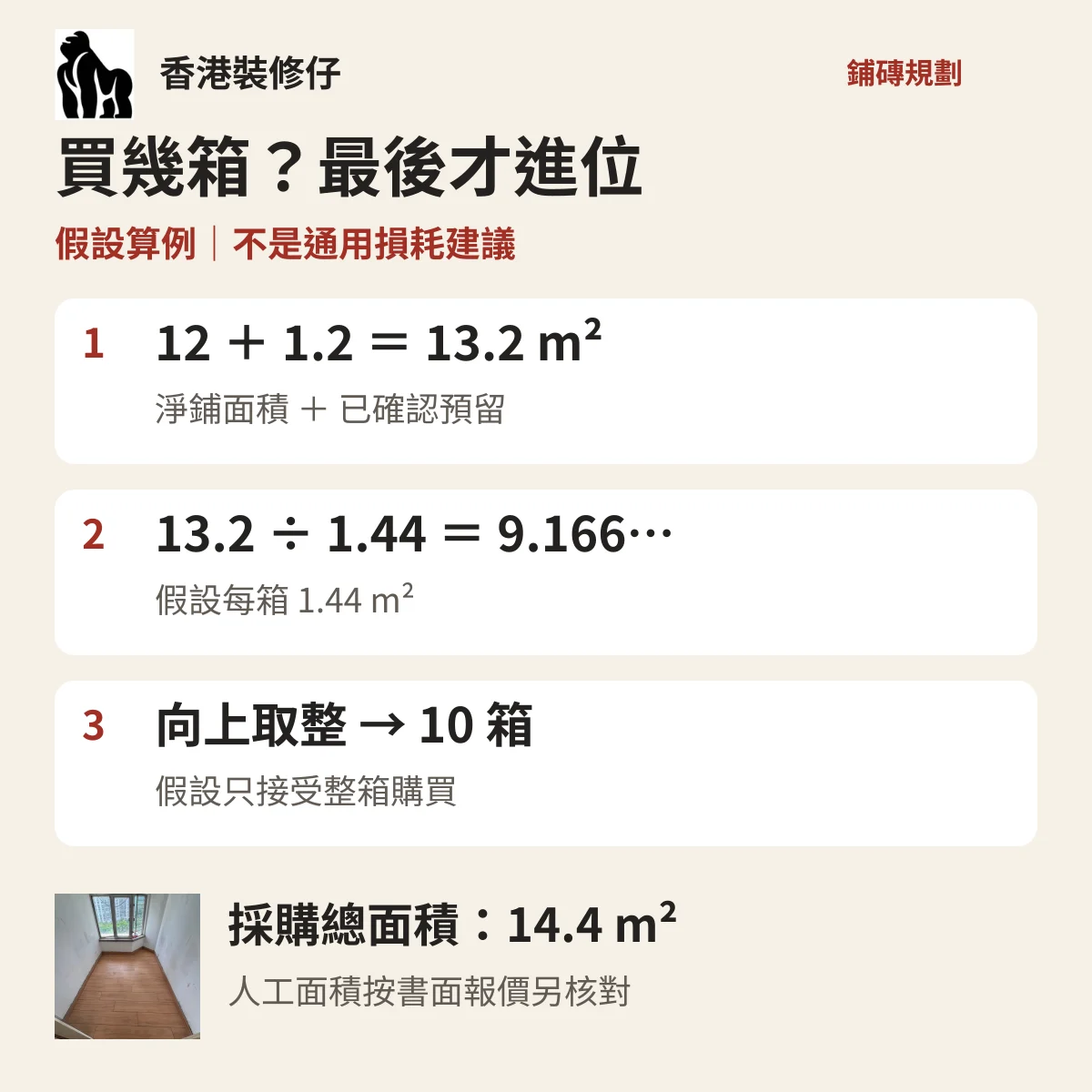
Add the net tiled area and confirmed allowance, divide by the area per box and round up to the next whole box. The allowance in the 12 m² example is hypothetical and may differ on another job.
If single tiles are available, record the terms and price separately. Calculate different models for separate rooms individually. Leftover coverage from one model may not be usable for another.
Worked example: how many boxes do you order for 12 m²?
Assumptions
- Net tiled area is 12 m². Assume that the installer confirms a combined 1.2 m² for cuts and spares.
- Assume 1.44 m² per box, sold in whole boxes only.
Checks to make
- Target purchase area: 12 + 1.2 = 13.2 m².
- 13.2 ÷ 1.44 = 9.166… boxes. Round up to 10 boxes.
- 10 × 1.44 = 14.4 m². Rounding up to whole boxes adds 1.2 m² beyond 13.2 m².
Buy 10 boxes totalling 14.4 m². The quotation determines the chargeable labour area separately.
Arithmetic example only. Actual packaging, prices and wastage vary. The actual site plan determines whether a 1.2 m² allowance is appropriate.
04
4. Check the shade and calibre as well as the model number
Marazzi describes shade as the colour batch and calibre as the size group, and recommends keeping these consistent when buying. Box code formats vary by manufacturer. Ask the supplier to identify the relevant fields.[2]
Photograph the full label for each model and match it to the order. If a code differs, ask the supplier and installer to check it. Phone photos alone cannot confirm shade. Set questionable tiles aside before installation.
For naturally patterned tiles or designs with deliberate variation, the display board shows just one possible appearance. Check the sample, product description and layout requirements when ordering. Individual tiles can differ.
05
5. Where will the delivery stop? Coordinate handling and work dates first
Treat the unloading point, lift or stairs, route into the flat and storage area as four separate questions. Have the carrier check package dimensions, weight and access. Let the appropriate personnel decide load sizes and storage locations.
Management delivery times may differ from permitted work hours. Check goods-lift bookings, the recipient and the contact for delays before scheduling delivery. Arrange adequate personnel before bringing a large quantity to site.
Ask each responsible party to confirm written charges for delivery, stair carrying, extra moves, waiting, replacement deliveries and returns. “Delivery included” can cover different services.
06
6. Check the delivery against the order and set questionable tiles aside
Check the model, box count, labels and visible damage against the order. Record the delivery time and affected box numbers. The Australian Tile Council recommends checking types, quantities and batches before installation and retaining box labels.[1]
Photograph damage, shortages or inconsistent batches. Set affected boxes aside and ask the supplier and installer to confirm how to proceed. Avoid mixing them to keep work moving. Sign only for what was actually checked and record any unopened boxes separately.
The actual order and both parties' agreement determine return terms, replacement deadlines and responsibility. This delivery checklist does not guarantee a supplier will accept a return.
Example delivery: 10 boxes arrive and 2 show obvious damage
Assumptions
- Assume an order for 10 boxes of the same model. On arrival, 2 boxes and some of the tiles inside show visible damage.
- The remaining 8 boxes have not been checked tile by tile.
Checks to make
- Record receipt of 10 boxes and visible issues with 2. The remaining 8 have still to be confirmed.
- Keep the affected boxes and photos of the labels. Ask the supplier and installer to check them and hold questionable tiles back from installation.
- Confirm the replacement batch, quantity and date. The installer can then adjust work in the affected area.
Record boxes received, boxes checked and usable quantities separately. The total usable quantity remains unconfirmed.
Hypothetical editorial example. The order terms govern replacement delivery, returns and responsibility. Free replacements are not promised.
07
7. How to compare client-supplied tiles with a supply-and-install quote
Buying finish tiles does not settle responsibility for all installation materials. Specify who supplies adhesive, grout, trims, cutting, holes and handling to avoid omissions or duplicate charges. The Consumer Council recommends listing items, quantities, unit rates and line-item charges so the total can be checked.[3]
Buying 14.4 m² of tiles does not set the labour charge at 14.4 m². Labour may follow the actual installed area, work scope or another agreed basis. Equally, purchase allowances can include usable spares as well as waste. Give each its own column in the quote.
To compare labour charges and exclusions, see Tiling prices and quote breakdown. For handling and finishing large tiles, see Laying large-format floor tiles.
You can swipe left or right on your phone to view the complete table.
| Item | Client-supplied finish tiles | Supply-and-install option |
|---|---|---|
| facing tiles | List supplier, model, quantity and selling price | List the included brands, models or range of choices |
| Installation materials and accessories | Confirm bedding materials, grout and edge finishing individually | Check inclusions and extras item by item |
| Delivery and handling | Name the person receiving the delivery and the person moving it inside | Confirm the delivery endpoint included |
| Replenishment and variations | Confirm the contact, costs and schedule arrangements | Agree on written approval for work beyond the original scope |
This table explains how to compare options. Actual prices, return rights and responsibilities depend on the order. [3]
08
8. Send five details together before enquiring about installation
Prepare the work location, approximate area, package details, access situation and preferred date. State whether the tiles have been bought, are still to be bought or await supplier confirmation. There is no need to remove tiles or cabinets or make openings for an enquiry.
The WhatsApp button below opens a draft. The company receives it only when you press send. You can first ask about Masonry and tiling services the work we can take on. Confirm tile suitability, installation and price on site and in the written quote.
- Installation location and approximate area. Note if it has not yet been measured.
- Tile model, dimensions, thickness and coverage per box.
- Order status, model number and batch details.
- Floor level, goods lift or stairs and restrictions on access into the flat.
- Preferred work date and whether anyone will occupy the flat.
FAQ
6 practical questions answered
01Can I buy floor tiles based on my flat's saleable area?
Avoid calculating directly from the floor area. Identify the actual installation areas, tile types and separate items, then have the installer check quantities.
02Is an extra 10% always enough?
There is no project-wide standard percentage. Layout, cuts and spare requirements vary. Ask the installer to explain the quantities.
03Does coverage per box always equal nominal length × width × number of pieces?
Order using coverage per box confirmed by the supplier and packaging. Check units and pieces per box. An online product name alone is insufficient.
04Will replacements with the same model number always be the same colour?
Possibly. Check shade and calibre as well. Keep the box label and ask the supplier what batches and quantities are available.
05Are client-supplied tiles always cheaper than supply and installation?
Compare delivery, carrying, replenishment and included installation materials as well as the tile price.
06Can I return leftover unopened boxes?
Check the supplier's actual returns terms. Before ordering, record the deadline, packaging requirements and any fees.
CHECK THE BASIS