01
Choose a paint range to suit the use
The right paint depends on the wall. Within one brand, standard interior, moisture-resistant, anti-mould, children’s and budget ranges can differ in coverage, recoating times, certifications and price. Before comparing brands, identify the condition of the wall, its purpose and your budget.
For example, Nippon Paint’s technical data gives 13 to 15 m² per litre per coat for 2nd Generation Super 5-in-1[9], compared with 8.5 to 10.5 m² per litre for Dulux Baby Paint Emulsion[18]. Lower coverage may reflect a different formulation or intended use. It affects quantities and cost, so check both when comparing quotations.
HK Create DesignPaintingWe mainly use Nippon Paint and Dulux. Our E01 stripping and skim coating specification also names these two brands[1]. The comparison below uses public manufacturer specifications and covers the properties of each range.
- Assess the wall condition and intended use first
- Ranges from the same brand can differ considerably
- Coverage affects quantity and cost
You can swipe left or right on your phone to view the complete table.
| Range | Manufacturer’s intended use | Theoretical coverage per coat | Recoat interval | Recommended coats |
|---|---|---|---|---|
| Nippon Paint 2nd Generation 5-in-1 | Multi-purpose matt interior emulsion | 13–15 m²/L | 2–3 hours | 1 sealer coat + 2 topcoats [9] |
| Nippon Paint Odour-less 5-in-1 (Moisture-Proof) | Moisture-resistant interior emulsion | 13–14 m²/L | 2 hours | 2 coats [10] |
| Nippon Paint Odour-less 2-in-1 | Budget interior emulsion | 12 m²/L | 2 hours | 2 coats [11] |
| Nippon Paint Odour-less Kids Paint | Matt paint for children’s rooms with computerised tinting | 13–14 m²/L | 2–3 hours | 2 coats [13] |
| Dulux Pentalite Upgrade | Standard matt interior emulsion | 13–16 m²/L | 2–3 hours | 2 coats [17] |
| Dulux Odourless Anti-mould 5-in-1 | Low-odour anti-mould interior paint | 13–16 m²/L | 2–3 hours | 2 coats [19] |
| Dulux Baby Paint | For children’s rooms, with several certifications listed | 8.5–10.5 m²/L | 2–3 hours | 2 coats [18] |
Figures are from the manufacturers’ websites or data sheets as accessed on 3 November 2026. Manufacturers may update their specifications. [9][10][11][13][17][19][18]
02
Common interior paint ranges in Hong Kong: manufacturer specifications
Nippon Paint 2nd Generation Super 5-in-1 is a multi-purpose matt interior emulsion. Its technical data recommends one sealer coat and two topcoats, with 2 to 3 hours between coats at 25°C and 7 days for full cure[9]. Odour-less 5-in-1 (Moisture-Proof) covers 13 to 14 m² per litre and can be recoated after 2 hours[10]. The budget Odour-less 2-in-1 range covers 12 m² per litre and allows recoating after 2 hours[11].
Nippon Paint Odour-less Kids Paint covers 13 to 14 m² per litre, with two coats recommended. It is touch-dry in 60 minutes and recoatable in 2 to 3 hours. The matt finish is available with computerised tinting. The manufacturer lists GREENGUARD Gold and A+ credentials[13].
Dulux’s Hong Kong product page describes Pentalite Upgrade Emulsion Paint as matt, with theoretical coverage of 13 to 16 m² per litre, touch-dry in 0.5 to 1 hour, recoatable in 2 to 3 hours and two coats recommended. Dark or vivid colours may need additional coats[17]. Dulux lists coverage of 13 to 16 m² per litre for Odourless Anti-mould 5in1 and a recoating interval of 2 to 3 hours[19]. Dulux Baby Paint Emulsion covers 8.5 to 10.5 m² per litre. The manufacturer lists the Hong Kong Green Label and GREENGUARD Gold among its certifications[18].
- Nippon Paint: 5-in-1, moisture-resistant, 2-in-1 and children’s ranges
- Dulux: Pentalite, Anti-mould 5in1 and Baby Paint Emulsion
- Refer to the manufacturer’s stated certifications
03
Choose by use: standard rooms, damp-prone areas, children’s rooms or budget repainting
Living rooms and bedrooms with sound walls usually only need standard or multi-purpose interior emulsion. Preparation matters. E03 direct repainting is HK$12 per sq ft for sound walls, while E02 local crack repairs are HK$21 per sq ft[1].
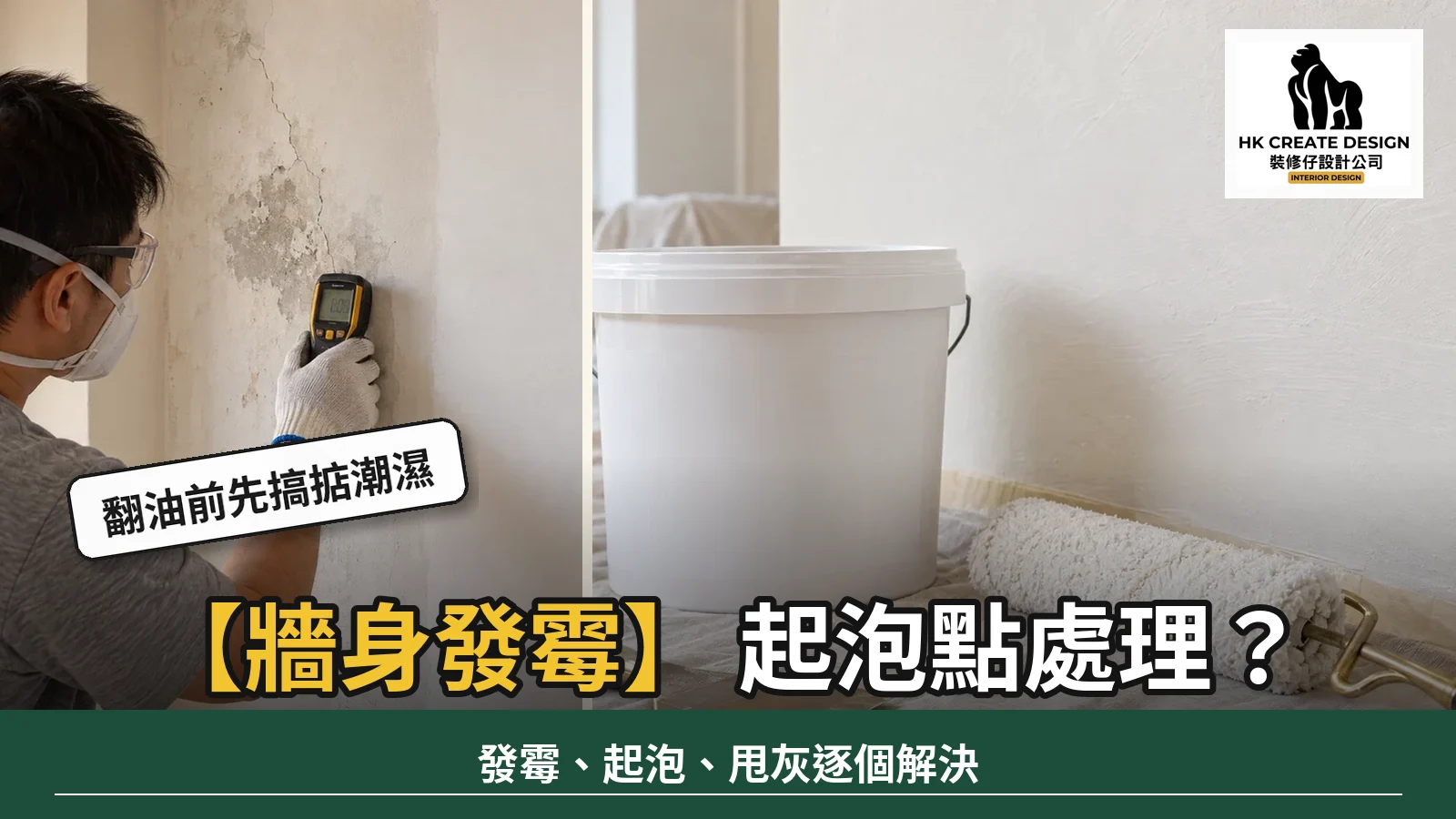
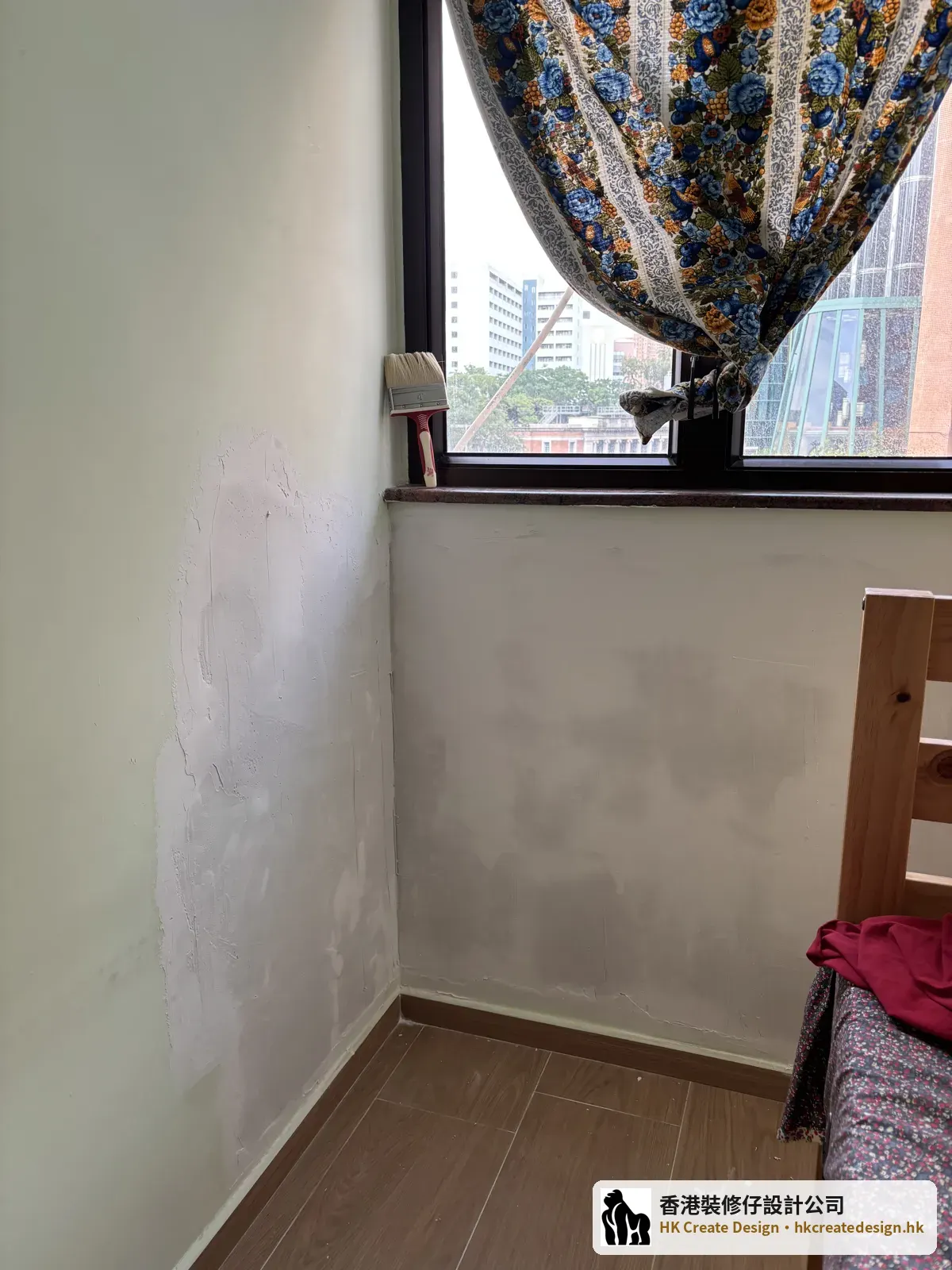
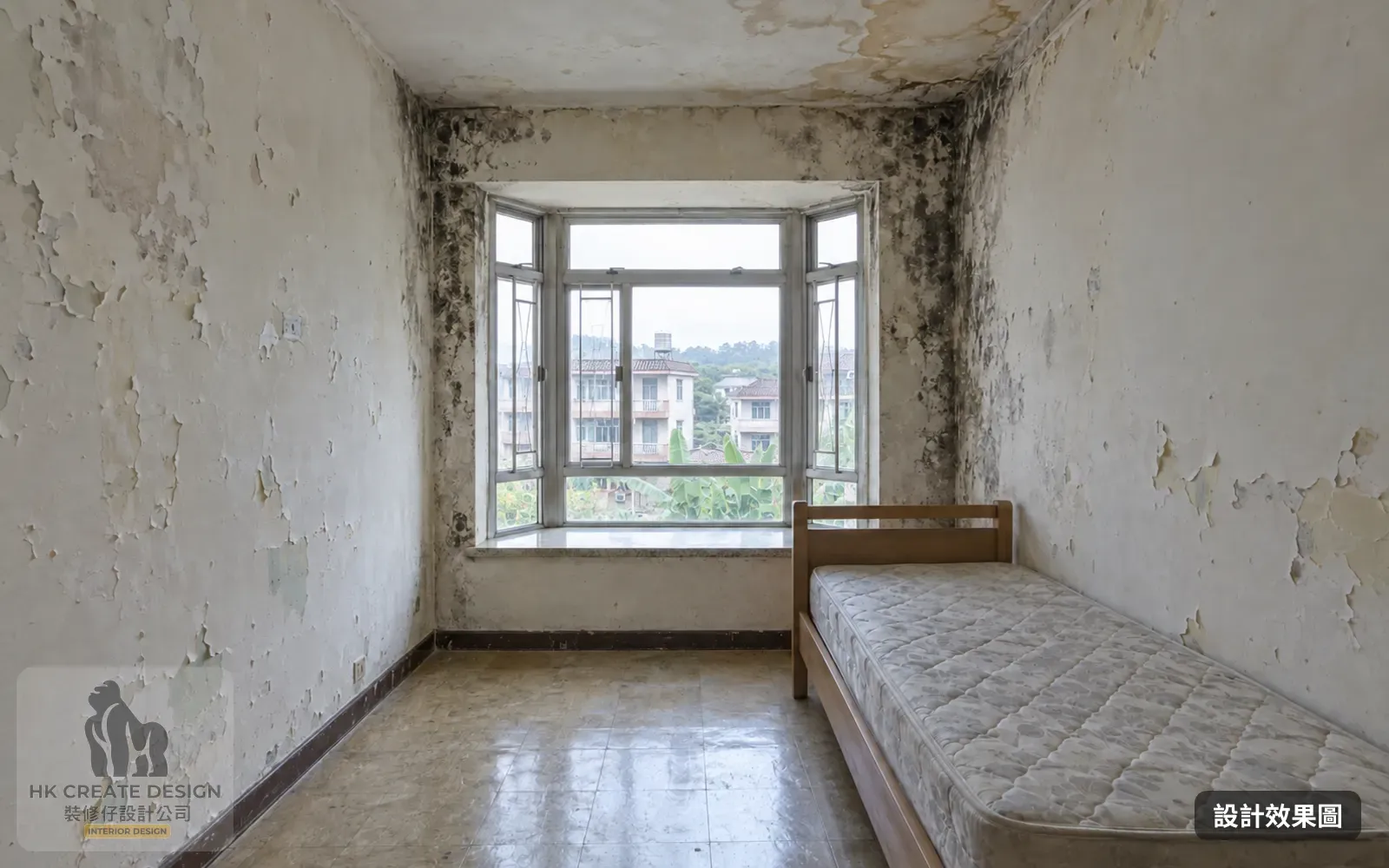
Window edges, inside faces of external walls and areas behind wardrobes are prone to damp. Consider moisture-resistant or anti-mould paint, but address any seepage first. The Buildings Department lists drains, water supply pipes, floor waterproofing and rainwater as common sources[7]. Repair any seepage at its source first. Changing the paint cannot resolve the underlying problem.
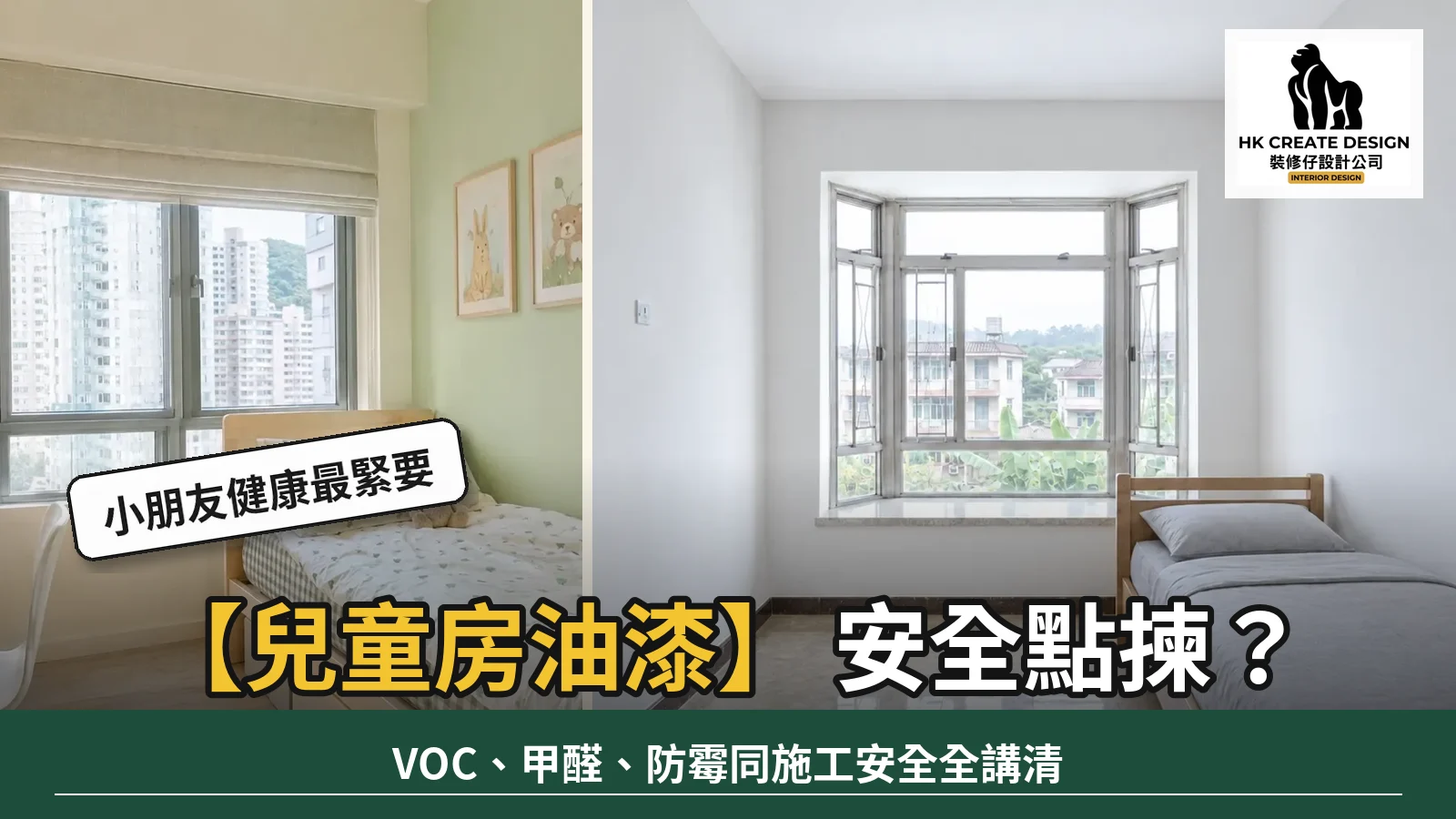
Both brands have ranges for children’s rooms. Upgrading E01–E03 painted surfaces to Nippon Paint children’s paint costs an extra HK$4 per sq ft[1]. See our separate guide to paint safety in children’s rooms.
For rentals or a limited budget, consider an economy range such as Nippon Paint Odour-less 2-in-1, with coverage of 12 m² per litre[11]. Budget products have fewer special features and can suit a simple colour change on walls in good condition.
- For ordinary rooms, wall preparation matters most
- Address seepage first in damp areas
- Children’s paint is an option for a child’s room
- Budget ranges can suit economical repainting
「Choose the range for the surface: anti-mould finishes for kitchens and bathrooms, low-VOC products for children’s rooms and washable finishes for halls and door frames. Entry-level and premium products from one brand can differ considerably.」
04
What else needs to be considered for different walls and locations?
Fresh cement-sand render is alkaline. Let it dry thoroughly before sealing and priming. Nippon Paint specifies substrate pH below 10 and moisture content below 6%[9]. These substrate conditions apply whatever topcoat you choose. Our B01 wall rendering rate is HK$43 per sq ft, minimum HK$2,350. Painting costs extra[1].
For former tiled walls in an old kitchen or outside a bathroom, B05 prepares the surface for painting at HK$31 per sq ft. Painting costs extra[1]. Such walls usually need a skim coat to level them. A moisture-resistant topcoat may be suitable once you have confirmed there is no seepage.
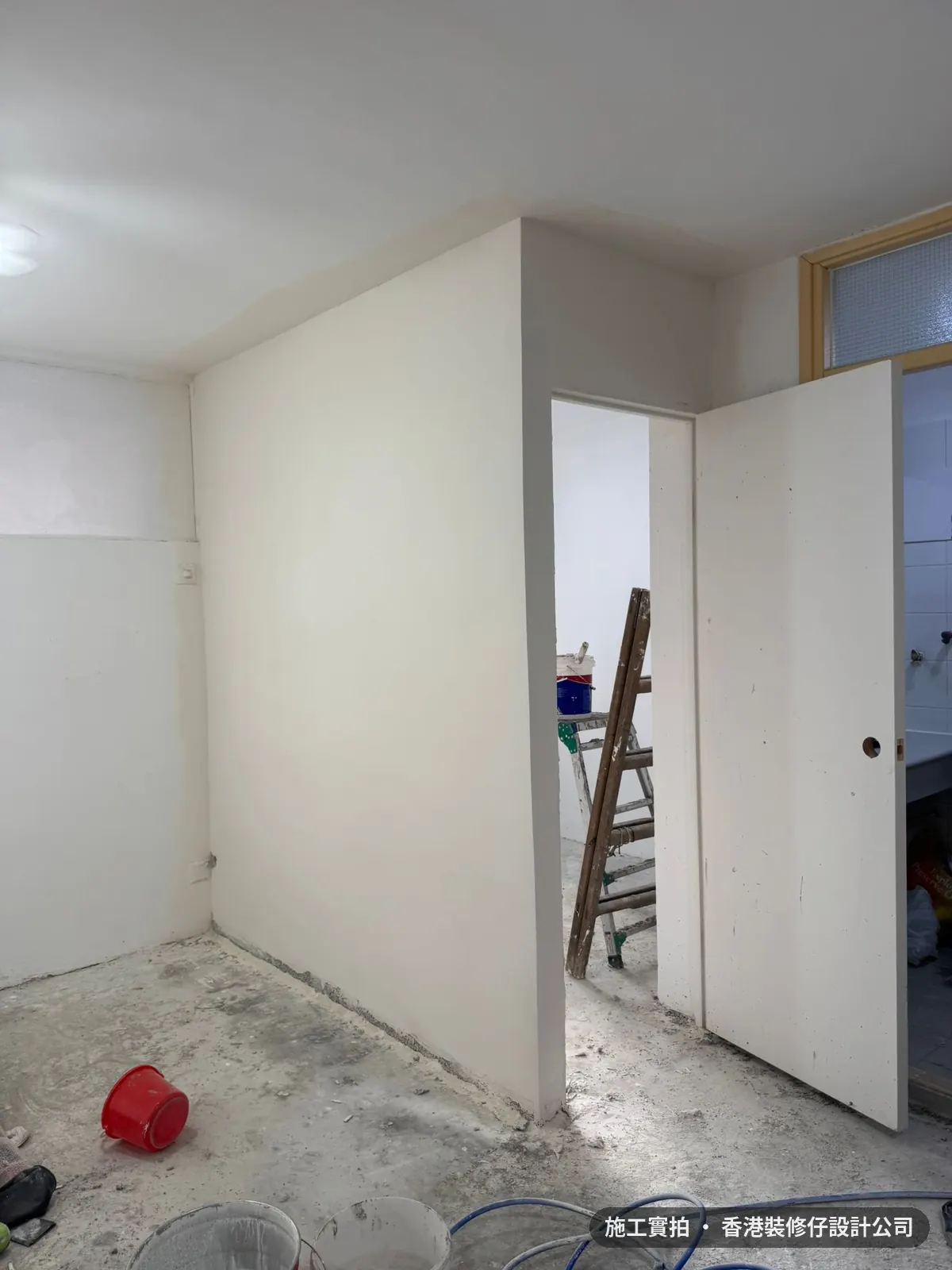
Old emulsion walls can be repainted directly if the existing paint is sound and free of peeling. Nippon Paint specifies cleaning the old film and removing any loose or unstable coating[9]. Changing ranges, for example from standard to anti-mould paint, usually only requires cleaning and sanding if the substrate is sound.
Ceilings receive little contact, so matt finishes are common. Check for upstairs seepage where steam gathers near kitchens and bathroom entrances. The Buildings Department lists damage to upstairs drains, supply pipes or floor waterproofing among possible sources of ceiling seepage[7].
Timber doors and frames need a separate coating system. E04 costs HK$1,650 per door-and-frame set[1]. Use a suitable timber coating on doors instead of wall emulsion.
- Allow new render to dry, then seal it
- Skim after converting a tiled wall to a painted finish
- Timber doors need a different coating system
Example 1: how many litres of topcoat does a 500 sq ft flat need?
Assumptions
- Flat saleable area: 500 sq ft. Our quick method multiplies by 3 to estimate the paintable area [1].
- 1 m² = 10.764 sq ft.
- Two topcoats, calculated using the manufacturers’ theoretical coverage [9][18].
How to calculate quantities
- Estimated paintable surface area: 500 × 3 = 1,500 sq ft.
- Convert to square metres: 1,500 ÷ 10.764 ≈ 139.4 m².
- Total area over two coats: 139.4 × 2 ≈ 278.7 m².
- At 13–15 m²/L: 278.7 ÷ 15 ≈ 18.6 litres, up to 278.7 ÷ 13 ≈ 21.4 litres.
- At 8.5–10.5 m²/L: 278.7 ÷ 10.5 ≈ 26.5 litres, up to 278.7 ÷ 8.5 ≈ 32.8 litres.
For the same home, theoretical quantities can range from about 18.6 to 32.8 litres, depending on product coverage.
Excludes primer, wastage, substrate absorbency and any extra coat for a dark-to-light change. Confirm quantities on site. [1][9][18]
05
How to check coverage and the quantity of paint needed
Coverage tells you how many square metres one litre can cover in one coat. Required litres = paintable area (m²) × number of coats ÷ coverage (m²/L). Our quick estimate uses saleable area × 3 for the paintable surface[1], then divide by 10.764 to convert to square metres.
For a 500 sq ft flat, estimated paintable area is 1,500 sq ft, or about 139.4 m². Two coats cover about 278.7 m² in total. At 13 to 15 m² per litre, the theoretical quantity is approximately 18.6 to 21.4 litres[9]. At 8.5 to 10.5 m² per litre, about 26.5 to 32.8 litres are needed[18].
Coverage figures assume ideal conditions. Fresh skim coat absorbs more paint, dark-to-light changes may need another coat, and rollers and brushes create wastage. Specify the range and number of coats in the quote as well as the tin quantity.
- Area × number of coats ÷ coverage
- 1 m² = 10.764 sq ft
- Allow for wastage on top of the theoretical quantity
You can swipe left or right on your phone to view the complete table.
| Purpose | Types of range to consider | Confirm before choosing | Related company price items |
|---|---|---|---|
| Living rooms and standard bedrooms | Multi-purpose or standard interior emulsion | Can the wall be repainted directly or does it need repairs? | E03 HK$12 per sq ft; E02 HK$21 per sq ft |
| Window edges, inside faces of external walls and other damp-prone areas | Moisture-resistant or anti-mould range | Is there seepage, and has the source been repaired? | E05 Treat localised mould and repaint: HK$1,250 per face |
| children's room | Children's paint series | Could a child chew loose paint, and is a particular colour needed? | Nippon Paint children’s paint upgrade +HK$4 per sq ft |
| Rental flats and budget repainting | Budget interior emulsion | Mostly sound walls with only ageing or marks | E03 HK$12 per sq ft, minimum HK$3,700 |
Company rates are from our published price list [1]. Suggested ranges reflect the manufacturers’ intended uses. Other ranges may also be suitable. [1]
06
VOCs, environmental labels and safety: what do the official figures show?
Environmental Protection Department VOC limits for regulated architectural paints, in g/L: matt coatings 50, non-matt coatings 150, primers, sealers and undercoats 200, waterproofing sealers 250, and rust-preventive coatings 400[2]. Regulated matt interior paint sold in Hong Kong must meet the 50 g/L VOC limit.
In CHOICE issue 457 (2014), the Consumer Council tested 10 water-based emulsions. VOC content ranged from below 10 g/L in six samples to 25 g/L, all below the 50 g/L limit. Four brands had trace lead at 20–38 ppm, and one had trace arsenic at 2.1–2.5 ppm. All met the environmental label requirements[6]. The Consumer Council advises ventilating while painting and keeping leftover paint out of drains[6].
The Environmental Protection Department recommends low-VOC or water-based paint and notes that lower-gloss coatings tend to contain fewer VOCs[3]. A matt range is generally a suitable starting point if odour and VOC content are concerns.
- Matt coating limit: 50 g/L
- All samples in the Consumer Council test met the limit
- Lower-gloss paint generally contains fewer VOCs
07
Matt, silk or semi-gloss: choosing a sheen
Matt finishes are popular on Hong Kong residential walls because they conceal minor imperfections and have a lower VOC limit[2]. Dulux explains that dark, matt and rough surfaces tend to have lower light reflectance values (LRV), while light, glossy and smooth surfaces tend to have higher values[20].
Glossier paint is easier to wipe but highlights uneven surfaces, so it requires careful skimming and sanding. Washable finishes can suit frequently touched kitchen or corridor walls. Matt finishes usually suffice in bedrooms and living rooms.
For more on how colour and light reflection affect small flats and north-facing rooms, see ourPaint coloursguide.
- Matt finishes conceal imperfections and have a lower VOC limit
- Gloss is easier to clean but highlights uneven surfaces
- Light, smooth surfaces reflect more light
08
Primer, sealer and skim coat: the layers underneath the topcoat
The coating system depends on a sound substrate. We use Kangaroo water-based sealer before and after skimming. The manufacturer describes it as quick-drying, resistant to acids and alkalis, suitable for both stages and carrying the Hong Kong Green Label[15]. The skim coat is ready-to-use Nippon Paint Odour-less Wall Putty, with 2 to 3 coats recommended[12]. For deeper skim coats we use Optimix SC273 cement-based skim coat at 1 to 3 mm per layer, with VOC content no more than 10 g/L[16].
Nippon Paint Odour-less Primer is recommended in one coat, with at least 2 hours before recoating[14]. Old walls and new render may need an alkali-resistant or multi-purpose primer.Waterproofing, our painters select waterproofing materials such as Sika products to suit the location before painting.
The full sequence is stripping and cleaning, initial sealing with water-based sealer, skimming, resealing, priming and topcoating. Specify the material for each layer in the quotation, including the topcoat.
- Specify sealer, skim coating and primer
- The topcoat is only the final layer
- Sequence: initial sealer, skim coat, reseal, prime and apply topcoats
Example 2: repainting a 120 sq ft child's room with a children's paint upgrade
Assumptions
- Room saleable area: 120 sq ft. Estimated paintable surface: 360 sq ft.
- Sound walls: E03 direct repainting at HK$12 per sq ft plus HK$4 per sq ft for a Nippon Paint children’s paint upgrade [1].
- Nippon Paint Odour-less Kids Paint covers 13–14 m²/L, with 2 coats recommended [13].
How to calculate quantities
- Work cost: 360 × (HK$12 + HK$4) = 360 × HK$16 = HK$5,760.
- The E03 minimum charge is HK$3,700. The calculated HK$5,760 exceeds it.
- Paintable area: 360 ÷ 10.764 ≈ 33.4 m². Two coats cover about 66.9 m² in total.
- 66.9 ÷ 14 ≈ 4.8 litres, up to 66.9 ÷ 13 ≈ 5.1 litres.
Estimated work cost: HK$5,760. Theoretical topcoat quantity: about 4.8–5.1 litres.
If the wall needs repairs or stripping, use E02 or E01. Dark-to-light changes cost extra. [1][13]
09
How should the brand and range appear in the quotation?
The Consumer Council recommends stating whether a supply-and-apply quote includes primer and topcoats and listing the coat counts separately. Only four contractors in its review supplied this level of detail[4]. Specify stripping for old walls, and corner beads, skim coats and paint coats for new walls. Special-function paints may carry a supplement[4].
Another Consumer Council study reported 1,205 renovation complaints from 2017 to 2023. It found that 49% of quotations lacked detail and 58% of respondents found the quotation formats difficult to compare[5]. Specifying the brand and range gives you a basis for comparing two quotations.
For a labour-only job using owner-supplied paint, agree beforehand on the exact range and litres required, who handles leftover paint and what the warranty covers.
- Specify the range and coat count
- Specify whether stripping old walls is included
- Clarify the warranty if supplying your own paint
You can swipe left or right on your phone to view the complete table.
| Range | coverage rate | Total area for two coats | Theoretical quantity |
|---|---|---|---|
| Nippon Paint 2nd Generation 5-in-1 | 13–15 m²/L | 278.7 m² | About 18.6–21.4 litres |
| Dulux Pentalite Upgrade | 13–16 m²/L | 278.7 m² | About 17.4–21.4 litres |
| Nippon Paint Odour-less 2-in-1 | 12 m²/L | 278.7 m² | About 23.2 litres |
| Dulux Baby Paint | 8.5–10.5 m²/L | 278.7 m² | About 26.5–32.8 litres |
Paintable surface: 500 × 3 = 1,500 sq ft ÷ 10.764 ≈ 139.4 m², or approximately 278.7 m² for two coats. This estimate covers topcoat only and excludes primer and wastage. Coverage rates come from the manufacturer. [9][17][11][18]
10
What do manufacturers, the Consumer Council and the Environmental Protection Department say?
Check the manufacturer’s technical data when choosing a range. Nippon Paint requires a clean, dry substrate with moisture below 6% and pH below 10, and repair of all seepage before painting[9]. Whichever brand you choose, prepare the wall until it meets the product requirements before painting.
Consumer Council tests found VOC levels in water-based emulsion paints generally well below the limit, although traces of heavy metals were detected. Ventilate during application[6]. The Department of Health’s Centre for Health Protection says some paint may contain lead. Remove peeling paint promptly and keep children from chewing flakes[8].
The Environmental Protection Department advises ventilating through windows and sealing the front door with tape or a damp towel. Keep leftover paint and solvents, which are chemical waste, out of drains. Fully dried paint can be disposed of as general waste[3].
- Paint only when the manufacturer’s conditions are met
- Maintain ventilation
- Keep leftover paint out of drains
Example 3: address damp at the window before choosing a moisture-resistant paint range
Assumptions
- Room saleable area: 150 sq ft. Estimated paintable surface: 450 sq ft.
- Loose filler beside the window needs E02 local repairs at HK$21 per sq ft [1].
- The window area has no ongoing seepage. Use a moisture-resistant topcoat.
How to calculate quantities
- Work cost: 450 × HK$21 = HK$9,450, above the minimum charge of HK$4,650.
- Area: 450 ÷ 10.764 ≈ 41.8 m², or about 83.6 m² for two coats. At 13–14 m²/L [10], that requires roughly 6.0–6.4 litres.
- If the window area still leaks, repair the window waterproofing before painting.
Estimated work cost: HK$9,450. A moisture-resistant finish can be used after the source of seepage has been addressed.
Repairs to the seepage source, such as window resealing or waterproofing, are quoted separately. The Buildings Department lists drains, supply pipes, floor slab waterproofing and rainwater as common sources [7]. [1][10][7]
11
Five common misconceptions when choosing paint
First, assuming all ranges from one brand have the same price and performance. Second, relying on anti-mould paint to solve seepage, only to find mould returning months later. Third, comparing tin prices without checking coverage and coat count.
Fourth, a quote saying only “Nippon Paint, Dulux or equivalent” leaves the range open. Fifth, forgetting the extra coat for a dark-to-light change can leave the old colour showing through. Our supplement is HK$4 per sq ft for one extra topcoat[1].
Compare the brand, range, coat count, primer, skim coating and stripping area on a like-for-like basis.
- Name the exact range
- Anti-mould paint cannot resolve seepage
- Compare coverage and the number of coats
12
How to verify that the specified paint was used
Check the paint cans at the start against the agreed brand, range and colour code. Keep a small amount for touch-ups. Inspect the finished surface under light from the side for show-through, trowel marks or roller marks.
For children’s rooms or specialist ranges, keep a photo of the can label. The same range and colour code make future touch-ups easier to match.
Our painting work has a one-year warranty covering cracking, blistering and peeling, except deliberate damage. Non-paint defects caused by leaks or seepage are excluded. We can provide a separate repair quote at a preferential rate.
- Check the paint cans at the start
- Keep a small quantity for touch-ups
- Specify the warranty coverage
You can swipe left or right on your phone to view the complete table.
| Item | Why specify it? | Example wording |
|---|---|---|
| Brand and range | Products within one brand differ in price and performance | Nippon Paint 2nd Generation 5-in-1 |
| Primer and topcoat counts | The Consumer Council found that few quotations listed these separately [4] | 1 sealer coat and 2 topcoats |
| Does the quote include stripping old walls? | Stripping and direct repainting are different scopes of work [4] | Strip loose old paint back to the plaster |
| Colour and colour code | A dark-to-light change may need an extra coat | Colour code; allow an extra coat when changing from dark to light |
| Special-function paint | Anti-mould or children’s paint may cost extra [4] | Children’s paint upgrade for bedrooms |
Based on the Consumer Council’s recommendations for renovation quotations. [4]
13
How we help you choose paint
The HK CreateDesign team has over 10 years of project experience. At measurement we assess the wall condition, moisture and intended use, recommend a range, and specify the brand, range, primer and topcoat counts in the quote. In addition to painting,Masonry and tiling, waterproofing,Whole-flat renovationandOlder flat renovationcan be arranged together.
Measurement arrangements are as follows. On-site measurement is free through 31 December 2026 for two or more work items, with no deposit. After that, the HK$500 fee is credited against the order.
For a free quotation from the HK Create Design team, WhatsApp 5243 7747 or visit our Wong Tai Sin shop, Monday to Saturday, 10:00–18:00.
- Assess the wall before choosing a range
- Specify the range and coat count in the quotation
- Coordinate painting, plastering and waterproofing
Advice from our tradespeople
「Choose the range for the surface: anti-mould finishes for kitchens and bathrooms, low-VOC products for children’s rooms and washable finishes for halls and door frames. Entry-level and premium products from one brand can differ considerably.」
「Choose colour and sheen together. Matt finishes conceal imperfections better but can be harder to wipe. Eggshell is easier to maintain and can suit small-flat corridors and children’s rooms.」
「We record the brand, range and colour code in the quote and leave the remaining paint with the client for matching future touch-ups.」
FAQ
14 practical questions answered
01Can topcoat be applied directly to a newly rendered wall?
Allow new render to dry fully. Once moisture is below 6% and pH below 10, seal and prime[9].
02What should I do with leftover paint?
Keep paint out of drains and toilets. The Environmental Protection Department says fully dried paint can go in general waste and small amounts of household leftover paint can be disposed of with household refuse[3]. Ask the HK Create Design painter to set aside some matching paint for touch-ups.
03Which should I choose, Nippon Paint or Dulux?
Both brands offer several ranges. Choose by intended use. Our E01 stripping and skim coating specification names Nippon Paint or Dulux[1]. We recommend a system to suit the wall condition.
04Why does paint coverage matter?
Coverage determines quantity. Two topcoats in a 500 sq ft flat take about 18.6–21.4 litres at 13–15 m²/L or around 26.5–32.8 litres at 8.5–10.5 m²/L[9][18].
05Can anti-mould paint solve a mould problem?
It can reduce surface mould growth. If seepage is the cause, repair the source first[7], then strip and refinish the surface.
06Does a child's room need children's paint?
It is optional. Both brands offer ranges for children’s rooms and list several certifications[13][18]. Our Nippon Paint children’s paint upgrade adds HK$4 per sq ft[1].
07Does Hong Kong regulate VOCs in paint?
Yes. The Environmental Protection Department sets VOC limits of 50 g/L for matt and 150 g/L for non-matt coatings[2].
08Is a matt or a gloss finish preferable?
Matt finishes are popular on residential walls because they help conceal small imperfections and have a lower VOC limit[2]. Glossy paint is easy to clean but highlights uneven surfaces.
09Is economy paint lower in quality?
Budget ranges have fewer special features and suit sound walls. For example, Nippon Paint Odour-less 2-in-1 covers 12 m² per litre[11].
10Can I buy paint myself for the painter to apply?
Yes. Agree on the range, quantity, leftover paint arrangements and warranty scope in advance.
11Is one 5-litre tin of paint enough for a room?
A 120 sq ft room has about 360 sq ft of paintable surface. Two coats cover about 66.9 m² in total, requiring roughly 4.8–5.1 litres of paint at a spread rate of 13–14 m²/L[13], before wastage.
12Can paint contain lead?
A 2014 Consumer Council test found traces of lead in some emulsion paints, within the applicable environmental label requirements[6]. The Centre for Health Protection advises removing peeling paint[8].
13Is “or equivalent” enough in a quotation?
Specify the brand and range. The Consumer Council recommends a quotation that identifies the materials and coat counts[4].
CHECK THE BASIS
Data and technical basis, sources can be verified
- [1]HK Create Design 2026 detailed renovation estimates and published prices (117 items) Accessed: 2026-11-03
- [2]Environmental Protection Department: Volatile organic compound content limits for regulated construction paints Accessed: 2026-11-03
- [3]Environmental Protection Department: Paint odour from renovation work and disposal of leftover paint Accessed: 2026-11-03
- [4]Consumer Council: Renovation quotations should be detailed and teach you one by one in 12 major areas Accessed: 2026-11-03
- [5]Consumer Council: home renovation study press release Accessed: 2026-11-03
- [6]Consumer Council, CHOICE issue 457: Trace levels of harmful substances in emulsion paints, including VOCs, lead or arsenic Accessed: 2026-11-03
- [7]Buildings Department: Frequently Asked Questions on Water Seepage Problems Accessed: 2026-11-03
- [8]Department of Health, Centre for Health Protection: lead Accessed: 2026-11-03
- [9]Nippon Paint Hong Kong: 2nd Generation Super 5-in-1 Interior Emulsion Paint Technical Data Sheet Accessed: 2026-11-03
- [10]Nippon Paint Hong Kong: Odour-less 5-in-1 (Moisture-Proof) Interior Emulsion Paint Technical Data Sheet Accessed: 2026-11-03
- [11]Nippon Paint Hong Kong: Odour-less 2-in-1 Interior Emulsion Paint Technical Data Sheet Accessed: 2026-11-03
- [12]Nippon Paint Hong Kong: Nippon Paint Odour-less Wall Putty Accessed: 2026-11-03
- [13]Nippon Paint Hong Kong: Odour-less Kids Paint interior emulsion Accessed: 2026-11-03
- [14]Nippon Paint Hong Kong: Odour-less Interior Primer Accessed: 2026-11-03
- [15]Chamco Chemical: Kangaroo Water Based Sealer Accessed: 2026-11-03
- [16]Optimix (Hong Kong) Limited:SC273 Skimcoat (Putty for Paint) Data Sheet 2026.02.05 Accessed: 2026-11-03
- [17]Dulux Hong Kong: Dulux Pentalite Upgrade Emulsion Paint Accessed: 2026-11-03
- [18]Dulux Hong Kong: Dulux Baby Paint Emulsion Accessed: 2026-11-03
- [19]Dulux Hong Kong: Dulux Odourless Anti-mould 5in1 Accessed: 2026-11-03
- [20]Dulux:Technical Notes: Colour and Light Reflective Values Accessed: 2026-11-03