01
Stop losses first: Don’t wait until “painting time to deal with these situations”
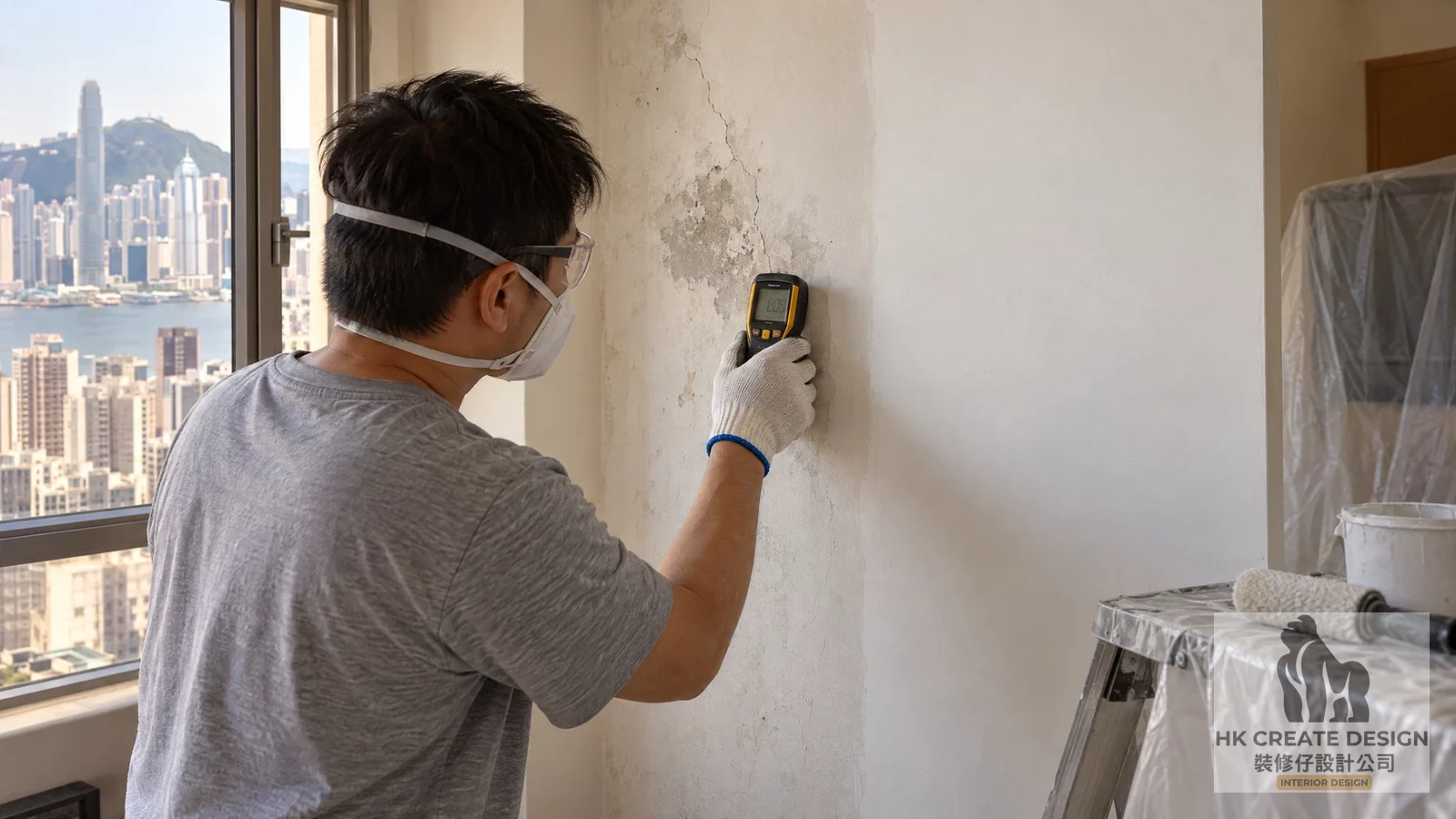
If water is dripping from the ceiling, the wall is close to sockets or electric switches, the paint surface suddenly bulges greatly, or the paint is in danger of falling off, stop construction and use of nearby electrical appliances at that location, notify the management office and arrange for the appropriate person to inspect. In particular, if the electrical area is affected by moisture, you should not rely on tape, blowers or removing the panels yourself; you can check the information of Hong Kong's registered electrical contractors in the Electrical and Mechanical Services Department's register.[4]
Water seepage may not always be in the upstairs units. Common sources listed by the Buildings Department include the water supply and drainage pipes of the building itself, the units above or adjacent to it, the waterproof layer of the floor or the edge sealing of the bathtub, as well as rainwater seeping through rooftops, terraces, balconies, external walls or windows.[1] Therefore, the most valuable information before quoting a paint quote is not "what color you want to paint", but where the water marks are, when they become deeper, and whether they are synchronized with water use or rain.
Tenants should first submit photos and timelines to the landlord and management office; landlords are advised to keep communication records first. This article is for project planning and reference only and does not make any conclusions about liability, compensation or legal rights.
- Take panoramic, close-up and adjacent wall/ceiling photos, and keep the date and scale in the photos for reference.
- Note whether the symptoms worsen after it rains, takes a bath, turns on the air conditioner, or uses water upstairs.
- If there are water stains near switches, pipes, window frames and ceilings, mark the locations first and do not dismantle them yourself.
02
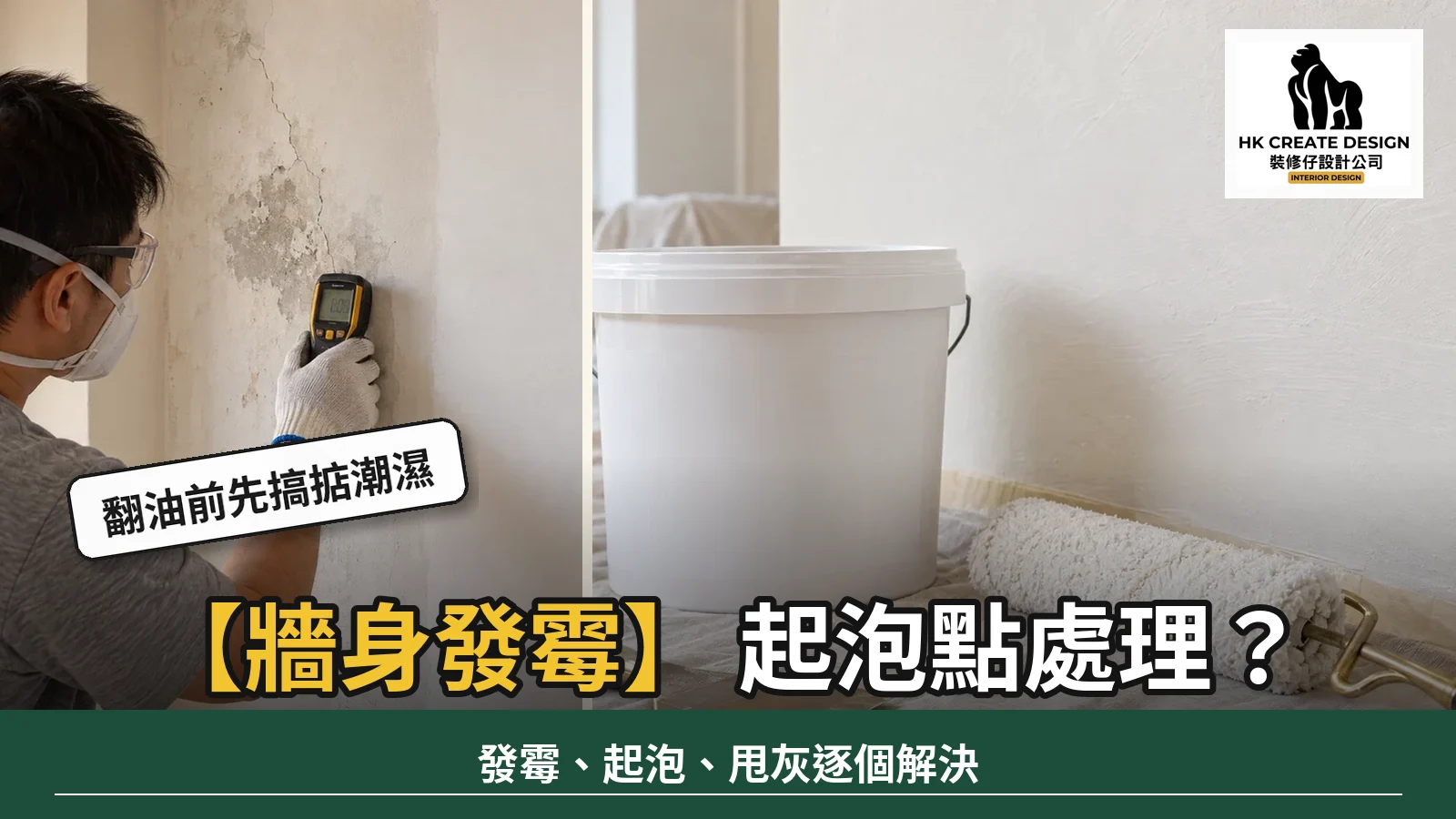
Mould, blistering and flaking plaster call for different assessments. Start with the symptoms.
Mould near windows, bathrooms, air conditioners, corners and furniture may come from humidity, condensation, poor ventilation or seepage. Blisters can indicate trapped moisture, salts or failed adhesion. Loose skim or hollow areas may reach deeper into the render or substrate. Trace water stains near ceilings, window corners or pipes before choosing paint.
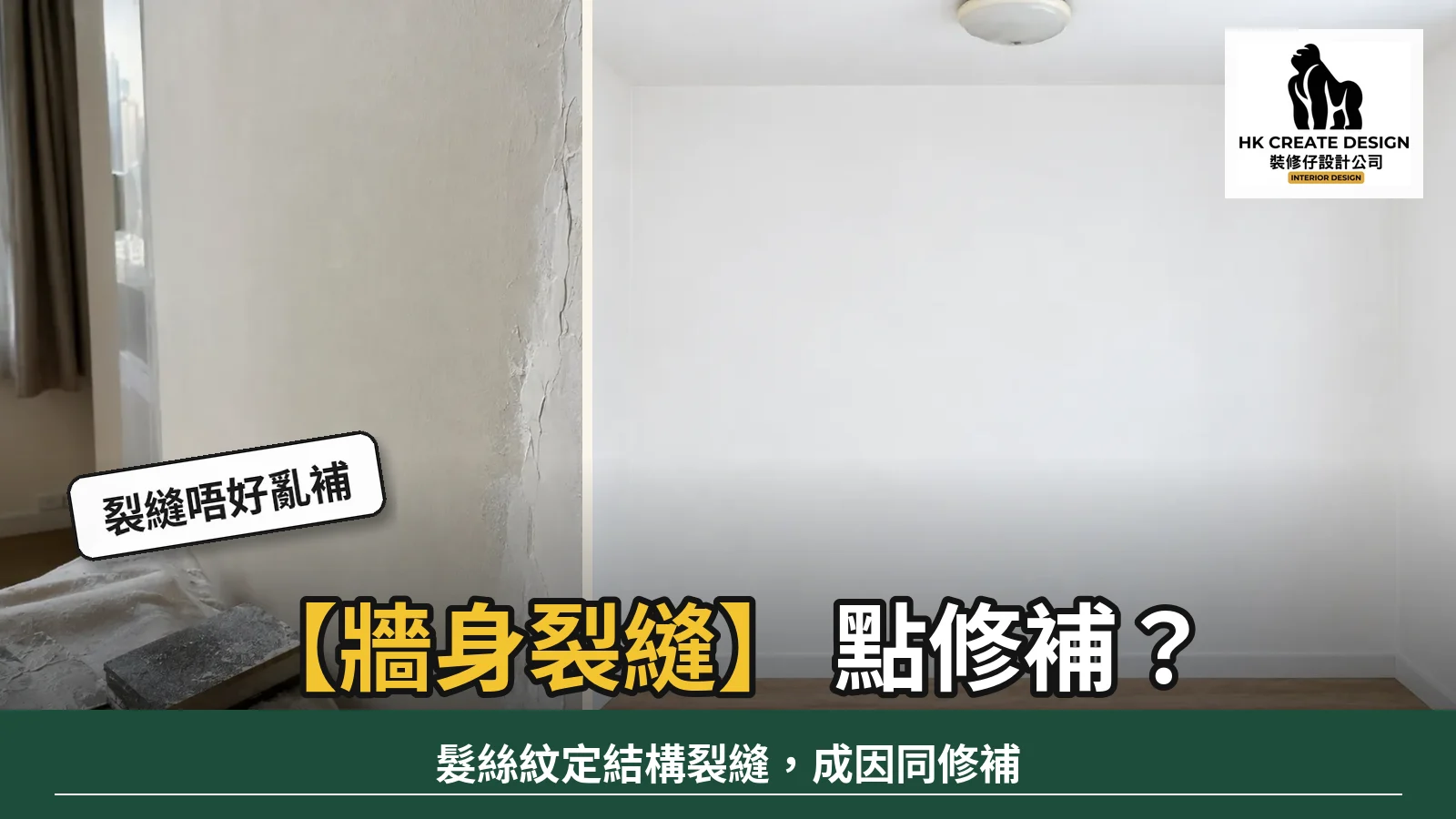
Cracks should also be looked at separately. The treatment conditions for fine surface cracks caused by dry shrinkage are different from cracks that continue to expand, extend diagonally, cross the corners of doors and windows, or accompany wall deformation. The latter should not be started by just adding a patching item to the painting quotation; a suitable person should first be asked to evaluate the on-site conditions.
The Indoor Air Quality Information Center points out that humid environments increase biological pollutants such as bacteria and fungi; people who are sensitive to mold or moisture may be at increased risk of allergic reactions or non-specific discomfort. The most effective prevention directions are to stay dry, control dust, repair leaks promptly, and remove visible mold.[2]
- Are the black spots just on the surface, or are there musty smells, dampness, watermarks or bubbling all at once?
- Mark the location by "window, ceiling, wall base, bathroom back wall, behind furniture". Don't just hand over a close-up lens.
- Record loose dust, hollows, cracks and color differences separately to prevent one "wall repair" from covering up different processes.
You can swipe left or right on your phone to view the complete table.
| Situation and intended scope of treatment | Evidence that homeowners should measure or retain | The pricing method should be stated in the quotation | Common items that are not included or need to be confirmed | Risks that should not be ignored |
|---|---|---|---|---|
| There is a small amount of mildew behind the furniture or near the windows, but the paint film and dust are still solid. | Affected wall width × height, photo, whether it worsened after rain or after turning on the air conditioner | Use the actual partial wall expansion area or treatment items one by one, and indicate the scope of cleaning, primer treatment and repainting. | Water leak detection, furniture relocation, color difference elimination on the entire surface, window seal repair | If the wall is still damp, it may still recur after surface treatment. |
| Blistering, watermarks or discoloration of the ceiling | Watermark location, first date, association with water use or rainy weather upstairs, location of nearby pipes and bathrooms | Diagnosis and source repair should be priced and confirmed separately from shoveling, repairing and repainting. | Upper unit coordination, pipe/waterproof layer/window inspection, waiting for drying and return to site | Covering the watermark directly does not prove that the water seepage has stopped. |
| The dust will be thrown away, the drum will be empty, or the dust will fall off when touched. | Mark the loose area one by one; record the condition of the base layer with photos of knocking, close-up and after shoveling | List the stabilization layer, repair materials, leveling, primer, and topcoat that are partially or completely shoveled to | Deep rendering, repairs after exposing concrete, protection, waste removal and handling | The hidden scope may be greater than the surface, and the procedures for stopping work and reviewing prices after discovery should be agreed upon in advance. |
| The back wall and base of the bathroom or the adjacent kitchen and toilet are repeatedly exposed to moisture | Location plan, changes after water use, old maintenance records and photos of adjacent rooms | Separate the inspection, related plumbing or waterproofing works, and the paint after drying. It cannot be done in one "shovel and repaint" | Waterproofing layer, sanitary ware/bathtub edge sealing, inspection by licensed plumber, tile removal and restoration | The source of moisture has not been treated and an anti-mildew topcoat is not a substitute for repairing the waterproofing layer |
| Water enters the window corners, exterior walls or top floors after rain | Photos from the same angle before and after rainy days, close-ups of window frames and windowsills, and management office records | Aluminum window or exterior wall inspection and indoor repair are quoted separately; only indoor paint is calculated based on the actual repair area. | Exterior walls, common areas, windows, scaffolding or management office procedures and fees | Window parts and exterior walls involve high areas or public parts and should not be removed by yourself or interior repainting should be regarded as permanent repairs. |
Common causes listed by the Buildings Department include water supply/drainage pipes, floor waterproofing or bathtub edge sealing, as well as rainwater infiltration from rooftops, terraces, balconies, external walls or windows. The table is a questioning framework for homeowners to use to dismantle the scope of the problem, not an on-site diagnosis or statutory liability determination. [1][2]
03
Find water sources by location and timing: eliminate them first, then decide who should intervene
If the window edges or exterior corners deepen after rain, the window frames, seals, exterior walls and public locations should be listed for inspection; if the back wall or ceiling of the bathroom changes after taking a bath or flushing the toilet, the drainage, water supply, sanitary ware edge sealing and waterproof layer should be inspected. If mold spots only appear on the back of furniture or when the air conditioner is turned on, ventilation, condensation, and the distance between the furniture and the wall should also be considered. These observations are used to schedule inspections and are not sufficient to determine liability by visual inspection alone.
When it is suspected that an apartment upstairs or adjacent is involved, the Buildings Department recommends discussing with the relevant tenants first, or seeking help from the property management company or owners' corporation. If necessary, construction technicians or licensed plumbers can be hired directly to determine the cause and make repairs.[1] Rather than shoveling away the entire wall first, it is better to first ask about the testing method, whether you can contact the relevant units, and whether the report will state the source judgment and restrictions.
If discussion does not resolve the problem, residents can contact the Joint Office via 1823. Under the procedure from 16 July 2026, straightforward cases with cooperation may receive a repair advisory notice in around 14 working days. Where there is reason to believe the source is upstairs, the notice asks the owner to investigate and complete repairs within 28 calendar days. Complex, intermittent or multiple-source leaks can take longer. These are not painting contractor completion guarantees.[1]
- First submit a written record to the management office and attach clearly dated photos.
- Get the inspection quotation and the painting quotation separately to avoid "finding leaks" being included in the oil-removing project.
- After the water seepage stops, it is still necessary to confirm the condition of the base layer before arranging shoveling and repainting.
04
First measure “how much repairs are needed” and then ask “how much does it cost per square foot”?
Painting normally uses actual wall and ceiling surface area. The quick calculator starts with saleable area × 3, then permits each item to be adjusted to measured dimensions.[6] This method is suitable for homeowners to reserve a budget, but it cannot replace unit-by-unit measurement, especially for units with open partitions, high floors, only partial construction, many wall cabinets, or no ceiling construction.
Homeowners can first measure each wall that is suspected of being treated: width × height, and then note the ceiling and height difference. It is not advisable to assume on your own whether windows, doors, and fixed furniture will be deducted, because whether repairs require full surface painting to reduce color difference, corner closing, and protection range will all affect the amount of construction. The best quotation is not an area figure, but a list of locations, such as "bedroom window wall", "bathroom exterior wall" and "living room ceiling".
If stripping exposes more loose plaster than expected, stop at a visibly sound layer, document it and confirm any revised price under the agreed variation procedure. Discovery alone does not determine who bears the extra cost.
- Name each wall by room, record width, height and type of problem.
- Write "the area that needs to be shoveled" and "the area that needs to be repainted" separately. The two are not necessarily the same.
- The request for a quote states who can approve it, when the quote will be quoted, and whether the location can be suspended if hidden problems are discovered after construction begins.
Example one: paintable surface area and planning allowance for a 450 sq ft flat
Assumptions
- This is a calculation example and not a company completed case, formal quote or market average price.
- Assume a 450 sq ft flat by saleable area. Apply the company's saleable area × 3 rule for a preliminary paint-area estimate.
- For demonstration purposes only, the "dust-proof and moisture-proof polishing oil" shown on the details page is HK$21/square foot and is included in the entire initial calculation of the unfolded area; it is not assumed that any unlisted processes are included.
How to calculate quantities
- Initial paintable area: 450 sq ft × 3 = 1,350 sq ft.
- Initial subtotal: 1,350 sq ft × HK$21 per sq ft = HK$28,350.
- Planning allowance: HK$28,350 × 20% = HK$5,670. Upper budget including the allowance: HK$34,020.
The initial calculated development area is 1,350 square feet, and the subtotal based on the above-mentioned single company itemization is HK$28,350; if the owner reserves 20% of the planning reservation by himself, the planning upper limit is HK$34,020. 20% is a reservation, not an automatic addition or payable amount.
Saleable area × 3 is a first estimate. Wall height, rooms, ceilings, openings, cabinet coverage, stripping, damp sources, protection, haulage and management rules can change the actual scope. Full kitchen and bathroom reconstruction, waterproofing, services replacement, furniture and finishes are outside the quick scheme. Confirm through site measurement and written quotation. [6][7]
05
From surface to finished surface: the scope of work should be broken down into at least six levels
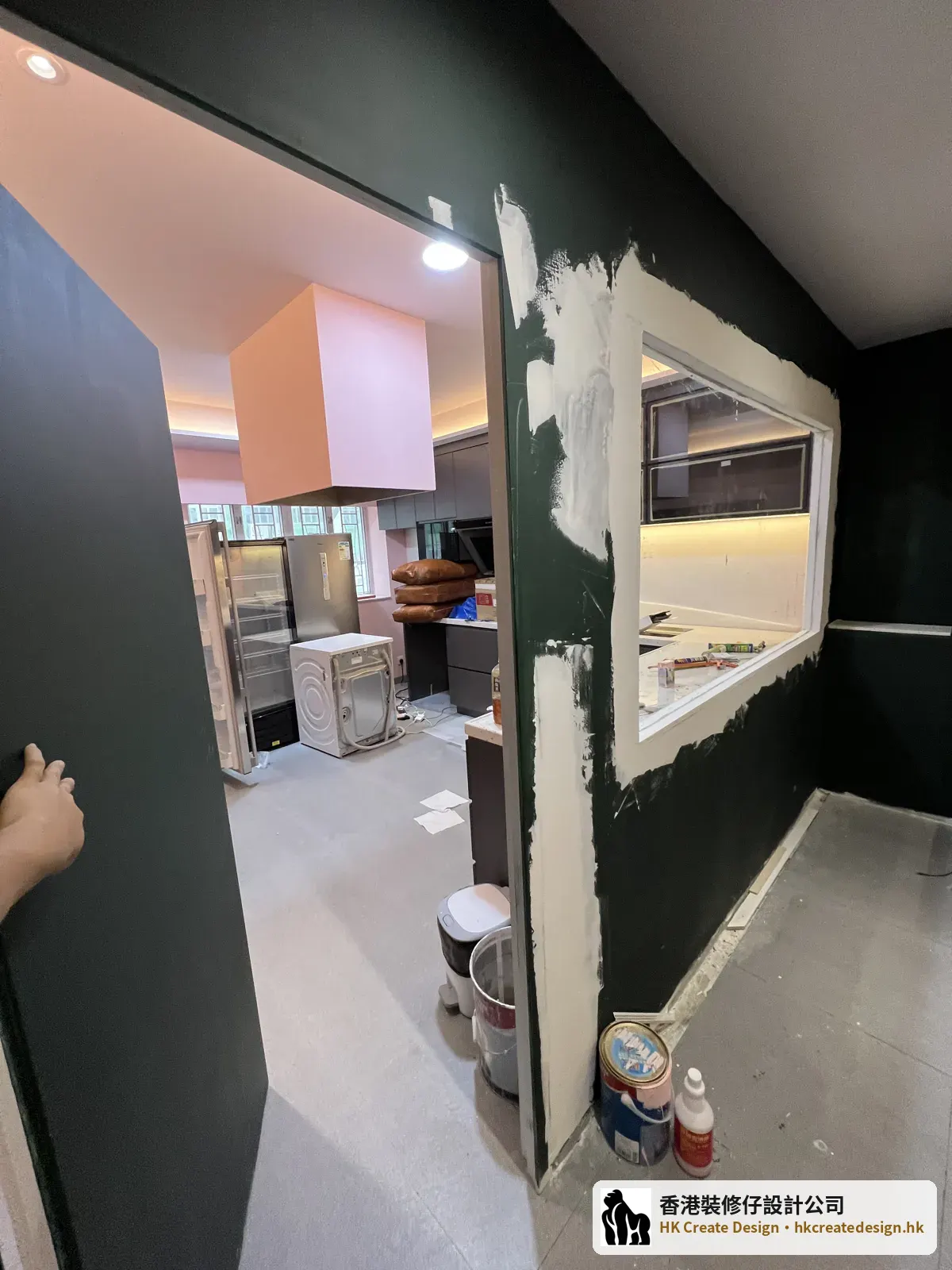
Compare protection and furniture moves, mould or stain treatment, removal of loose paint or skim, substrate repair and levelling, primer, and topcoat product and coat count. “Strip and repaint” could mean local paint removal, stripping to render or stripping to concrete. The scope, dust, noise, repairs and price differ.
Local stripping need not extend to the whole home. Conversely, new plaster and paint cannot cure a wall with an active leak. Make repair of the source a prerequisite for interior reinstatement before agreeing the programme.
In kitchens and bathrooms, itemise painting separately from waterproofing, pipework, tile removal and reinstatement. Do not assume a moisture-resistant primer isWaterproofing. Interior paint touch-ups are not a substitute for work on external walls,Aluminium windowsor repairs to shared areas.
Our standard method starts by stripping and cleaning, applying Kangaroo water-based sealer, then two or three thin coats of Nippon Paint odourless wall putty. After sanding and removing dust, we seal again before primer and topcoat. Nippon's product page describes the putty as ready to use without dilution, water-based, and using about 1 to 1.2 kg per m² per coat.[8]. The manufacturer's page says the water-based sealer seals the substrate before and after skim coating and forms a water-resistant film when dry.[9]. A water-based sealer is a sealing primer, not a waterproofing or drainage product. Address active leak sources first.
- State the purpose of each layer: remove loose layers, smooth, seal against moisture, cover stains or finish with paint.
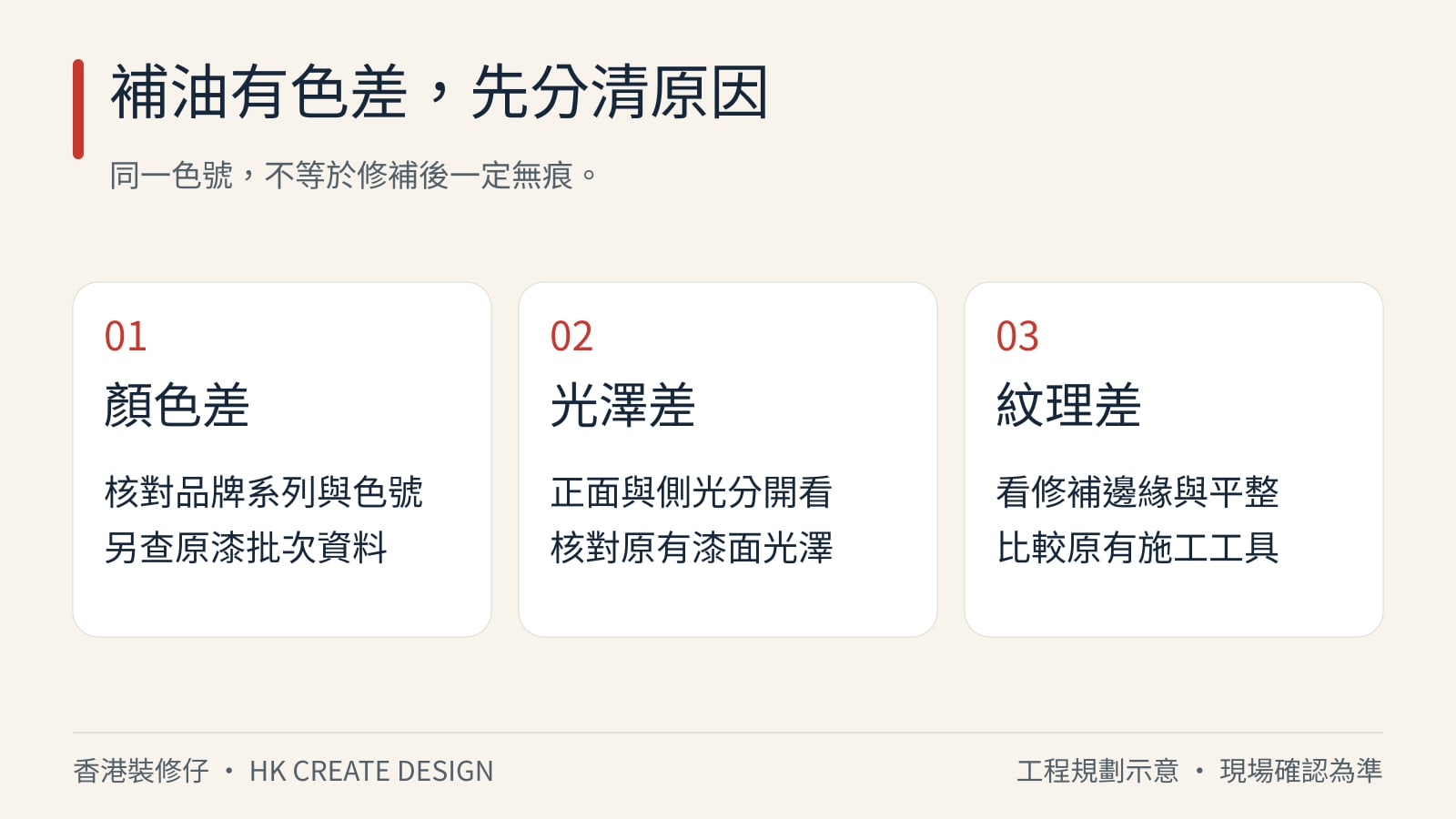
- Ask whether the entire surface will be repainted after partial repairs to deal with the color difference between the old and new.
- Protect floors, doors, windows, furniture and public corridors, and whether completion cleaning is included in the quotation.
06
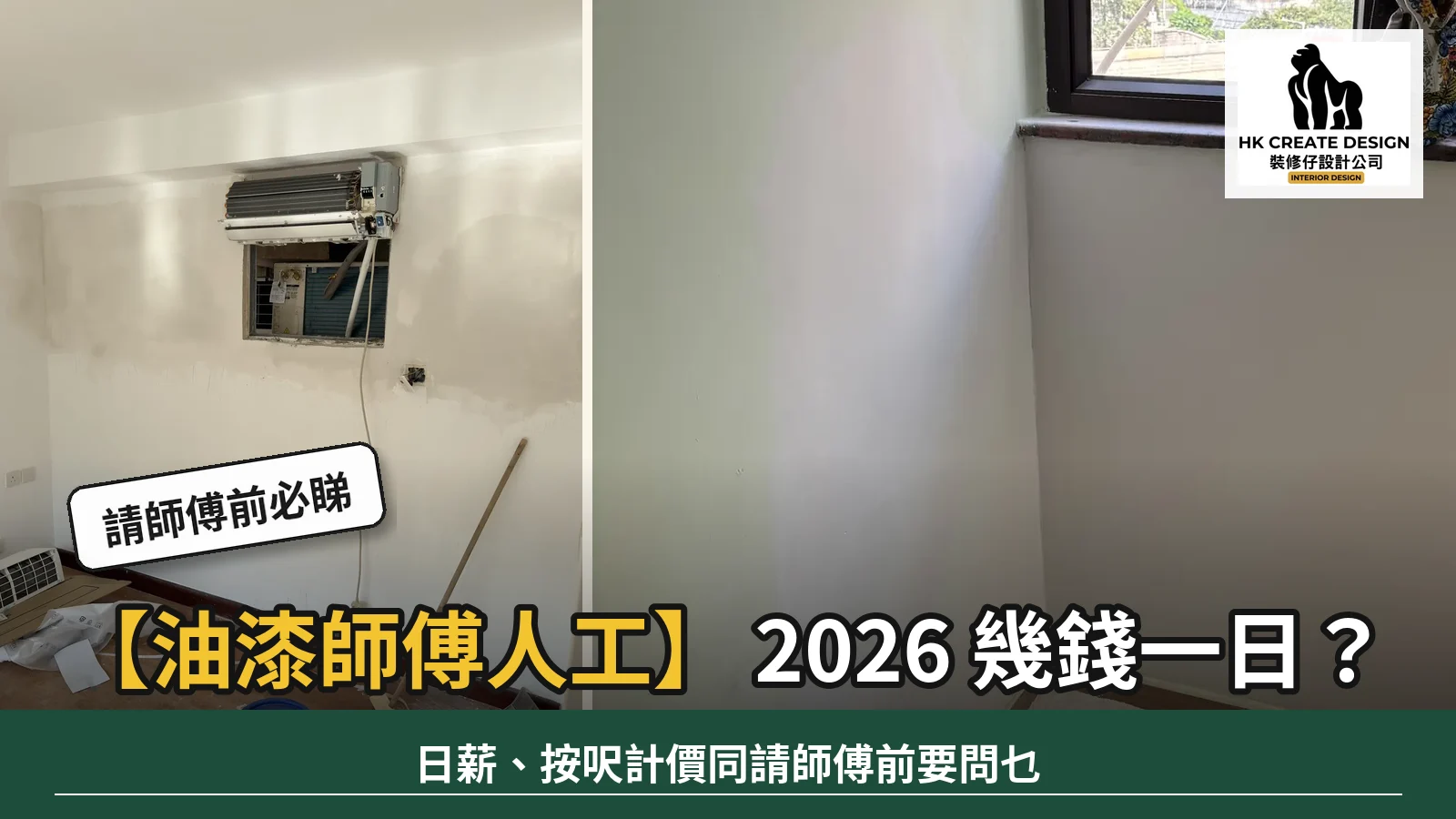
Understand the public price list: Having a unit price does not mean that you have a complete budget
HK Create Design's 2026 public calculator lists 117 work and service options in 8 categories. Of these, 116 have indicative unit prices. The remaining 1 rooftop package is priced on enquiry.[6] The most useful thing for homeowners is that they can break down the quantity, unit and subtotal first. However, these are the company's price benchmarks, not the Hong Kong market average, and they cannot be used to infer the prices of other companies, different bases or unlisted projects.
The details page publicly shows that "shoveling the paint wall until the concrete is visible" is HK$18/square foot, and the budget item shows "carrying dust and moisture-proof polishing oil" is HK$21/square foot.[7] The two numbers serve different purposes: the former is a shovel entry, and the latter is another paint entry. When comparing quotes, they should not be added together and called an all-inclusive package, nor should one of them be considered to include water penetration testing, waterproofing, utilities, furniture removal, management fees, or all removals.
The quick scheme excludes full kitchen and bathroom reconstruction, waterproofing, replumbing and rewiring, furniture, finish tiles, sanitaryware, works insurance, management deposits and renovation administration fees.[6] A 20% planning reservation can be added to the budget cap, but this reservation is not an automatic company surcharge. The purpose of the table and the two calculation examples is to allow homeowners to spread out and compare ranges under the same assumptions, not to create a seemingly accurate total price.
- Next to each unit price, confirm the unit: square feet, square feet, piece, car or whole item.
- Separate the columns for "Included", "Additional", "On-site confirmation" and "Customer supply". Don't leave it to verbal promises.
- List the 20% planning reservation separately from the official project subtotal to avoid misunderstanding that it is an established price increase.
07
How two calculation examples help you compare partial versus whole-house plans
Example one converts 450 sq ft of saleable area to 1,350 sq ft of paintable surfaces. At the company's detailed rate of HK$21 per sq ft, the subtotal is HK$28,350, rising to an upper budget of HK$34,020 with a 20% allowance. It is a comparison under stated assumptions. If only two walls need work after measurement, the whole-flat estimate is not payable automatically. See example one for the calculation and limits.[6] [7]
Example two uses two affected walls measuring 8 ft × 9 ft and 6 ft × 9 ft, totalling 126 sq ft. At HK$18 per sq ft for stripping, the illustrative subtotal is HK$2,268. This excludes repairs, primer, topcoat and tracing the leak. Distinguish the area to strip from the larger finished surface that may need repainting.[7]
Neither example is a completed project for the company, nor are they a quote. They intentionally show how quantities affect the subtotal, while leaving items uninclusive so homeowners can plug in their own measurements, photos, and official ranges.
- Ask different contractors to quote quotes from the same location list, rather than just the usable area.
- For partial plans, ask about color differences and options for repainting the entire surface; for whole-house plans, ask about which walls do not actually need to be repainted.
- When the amount is very different, first compare the depth of the shovel, the repair area and the items not included. Do not judge which one is flatter first.
You can swipe left or right on your phone to view the complete table.
| Item | Public calculation basis | Quantity or pricing method | Not included or not confirmed | How homeowners should use |
|---|---|---|---|---|
| Quick paint calculation | Paint area initially estimated as saleable area × 3 | Estimate surface area from saleable area initially, then adjust each item using site measurements. | Wall height, spacing, actual painting needs, furniture blocking and partial/complete shoveling | It is only used to prepare questions and compare the scope, and cannot be used as the construction amount or final amount. |
| "Shovel paint the wall until you see the concrete" | Detail page public reference HK$18/square foot | It should be calculated based on the actual wall area that needs to be shoveled until the concrete is visible, not the usable area of the whole house. | It is necessary to check whether the repair, re-approval, primer, topcoat, protection and removal of the base layer after deep drilling are additional. | It is suitable for asking about the depth and interface of the shovel bottom; not all moldy walls need to be shoveled until the stone is visible. |
| "Moisture-proof polishing oil" | The budget item on the detailed page shows HK$21/square foot | Calculated based on the expanded area of the wall and ceiling; the applicable area and formal scope should be rechecked | Source diagnosis, waterproofing or plumbing repair, furniture relocation, special protection, color difference treatment and unselected items | Can calculate the preliminary subtotal under the same assumption, but cannot be used as the Hong Kong market average price or the whole house price. |
| 20% planning reservation | The upper limit of quick page description can include 20% planning reservation | Make your own reservations on the established subtotal to facilitate response to unspecified base or option changes | It is not an automatic surcharge for the company, nor does it mean that the project must add 20% | Record reservations and formal project subtotals separately, and adjust after confirming the scope. |
| On-site measurement and online inquiry | Online estimates and enquiries are free. On-site measurement is free through 31 December 2026 for two or more work items, with no deposit. After that, the HK$500 fee is credited against the order. | Provide location, photos, usable area, furniture and occupancy status before making an appointment | Confirm management requirements and any special access hours separately. | Use the measuring visit to confirm the scope. WhatsApp 52437747 if you have questions. |
These figures are from HK Create Design's public 2026 information, checked on 21 October 2026. The quick schemes exclude full kitchen and bathroom rebuilds, waterproofing, rewiring, replumbing, furniture, tile finishes, sanitaryware, works insurance, management deposits and administration fees. They are not all-inclusive whole-home prices or market averages. [6][7]
08
Before choosing anti-mildew paint, check what it can and cannot do
Anti-mildew paint can be part of a paint system that has dried and stabilized the base. It is not a substitute for repairing leaks, pipes, waterproofing or windows. Don’t just listen to the name of the product: you should ask about the suitability for interior or exterior walls, substrate requirements, primer matching, coverage, recommended number of coats, repainting time and safety information. If the sales or construction party changes to another series, it should be rechecked with the technical data and safety data of the product.
For example, Dulux Hong Kong's "Odourless Anti-mould 5in1" is one of the specific indoor wall/ceiling products that can be checked. The page lists functions such as mildew resistance, alkali resistance, moisture resistance and waterproofing. The coverage rate is 13-16 square meters per liter per layer. It is recommended to use 2 layers and repaint for about 2-3 hours.[5] These are published specifications for this product and are not a guarantee of a permanent cure for permeable walls, nor are they the only recommendations. The product page also cautions that actual coverage will be affected by surface condition and strong color variations.
If the surface is still wet, salty, chalky or loose, the first primer you use is more important than which can of topcoat you choose. Homeowners should be asked to include the actual brand, series, color number, gloss, number of primers and topcoats in the quotation, and keep the barrel and technical information for future repairs.
- Do not interpret the words "moisture-proof" or "mildew-proof" to mean sealing a wall that is seeping water.
- Use product technical data to check the dosage and repainting conditions of each layer, rather than just asking "how many days to dry."
- If there are watermarks in the same location, first ask if stain sealing, base repair and topcoat are listed separately.
09
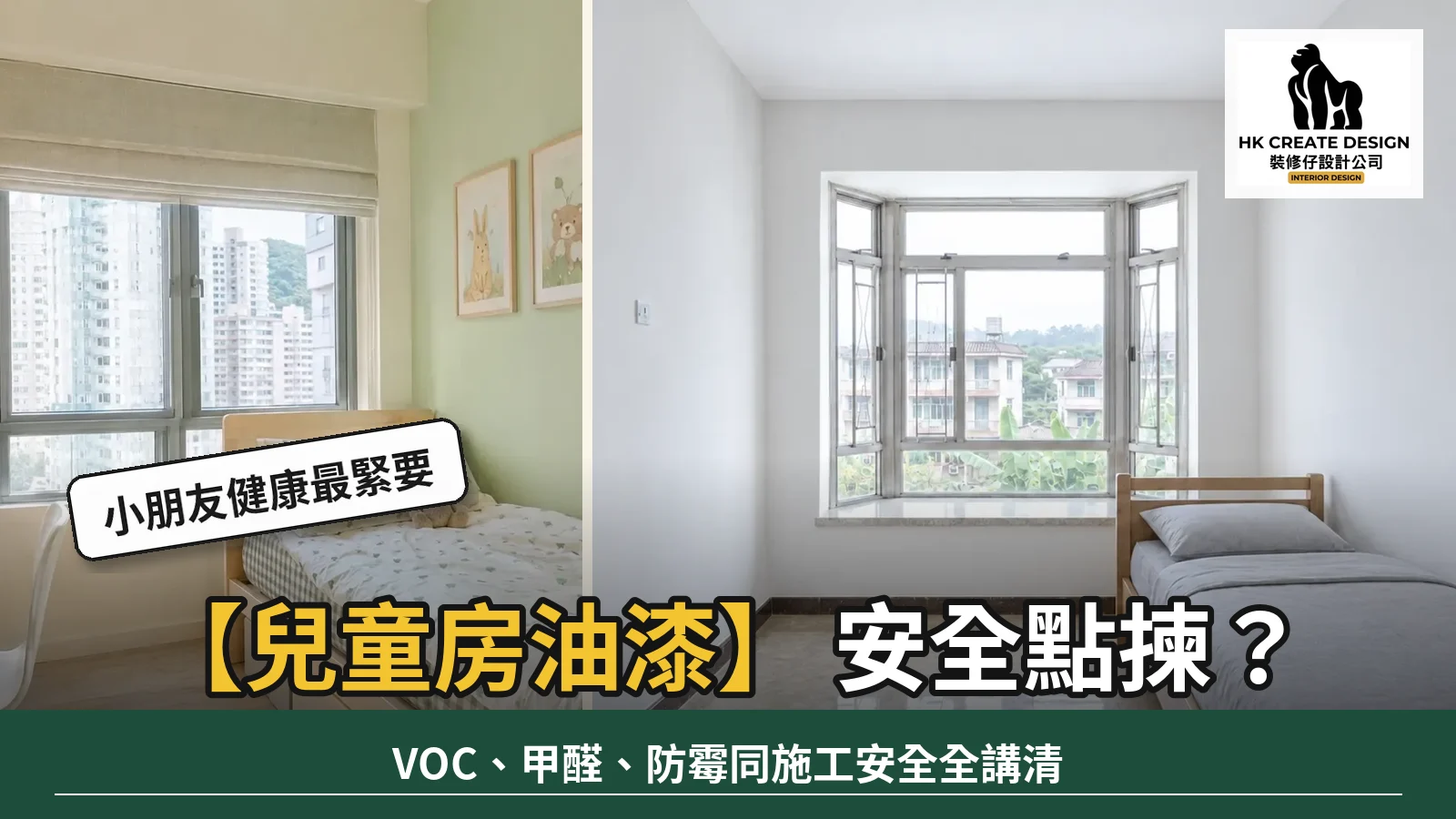
Health and safety during construction: write ventilation, isolation and chemical information next to the process
When removing visible mold, the Indoor Air Quality Information Center recommends using appropriate personal protective equipment, such as N95 masks, gloves and goggles, as needed, and keeping people with allergies or other sensitivities away from the cleaning area. Hard surfaces or non-porous materials can be washed with detergent and water and dried thoroughly; absorbent materials that cannot be cleaned of mold, such as false ceilings or carpets, may need to be disposed of properly. Work that is large-scale, repeatedly polluting, or produces a large amount of dust should be evaluated by a suitable person, and large-scale demolition work should not be carried out on your own.[2]
Spraying, sanding and solvent processes carry different risks than regular roller painting. The Labor Department's guidelines point out that the substances involved in spray painting can be inhaled or absorbed through the skin, and may also be flammable; the construction party should arrange the process according to product safety information, on-site risks, ventilation, isolation and appropriate protection.[3] Therefore, homeowners can ask "whether to spray, where to spray, how to isolate and ventilate, when to remove children or pets, and whether product safety information is available." Instead of spraying in a small, humid or close to a power source, homeowners should not spray paint by themselves.
Ventilation can help dilute pollutants, but "no smell" cannot be used to claim that it is ready for immediate move-in, nor can any removal of formaldehyde or low odor be said to be a guarantee of a healthy stay. Arrangements for use, repainting, ventilation and reuse of spaces should be confirmed based on the selected product information, actual construction methods and on-site conditions; if anyone experiences persistent discomfort, contact should be discontinued and medical advice should be sought.
- Before construction, obtain the name and safety information of the product used, and confirm whether there are spraying, grinding or solvent processes.
- Keep children, the elderly, people with allergies, and pets away from affected areas, and confirm how furniture and food are protected.
- Do not carry out any work near damp electrical switches; leave electrical power, aluminum window disassembly and large-scale demolition to planning by appropriately trained/registered persons.
Example two: stripping area, indicative subtotal and topcoat quantity for two locally affected walls
Assumptions
- This is a calculation example and not a completed case, formal quotation or construction instruction from the company.
- Assume only two walls have been confirmed on site for treatment: 8 ft × 9 ft and 6 ft × 9 ft. Adjoining walls, ceilings and concealed loose plaster have not been included.
- Our detailed price page gives HK$18/sq ft for stripping a painted wall back to concrete. For the specified Dulux finish, the quantity example assumes two coats and theoretical coverage of 13–16 m² per litre per coat.
How to calculate quantities
- Surface to strip: 8 × 9 + 6 × 9 = 126 sq ft.
- 126 sq ft × HK$18 per sq ft = HK$2,268 for the stripping item only.
- 126 sq ft × 0.09290304 = 11.71 m². Theoretical topcoat quantity for two coats: 11.71 × 2 ÷ 16 to 11.71 × 2 ÷ 13 = 1.46–1.80 litres.
The two walls total 126 square feet; the subtotal indicated on the bottom of the shovel alone is HK$2,268. According to the public coverage rate of this designated product, two layers of topcoat theoretically require about 1.46-1.80 liters. Therefore, the purchasing capacity, primer and loss should be confirmed by the construction party according to the site and product description.
HK$2,268 excludes tracing seepage, substrate repairs, skimming, moisture-resistant primer, topcoat, protection, handling, disposal, moving furniture and colour matching. Hollow areas or seepage found after stripping may increase the measured area and cost. Mould-resistant paint cannot repair pipes or waterproofing. [5][7]
10
How to prepare before measuring so that the quotation does not rely on guesswork
Before making an appointment, prepare the usable area, room floor plan, near and far photos of each problem location, wall and ceiling width and height, window and switch positions, the number of furniture, whether there are people living in it, when construction can be carried out, and changes after rain/water use. Do not completely cover mold spots or wall bases with furniture first; if you are worried about privacy, you can first sort out the partial locations to be displayed and relevant old maintenance records.
Online estimates and enquiries are free under the company's published terms. On-site measurement is free through 31 December 2026 for two or more work items, with no deposit. After that, the HK$500 fee is credited against the order. Send photos, location and approximate area to WhatsApp 52437747, then confirm the measurement arrangements.[6] Site measurement verifies the substrate, actual surface area and protection requirements so a preliminary estimate can be refined.
After measuring, ask that the written range you receive correspond to each problem location you have photographed. If the contractor states that it will wait for the wall to dry or for inspection by the management office or other professionals before bidding on a certain part, this should be listed as an item to be confirmed and the unknown unit price should not be written as zero.
- Number the problem wall and match the photo file name with the location on the floor plan.
- Explain furniture relocation, check-in, lifts, construction periods and management restrictions in one go.
- Request written scope, materials, area, unincluded items, change procedures and completion cleanup arrangements.
11
Acceptance is not just about looking at nothing: comparing it point by point with observable items
After completion, first check the original position list one by one: whether the removal and repair positions are smooth, whether the corners and door and window edges are closed, whether the topcoat is covered uniformly, whether the protection is removed, whether the site is cleaned, and whether the paint bucket body and color number are retained. Partial repairs may cause color differences between old and new. This should be explained before construction as to whether the entire frame or surface will be repainted, rather than debated after completion.
Acceptance also requires checking back to see if the problem is only temporarily covered. If the watermark still expands, the wall becomes damp again, bubbling reappears, or the musty smell persists, return the symptoms, date and photos to the relevant construction company/management office first, and return to the source for judgment instead of immediately requesting a layer of topcoat. The government's procedures for dealing with water seepage, the arrangements for painting construction and the responsibilities of private contracts are at different levels. This article does not replace individual contracts or legal advice.
Put the official quotation, change confirmation, product information, photos and acceptance records in the same folder. When there is a problem at the same location in the future, you can tell whether it is a new leakage, an old source that has not been repaired, or a defect in the coating system itself.
- Accept by room and location list, don’t just take a quick look in a dark environment.
- Keep color numbers, product ranges, before and after photos and any additional confirmations.
- When it gets wet again or the watermark expands, record it first and then contact it to avoid covering the evidence yourself.
FAQ
7 practical questions answered
01If the wall is moldy, can I apply anti-mold paint directly?
Anti-mildew paint should not be considered the first step. First confirm whether there are still water leaks, condensation or ventilation problems, remove visible mold and make the base dry; if the dust or plaster has been loosened, the base must also be treated. Mildew-resistant topcoats can be part of a painting system over a suitable, dry substrate, but are not a replacement for plumbing, waterproofing, window or exterior wall repairs.[2] [5]
02Is bubbling paint necessarily due to a water leak upstairs?
uncertain. Blistering can be related to moisture under the paint film, wet base, salt, bond failure of old paint, or water seepage. If it appears repeatedly on the ceiling, the back wall of the bathroom, the corner of the window or near the pipe, or is synchronized with water use or rainy days, the source should be investigated first; the common sources of water seepage listed by the Buildings Department are not limited to upper-floor units.[1]
03The quote says "shovel and repaint", does it include waterproofing?
You cannot make assumptions on your own. Ask which level was removed and whether it included base repair, primer and topcoat. Also ask if there was any water leakage testing, pipe repairs, waterproofing, tile removal or window work. By dividing the paint restoration and source repairs into items, it is easier to see which ones have been included and which ones need to be confirmed on site.
04Is saleable area × 3 from the online paint calculator the formal work quantity?
no. It is a preliminary approach to the company's quick calculator, suitable as a starting point for budgeting. The actual amount of work depends on the height of walls, room separations, ceilings, windows and doors, furniture, partial or full treatment scope, and the condition of the site's grassroots. The formal quotation should be based on measurement and confirmation range one by one or area by area.[6]
05Does the 20% reservation mean that the company will definitely charge an additional 20%?
No. The company defines the 20% as an owner's planning contingency. It allows for an unresolved cause, loose plaster found after stripping or extra preparation. Confirm the contract price against site measurements, agreed scope and the written quotation.[6]
06After the wall becomes moldy, when can I move in again?
There is no set number of hours that will apply to all residential, paint and mold situations. The source of moisture should be dealt with first, ventilation and isolation should be arranged according to the construction and repainting information of the products used, and depending on whether there are sanding, spraying or solvent processes. Do not rely on disappearing odors, low odor labels or formaldehyde removal services as a guarantee of a healthy stay; if there are infants, young children, the elderly, pets or people with allergies at home, you should confirm the individual situation with the builder and, if necessary, medical professionals.
07I discovered that there is suspected water leakage upstairs. Do I have to wait for the government procedures to be completed before repairing the interior?
Not necessarily, but if the source is unknown or water is still leaking, there is a risk of redoing a large area of the interior too early. You can notify the management office first, keep photos, and arrange for appropriate people to find the source. If the negotiation fails, you can contact the joint office for help through 1823; the applicability of government procedures, investigation and notification time are not equal to the painting construction period, and when indoor repairs start still depends on the source, grassroots and arrangements of all parties.[1]
CHECK THE BASIS
Data and technical basis, sources can be verified
- [1]Water seepage problem | Buildings Department Accessed: 2026-10-21
- [2]Frequently Asked Questions | Indoor Air Quality Information Center Accessed: 2026-10-21
- [3]Guidelines for Spray Painting and Related Spraying Processes | Labor Department Accessed: 2026-10-21
- [4]Registered Electrical Contractors | Electrical and Mechanical Services Department Accessed: 2026-10-21
- [5]Dulux Odourless Anti-mould 5in1|Dulux Hong Kong Accessed: 2026-10-21
- [6]HK Create Design 2026 quick estimator and company rates Accessed: 2026-10-21
- [7]HK Create Design 2026 detailed works estimate Accessed: 2026-10-21
- [8]Nippon Paint Odour-less Wall Putty | Nippon Paint Hong Kong Accessed: 2026-11-02
- [9]Kangaroo water-based sealer | Chamco Chemical Accessed: 2026-11-02