01
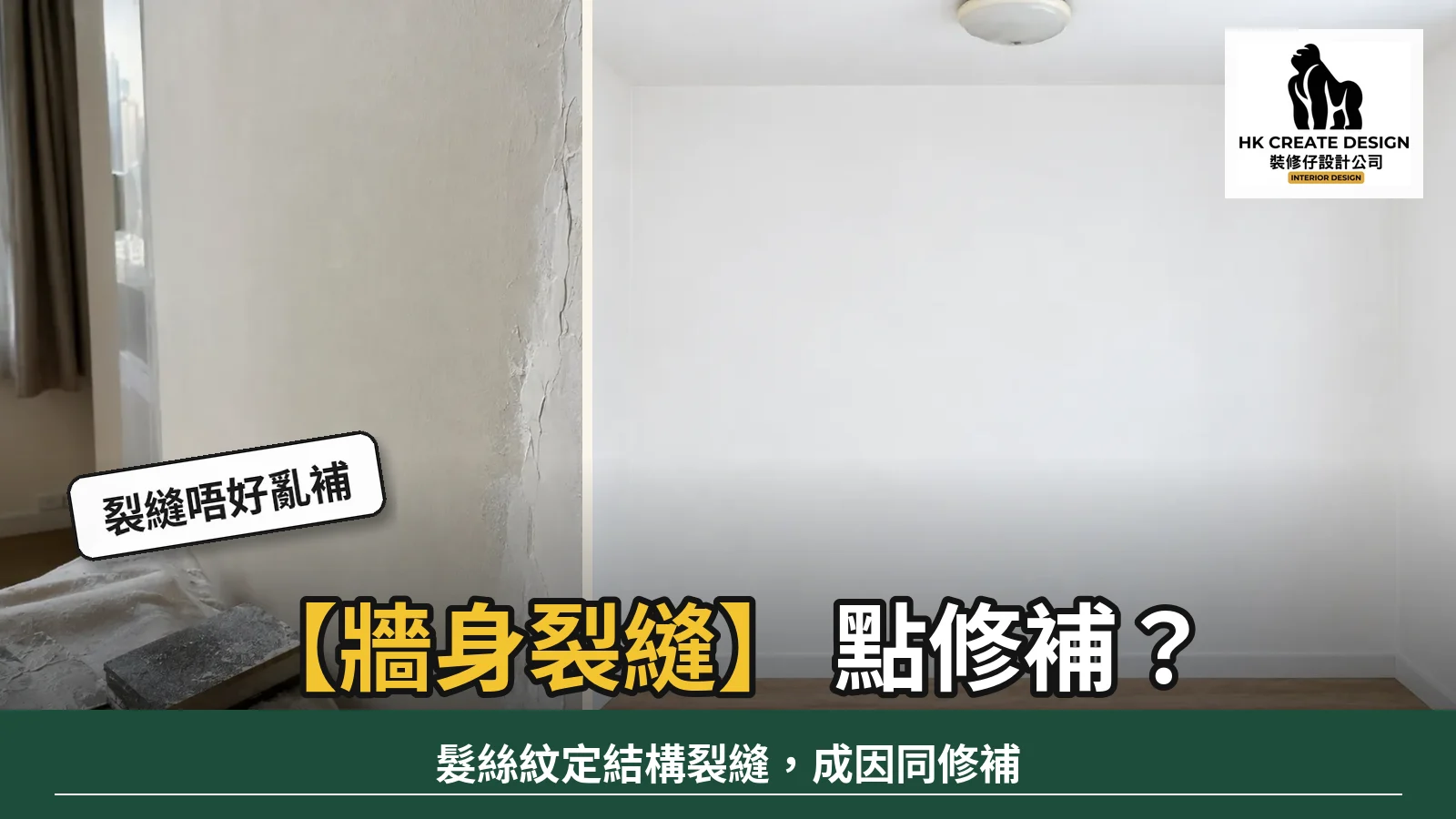
There are two categories of cracks: non-structural and structural
The Buildings Department describes non-structural cracks as: hairline cracks, cracks that extend in multiple directions, and cracks that occur between non-structural walls and structural members (such as brick walls and beam-column interfaces)[1]. "Building Maintenance Encyclopedia" adds that such cracks usually appear in plaster or cement mortar-based finishes, which only affect the appearance of the building and do not pose a safety threat; cracks that extend in multiple directions are usually caused by shrinkage[2].
Structural cracks are different. Symptoms listed by the Buildings Department include: cracks through the grout deep into structural concrete or load-bearing brick walls, cracks in beams, long cracks across walls, rust stains in cracks, and diagonal cracks in the corners of window or door frames.[1]. These cracks may indicate that the structure is bearing excessive loads.[2].
The Buildings Department recommends that for non-structural cracks, owners should continue to pay attention to the situation; for structural cracks, timely repairs and maintenance should be arranged[1]. In other words, the former can usually be dealt with at the same time as the paint renovation, while the latter requires figuring out the reasons first.
For ordinary residents, the most practical way to identify is to look at three things: crack width and depth, location and direction, and whether there are changes. If it is as thin as a hair, is only on the surface of paint or plastering, has not changed for many years, and is mostly non-structural; if it is wide, deep, leaning diagonally on beams, pillars or corners of doors and windows, with rust seeping out, and getting longer and longer, you should seek professional inspection as soon as possible.
One thing to note: the same crack may be judged differently in the eyes of different people. The owner's own inspection can only make a preliminary classification and cannot replace a professional assessment. If you are not sure, you would rather take photos and ask for an opinion; when our technicians see suspected structural problems, they will directly recommend that you hire a professional instead of just saying that there is no problem in accepting the project.
02
Cracks will appear
Shrinkage is a common cause of non-structural cracking. Cement-sand render and filler shrink as they dry. Excessive coat thickness, rapid drying or poor curing can cause fine or mesh-like cracks. The Buildings Department notes that cracks running in several directions often result from shrinkage[2].
Another common location is the interface between brick walls and concrete beams. The expansion and contraction characteristics of the two materials are different, coupled with changes in temperature and humidity, it is easy for a straight crack to appear at the intersection. The Buildings Department also classifies this type as non-structural.[1]. Newly built brick walls or lightweight partition walls will have similar situations if the interfaces are not properly handled.
The causes of structural cracks are much more serious. The Buildings Department's "Building Maintenance Manual" and the Building Rehabilitation Platform both list: excessive movement of the building structure, settlement of the foundation, excessive structural load, fragility of part of the structure due to rust or aging of materials, accidental damage, or poor design and construction[2][4].
In addition, the rust and expansion of steel bars will also cause cracks in the concrete. The cracks usually follow the direction of the steel bars and may contain rust stains, which may later develop into concrete spalling.[1]. Therefore, cracks with rust stains should not be treated as ordinary paint problems.
Another common reason for old buildings in Hong Kong is previous alterations. For example, the previous owner demolished the wall, added heavy cabinets, made large holes in the wall, or changed the partition of the upstairs unit, which may cause the stress on the partial wall to change. When buying a second-hand building, you can ask what kind of work has been done on the unit and whether there are relevant plans or records.
You can swipe left or right on your phone to view the complete table.
| compare | non-structural cracks | structural cracks |
|---|---|---|
| Appearance | Hair-like, multi-directional[1] | wide, deep, across the wall[1] |
| location | Blast surface, brick wall beam and column interface[1][2] | Oblique cracks on beams and corners of doors and windows[1] |
| Other symptoms | unchanged for many years | There are rust stains and the spread[1][2] |
| Cause | Differences in shrinkage and material expansion[2] | Structural movement, settlement, overloading[2][4] |
| Process | Pay attention and repair during renovation[1] | First investigate and cure, and let professionals handle it[2][3] |
It is compiled based on the data of the Buildings Department and the building restoration platform, and it actually requires on-site judgment [1][2][4]. [1][2][4]
03
When to hire a structural engineer?
The Buildings Department's "Building Maintenance Manual" emphasizes that if structural cracks are discovered, they should be taken seriously immediately; if structural cracks suddenly appear, or the cracks expand or show signs of spreading, they should be reported to the Buildings Department immediately.[2]. If you find such cracks, you should first investigate, find out the cause and repair them, and then repair the cracks first.[2].
The "Building Maintenance Book" also points out that it is usually necessary to hire professionals in the construction industry, such as registered structural engineers, to find out the causes of cracks, assess the impact on the structure, and recommend and supervise appropriate correction and repair works; the relevant remedial works should be carried out by contractors registered under the Building Ordinance[2][3].
The Buildings Department also stated that if only repairing cracks and ignoring the causes will continue to worsen the problem, there may even be a risk of collapse.[3]. If a crack may be structural, have it assessed before filling or painting. Covering it makes it harder for a professional to diagnose.
For cracks located in common parts or exterior walls, the corporation or management company should be notified to deal with them. The cost is generally shared according to the shares in the deed of mutual covenant of the building.[1]. During the structural warranty period, owners of Home Ownership Scheme housing can apply to the management office if cracks occur in the structural components.[5].
04
Spot the cracks yourself
Buildings Department advises owners to continue to pay attention to non-structural cracks[1]. To monitor it, mark both ends of the crack lightly in pencil and note the date. Photograph it with a ruler or coin for scale. Repeat every few weeks to compare length and width.
You can pay attention to several things when recording: are the cracks straight and slanted, are the door and window corners in the middle of the wall, do they extend to the ceiling or floor, are there any water or rust stains after rain, and are there any hollow sounds around the cracks. This information is very useful for masters or professionals to make judgments.
If the crack is near a bathroom or kitchen, or on the side of an exterior wall, be especially wary of water seepage. The Buildings Department's "Building Maintenance Manual" states that rainwater can penetrate through damaged places such as cracks in exterior walls, joints, and honeycomb concrete spalling locations.[2]; Water seepage data from the Buildings Department also mentioned that rainwater seeping through external walls is one of the common causes.[7].
If during the observation period you find that the cracks have become significantly longer or wider, the doors and windows have begun to latch, or you hear unusual noises, you should not wait any longer and call a professional as soon as possible.
There are also simple crack observation films on the market, which can be attached to both sides of the crack and see whether there is movement through the scale. But for ordinary households, regular photography is enough. The point is to keep recording, not just to be surprised when you see it.
- Draw lines at both ends to write the date
- Include a ruler in the photograph for comparison
- Watch out for water and rust stains
- Get longer and wider and hire professionals
Example one: patching and repainting hairline cracks on walls throughout a flat
Assumptions
- Hypothetical examples, not actual quotes.
- The paint area is about 600 square feet. The cracks are non-structural and the wall is generally stable.
- After applying facial oil 2 times, the color is similar to the original one.
How to calculate quantities
- "E02" Moisture-proof polishing oil: HK$21/square foot × 600 = HK$12,600
- Subtotal HK$12,600.
About HK$12,600.
If it is found that the sealant is loose or moldy after shoveling, use E01 instead or add additional sealant. (see published rates)
05
Non-structural crack spot repair
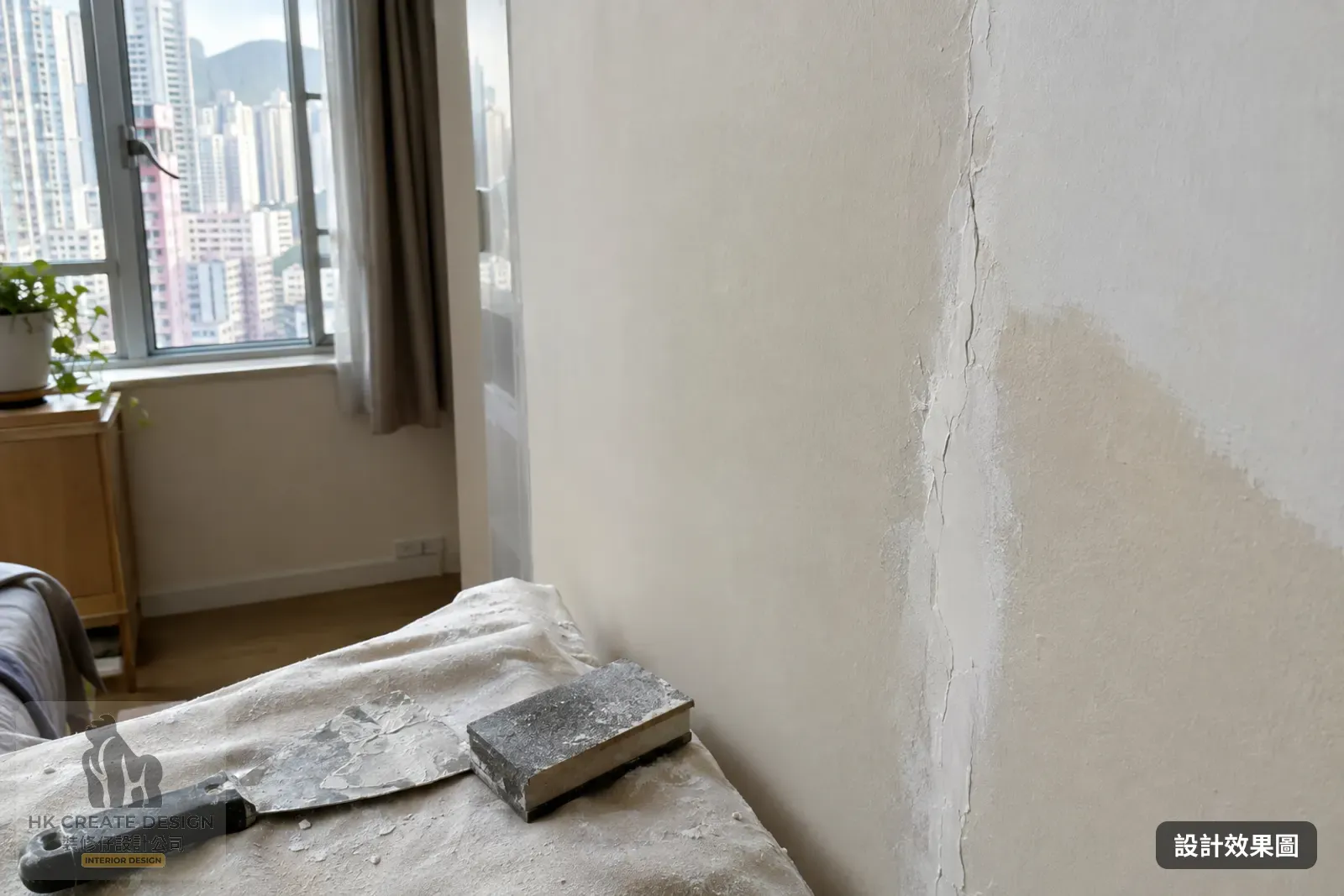
Non-structural cracks need suitable preparation, filling and repainting. The Buildings Department's Building Maintenance Guidebook describes specialist chemical injection or opening up the crack to establish a firm bond between the existing surface and a cement-and-sand mortar repair[3].
For sound interior walls with local cracks, the E02 process removes loose filler and paint, clears dust, fills cracks and chips, skim coats and sands once dry, then applies a moisture-resistant primer and 2 finish coats. The published rate is HK$21 per sq ft, minimum HK$4,650. (see published rates).
Extensive crazing, peeling or mould can require more than local patching. E01 strips the old paint back to the base, applies 2 to 3 skim coats, treats moisture, sands and repaints. The rate is HK$39 per sq ft, minimum HK$7,450. (see published rates). If the underlying render is loose, remove and renew it. B01 cement-sand rendering is HK$43 per sq ft, minimum HK$2,350. (see published rates).
There are some paint products that claim to be able to cover hairline cracks. For example, Dulux Odorless and Mildew Resistant 5-in-1 Latex Paint is listed as having the ability to cover hairline cracks. It is recommended to apply 2 coats.[6]. However, paint is only for "covering" and not for "repairing". If the cracks are wide or swollen, the base layer still needs to be treated first.
Repeated linear cracks at the interface between brick walls and beams and columns can easily re-explode simply by removing dust, because the materials on both sides will continue to expand and contract slightly. A more stable approach is to shovel a wider area along the joint, add appropriate joint treatment and then patch the dust so that the surface can withstand some vibration. The actual practice must be judged on site.
After a non-structural crack is repaired, our standard method is to strip and clean, apply one coat of Kangaroo water-based sealer, then 2–3 thin coats of Nippon Paint odourless wall putty. After sanding and dust removal, we seal again before applying primer and topcoat. Nippon describes its water-based putty as ready to use without dilution.[9]. Chamco Chemical describes its water-based sealer as a substrate sealer for use before and after skim coating.[10]. Water-based sealer is not waterproofing. Trace the source of any leak first.
- Shovel loose material along cracks
- Fill firmly, skim and sand
- Local crack: E02
- Large area: E01; loosening: B01
06
Structural Crack Spot Repair
When repairing structural cracks, the first step is always inspection. The Buildings Department's "Building Maintenance Manual" states that a detailed investigation must be carried out immediately to find out the cause of the crack and cure it, and then repair it first; to find out the cause, a structural engineer should be hired[3].
After determining and eradicating the cause, the Buildings Department lists general repair methods: use high pressure to pour non-shrinking cement slurry or epoxy resin into the crack; or dig out the crack and then add or re-pour concrete.[3]. The chemical slurry used can be epoxy synthetic resin or polyester resin, etc.[3]. This type of project must be executed by a registered contractor according to the engineer's design[3].
The Buildings Department also mentioned that there are other repair methods on the market, such as adding chemical additives to the concrete surface and injecting chemical grout to fill cracks and pores. However, these are only temporary repair measures and are usually used when upstairs residents or rooftop owners are uncooperative.[3]. That is to say, if you see an advertisement saying "injection", you should get it done. You need to ask clearly whether the root cause will be cured and how long it will take.
If structural cracks are accompanied by steel bars rusting and concrete peeling off, the building repair platform points out that it is necessary to drill down to a solid bottom layer and fill it with appropriate mortar. After the steel bars are rusted, the diameter is significantly reduced and must be added or replaced. If the problem goes deep into the structure, a structural engineer will be required and temporary supports must be ensured.[4].
Owners should understand that it is difficult to accurately estimate the cost and time of structural repairs in advance because they require surveying first. Professionals will provide a report and repair plan, and the contractor will quote a price based on the plan. Although this process is more time-consuming, it is the most reliable way to ensure safety.
07
Special locations: corner of doors and windows, bottom of beams, bathroom
Angular cracks in doors and windows are one of the symptoms of structural cracks named by the Buildings Department[1]. However, fine lines may sometimes appear on the corners of indoor door frames due to the installation of door frames and shrinkage of brick walls. The difference lies in depth and development: only on the surface, which has not changed for many years, most of them are superficial problems; if it goes deeper into the wall, gets wider and wider, and the door starts to get stuck, it is necessary to hire a professional.
Be especially careful with cracks at the bottom and sides of beams. The Buildings Department classifies cracks in beams as symptoms of structural cracks[1]. If you see cracks and rust stains along the length of the bottom of the beam, it is most likely that the steel bars are rusted, and you need to treat them according to the method of concrete spalling.
There are cracks in the bathroom and kitchen walls. The biggest concern is water entering through the cracks. The Buildings Department states that the space between the bathtub or shower basin and the wall finish must be sealed with appropriate leak-proof adhesive. The wall tiles should be fully paved with cement mortar, and the interfaces must be sealed with waterproof cement.[3]. If there are cracks in the brick joints or the brick surface, water can seep into the wall, causing the wall in the partition room to blister and become moldy.
If the interior wall on the exterior wall gets wet every time it rains heavily, the crack may be in the exterior wall. Water seepage information from the Buildings Department indicates that rainwater can penetrate through external walls[7]; The external wall is a public part and the management company or corporation must be notified to handle it.[1].
Ceiling cracks should also be inspected separately. Joint cracks in gypsum board false ceilings are usually caused by board joints or hanger problems, which are different in nature from cracks in concrete ceilings. If the concrete ceiling is cracked and has water stains, you should first check whether there is water seepage upstairs.
- Door and window angles: see depth changes
- There are rust stains on the bottom of the beam: treat it as peeling
- Cracked bathroom tiles: prevent water seepage
- Rain seeping from exterior walls: Recruitment Management Office
You can swipe left or right on your phone to view the complete table.
| Item | No. | Unit price | Minimum charge |
|---|---|---|---|
| Patch the surface, damp-proof, sand and paint | E02 | HK$21 per sq ft | HK$4,650 |
| Strip, skim, apply moisture-resistant primer and paint | E01 | HK$39 per sq ft | HK$7,450 |
| English sediment batch | B01 | HK$43 per sq ft | HK$2,350 |
| Shovel paint until you see concrete | A03 | HK$18 per sq ft | — |
| Mason’s day rate | B06 | HK$2,700 per day | Materials charged at cost against receipts |
These are published reference prices. The written quotation confirms the price. (see published rates)
08
Home Ownership Guarantee Building Inspection: Some are covered, some are not covered
The Housing Authority provides building structural safety guarantees for Home Ownership Scheme Housing Schemes, Private Participation Scheme Housing Schemes and Green Home Ownership Scheme housing estates with a guarantee period of 10 years (20 years for Home Ownership Scheme housing estates in Tin Shui Wai District). It is responsible for the structural repairs required for structural components, including repairs of spalling and cracked concrete.[5].
However, the guarantee does not cover damage that is not related to the stability of the overall structure, such as water seepage from the ceiling, water seepage from windows, water seepage from walls, cracks in plastering, and damage to wall and floor tiles.[5]. That is to say, generally the owners have to deal with hairline cracks by themselves, and cracks in structural members are covered by the warranty.
The application method is to obtain the "Building Structural Safety Guarantee Repair Application Form" from the housing estate management office, attach proof of ownership (such as rates bill) and photos, and return it to the management office; the Housing Department will conduct an on-site inspection and notify in writing whether it is within the scope of the guarantee.[5].
When taking possession of a new or resale flat, or duringFlat inspection, take dated photos of existing cracks. They give you a baseline for any changes and help you identify the areas to repair when discussing renovation.
For private buildings, cracks in common parts and exterior walls of the building are usually inspected and repaired by the corporation. The owners can report the cracks to the management company and keep photo records.
09
I need to ask clearly for the quotation.
When reviewing renovation quotations, the Consumer Council advises thatPaintingthe number of primer and finish coats should be stated separately. Only 4 contractors provided this detail. For existing walls, specify whether old paint will be removed to the skim coat or right back to concrete, as the two scopes can be priced differently.[8].
When repairing wall cracks, it is best to clearly state the quotation: the repair scope (how many square feet of the wall), the method (partial dust removal, shoveling the bottom, and re-approving), the same type of filler, the same brand of topcoat, and the same number of layers. If the problem is found to be more serious after shoveling, how to deal with it.
The Consumer Council also mentioned that if you want to use paint with special functions, such as anti-formaldehyde, you should pay attention to whether there will be additional charges.[8]. As with functional paints such as anti-mildew and covering cracks, the model number must be stated in the quotation.
If the crack may be structural,Renovation tradespeopleshould cover surface reinstatement only after investigation. Price structural repairs separately in line with the engineer's advice and the registered contractor's quotation.
Photograph the repair from the same position before and after the work. If the crack returns within the warranty period, the records help establish what changed and what to do next.
Example two: a recurring crack at the junction of a brick wall and beam
Assumptions
- Hypothetical examples, not actual quotes.
- The crack is a non-structural crack at the interface between the brick wall and the beam and column. It has been observed for several months and has not expanded.
- An area of about 30 square feet along the crack was re-plated, and the entire wall, 300 square feet, was heavily oiled.
How to calculate quantities
- "A03" Spread the paint along the cracks until it bottoms out: HK$18/square foot × 30 = HK$540
- "B01" Partial sediment removal and repair: HK$43/square foot × 30 = HK$2,350 (based on the minimum charge)
- E02 whole-wall patching, damp treatment and painting: HK$21 per square foot × 300 = HK$6,300
- Subtotal HK$9,190.
About HK$9,190.
The demolition is based on a minimum fee; if cracks are found deep in the concrete or there are rust stains, they must be evaluated by professionals first. (see published rates)
10
Spotting reduces the recurrence of cracks
When new plastering or new walls are built, sufficient time should be allowed for them to dry thoroughly before plastering. Rushing will cause shrinkage cracks to appear first after painting. The interface between brick walls and beams and columns, as well as the interface between old and new walls, can be treated with appropriate mesh or joints to reduce future cracking.
Keeping indoor humidity stable can also help. Hong Kong is humid in spring, and walls are prone to moisture. Using a dehumidifier and maintaining ventilation can reduce peeling and cracking of dust and paint due to changes in humidity. Bathrooms and kitchens should be waterproofed to prevent moisture from entering the walls.
Do not drill heavily into a wall or remove it before checking whether it is structural. Published item A04 at HK$69 per sq ft is specifically for removing non-loadbearing brick walls. (see published rates). Alterations to structural walls must be handled by the appropriate professionals.
Finally, observe regularly. Buildings Department advises owners to pay attention to non-structural cracks[1], develop the habit of checking once a year, and deal with changes as soon as possible to avoid small problems turning into big ones.
For new wall cabinets or a heavy TV bracket, tell the installer about the wall condition and loads before choosing the fixings. Have a cracked wall assessed before mounting heavy items.
- Oil the new batch before drying it thoroughly
- The interface bit is properly processed
- Keep indoor humidity stable
- Don't change the structural wall casually
11
Let us help you deal with cracks in the wall
HK Create Design (HK CREATE DESIGN) takes on jobs big and small, from patching and repainting cracks on one wall to stripping and repainting the whole home and re-plastering. Our designers and tradesmen with over 15 years' experience will discuss plans with you for free; if we judge a crack may be structural, we will advise you to consult a registered structural engineer or the management office first, rather than simply covering it with skim coat.
Send photos of the cracks, ideally with a ruler for scale, to WhatsApp 5243 7747 for a free consultation. A site assessment can be arranged. On-site measurement is free through 31 December 2026 for two or more work items, with no deposit. After that, the HK$500 fee is credited against the order. (see published rates). The AI quotation assistant and 117-item price calculator provide preliminary estimates only. A written quotation after on-site measurement confirms the final price.
After the work is completed, we will remove the trash, sweep and do basic cleaning so that the dust from shoveling and polishing will not be left behind.
We can also coordinate repainting,Bespoke furnitureand whole-home design, allowing walls and other renovation work to be addressed together in fewer visits.
- WhatsApp 5243 7747 Free consultation
- HK$500 (rebate on order)
- AI quotation is for reference only
- If there are suspected structural cracks, call a professional first
FAQ
7 practical questions answered
01Are hairline cracks in the wall dangerous?
The Buildings Department stated that the hair-like, multi-directional cracks are non-structural and only affect the appearance and do not pose a safety threat.[1][2], but should continue to pay attention.
02Can you identify structural cracks?
Penetrating into concrete or load-bearing brick walls, across walls, diagonal cracks at the corners of doors and windows, cracks on beams, and rust stains may all be structural problems.[1].
03Structural crack spot treatment?
First, a registered structural engineer will investigate to find out the cause and cure it, then use high pressure to pour non-shrink cement slurry or epoxy resin, or cut and re-pour the concrete.[2][3].
04Why did the crack suddenly become bigger?
The Buildings Department recommends that if structural cracks suddenly appear, expand or spread, you should report them to the Buildings Department immediately[2].
05Will the Housing Authority cover cracks in the walls of HOS flats?
Cracks in structural members are covered by the 10-year (Tin Shui Wai 20-year) structural warranty, but crack detection is not covered[5].
06Is it possible to use anti-cracking paint?
Some paints are labeled to cover hairline cracks[6], but it is only for covering; cracks that are wide or may become swollen must be repaired on the base layer first.
07How much does crack oil cost?
For local cracks, E02 costs HK$21 per sq ft, minimum HK$4,650. (see published rates). The written quotation after measurement confirms the price.
CHECK THE BASIS
Data and technical basis, sources can be verified
- [1]Buildings Department: Building deficiencies Accessed: 2026-11-01
- [2]Buildings Department: Building Maintenance Guidebook, Chapter 3 Accessed: 2026-11-01
- [3]Buildings Department: Building Maintenance Guidebook, Chapter 4 Accessed: 2026-11-01
- [4]Urban Renewal Authority Building Rehabilitation Platform: Building Rehabilitation Platform: Concrete Spalling Accessed: 2026-11-01
- [5]Hong Kong Housing Authority: Building Structural Safety Assurance (HOS/GSH Estates) Accessed: 2026-11-01
- [6]Dulux Hong Kong:Odourless Anti-mould 5in1 Accessed: 2026-11-01
- [7]Buildings Department: Frequently Asked Questions on Water Seepage Problems Accessed: 2026-11-01
- [8]Consumer Council: 12 Categories of Renovation Quotation Accessed: 2026-11-01
- PricesHK Create Design 2026 detailed project budget and public price list Accessed: 2026-11-01
- [9]Nippon Paint Odour-less Wall Putty | Nippon Paint Hong Kong Accessed: 2026-11-02
- [10]Kangaroo water-based sealer | Chamco Chemical Accessed: 2026-11-02