01
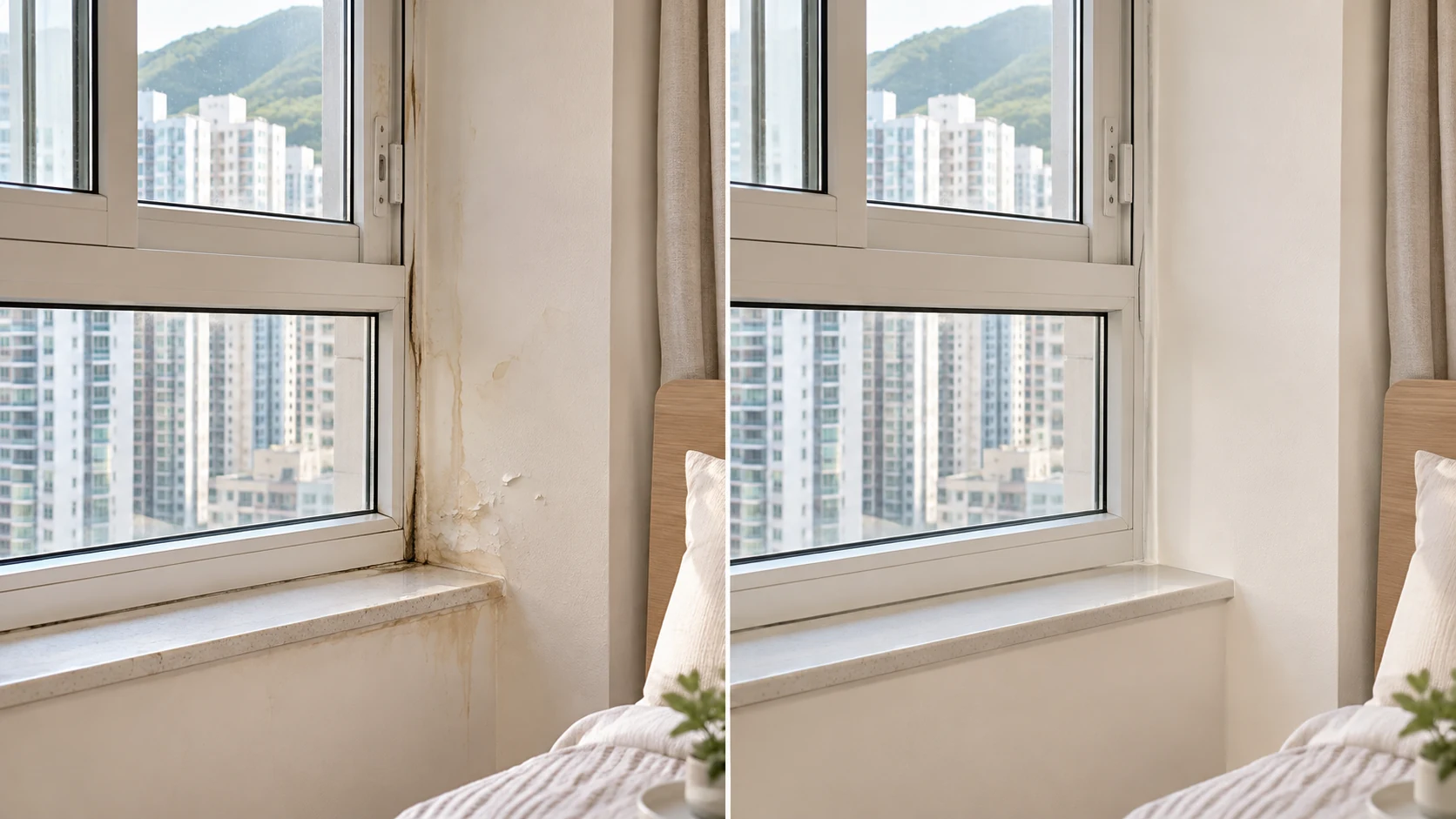
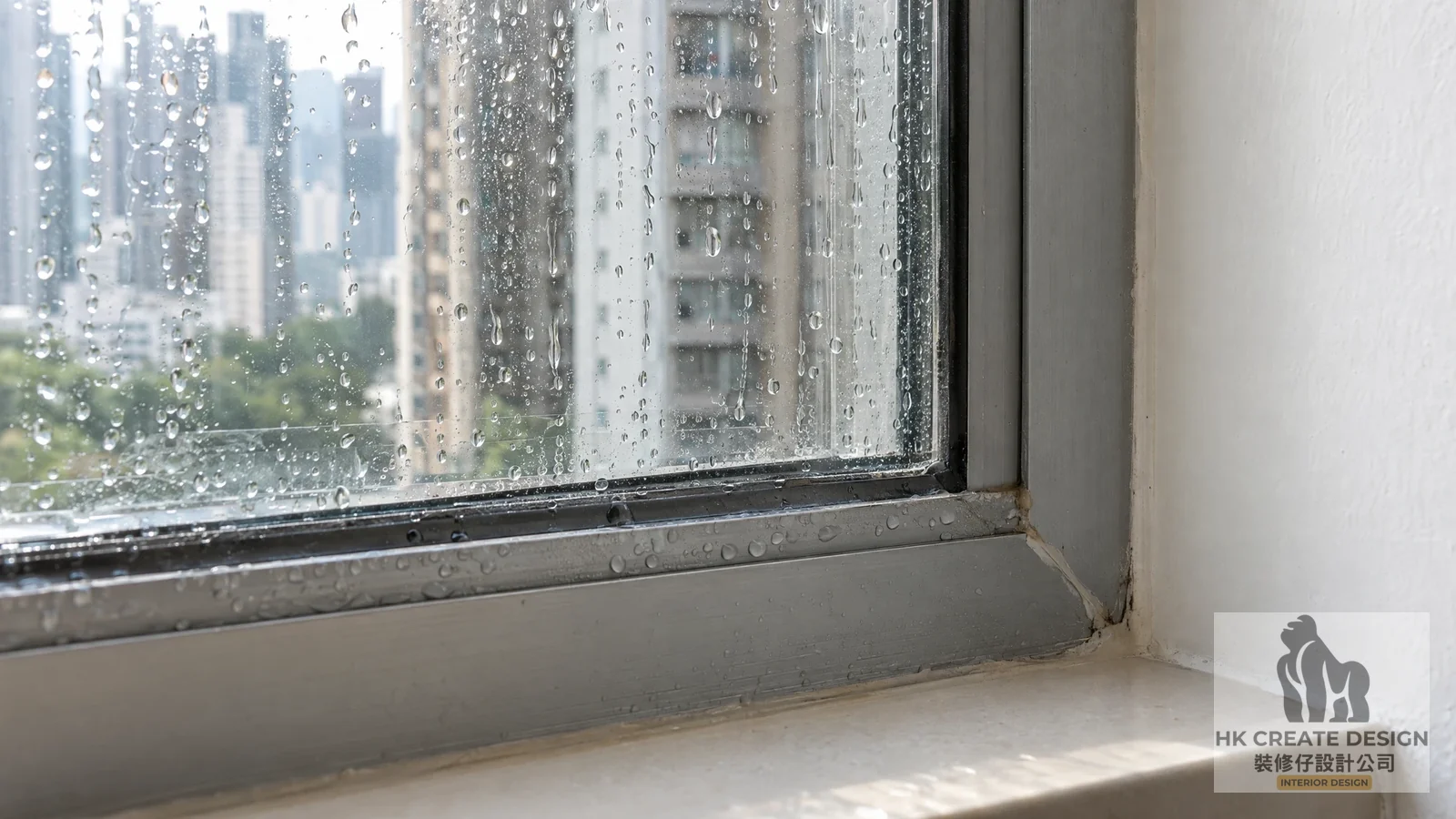
Make a water leakage log first: the location of the water mark is not equal to the source of the water.
For each water seepage, record the date, rain intensity and wind direction, window opening and closing, and the first wetted position, and take near and far photos of the four corners of the window frame, window rails, window sills, and walls. This information cannot make a final decision on its own, but it can give the on-site investigation a traceable starting point.
If marks appear only after driving rain, inspect the frame-to-wall junction, sash closure, sill and external wall interface first. If surfaces stay wet in dry weather, worsen after neighbours use water, or are well away from the window, investigate more than just theAluminium windows. The Buildings Department also lists supply and drain pipes, sanitaryware, and waterproofing to floors or bathtubs as common sources.[3]
Mildew, bubbling paint, and salt stains are the result of moisture, not the source. Mark the damp area first and contact a window assessor, construction technician or licensed plumber depending on the situation; if it spans units or public locations, it is recommended to notify the management office as soon as possible.
- The photos are named after the window positions such as "lower left corner of the east-facing window in the living room".
- The same event records rain intensity, wind direction, water usage upstairs and window status.
- Do not cut into walls, tear down windows or measure outside the window to find the source.
02
Split the window into three paths: wall connection, window sash, and drainage
The interface between the window frame and the wall fails, or there are cracks in the adjacent exterior wall/window sill, which can allow rainwater to enter; the key is to confirm which section of old material needs to be removed, whether the base surface is solid, and the actual line of new sealing. Do not cover the room with a layer of glue instead of searching for water inlets.
Aging of the rubber strips, misalignment of the window sash, and misalignment of the lock or hinge will cause the window sash to be insufficiently pressed. Seeing water indoors does not mean that you need to apply glue on the inside; the water may first travel along the profile and then appear on the inside. The quotation should separate the outer frame wall connection and the window sash pressing.
Dust accumulation on window rails or poor drainage can also cause water to take the wrong route. The Buildings Department recommends removing sediment from the hinges and window rails, cleaning them with clean water, and not forcing opening or closing or weighting the window sash.[2] Do not use sharp objects to penetrate the hole, remove the window sash or lean out of the window to handle it.
- Circle the wall joints, window sash gaps and window track/drainage locations in the photo.
- Ask about the basis for judging the water entry path and the starting and ending points of the construction line.
- Stop trying to open the window sash repeatedly if it gets stuck, falls or makes strange noises.
You can swipe left or right on your phone to view the complete table.
| Phenomenon and Evidence | Possible project scope | Quantity | The pricing method should be written clearly | Uncovered items and risks |
|---|---|---|---|---|
| Water comes out of the window corner or wall after heavy wind and heavy rain; with date, wind direction and distance photos | Check the interface between the outer frame and the wall, the window sill and the exterior wall; possible removal of old materials, treatment of the base surface and re-sealing | Window width and height, joint extension meters, floors | It can be calculated by meter/window level, but the old glue, protection and testing must be listed. | Exterior wall cracks, exterior access, finish repairs and management requirements may not be included |
| Water accumulates in the window rails or water overflows inside; take pictures of the drainage holes and rails | Check the drainage path, rubber strips, closure and adjustment | Number of sash, track length, hole position | List by sash, window level, parts or labor hours | When deformation or design failure occurs, simple dredging may not be effective. |
| Falling, strange noises, loose locks, rusty or cracked glass | Safety check first, then handle fixings, hinges or glass fixings as needed | Affected window sash, hinge position and number of parts | By number of sash, hardware set or parts; list material/size | There are risks of falling objects, heights and glass; do not dismantle windows by yourself |
| It’s still wet on a sunny day or it gets worse after using water upstairs. | Simultaneously check water supply and drainage, sanitary ware or floor waterproofing | Wet mark range, duration, coordination of adjacent units | Investigation, testing, opening and repair breakdown | Neighborhood/common location responsibilities and access arrangements may be negotiated separately |
Rainwater can enter through exterior walls, windows, etc.; water pipes, drainage, sanitary ware and waterproofing layers are also common sources. This form is a framework for questioning, not a diagnosis or standard fee schedule. [3] [3][2]
03
Safety Red Flags: Address Risks First, Compare Waterproofing Prices Later
Loose, missing or rusted fasteners, bent hinges, gray and white dust, cracked glass, abnormal noises, failure to lock properly, being too loose when opened, deformation and falling of window frames or sash are all signs of defects listed by the Buildings Department; leakage of window frames and sash, and water seepage around the window are also on the attention list.[2] A quote for glue repair cannot replace a safety inspection.
First, keep people away from under and beside the window. Do not pull, hang objects, add heavy objects, or remove the window sash by yourself. Aluminum windows have no fixed service life; the Buildings Department pointed out that failure of hinge rivets/screws due to corrosion or wear and tear was one of the main causes of window falling accidents in the past.[1]
Before quoting, make sure you know who is responsible for the corresponding inspections and procedures. When it comes to safety components, glass or window frames, verify applicable qualifications and registration information; do not assume that licenses, years of experience, ratings or track records are not provided as confirmation.
- Pat the hinges, fixings, locks, glass edges and the entire window. Do not test for looseness with bare hands.
- First isolate the location that may be affected by falling objects.
- Separate safety defect, waterproofing and finish repairs into separate quote items.
04
Mandatory window inspection and leak prevention works: related, but not in the same scope
If a building aged 10 years or above (except residential buildings not exceeding 3 storeys) receives a statutory notice, the owner must appoint a qualified person to inspect and supervise the necessary prescribed repairs; when repairs are required, they must be carried out by a registered contractor under his or her supervision.[4] Check the notice, window level, time limit and form first.
The time limit listed in the general information is 6 months for individual premises and 9 months for common parts, but the specific requirements of the notification and the Buildings Department will take priority.[4] Verbal dates for ordinary repairs cannot replace statutory arrangements, nor should unconfirmed minimum durations be written into commitments.
It is stipulated that repairs should not be inferior to the original design, and defective parts that affect safety must be repaired or replaced; weather-resistant sealants and rubber strips that do not affect safety are not within the scope of the regulations.[1] They can still cause leaks, so safety work and leak prevention work should be separated.
- Keep notices, appointment information and inspection records.
- Verify the registration/qualification of qualified persons and contractors.
- Verify the procedures before removing or modifying windows, window walls or protective components.
Example one: measuring outer frame joints on three windows
Assumptions
- For cases that are not completed by the company and are not construction instructions, the unit price of aluminum windows is not applied.
- Assume 3 windows each 1.20 m wide and 1.50 m high, with the contractor confirming that all four outer frame edges are included.
- 10% is reserved as a measurement and is purely for demonstration.
How to calculate quantities
- Perimeter of each window = 2 × (1.20 + 1.50) = 5.40 m.
- The basic volume of 3 barrels = 5.40 × 3 = 16.20 meters.
- After demonstration reservation=16.20×1.10=17.82 meters.
The preliminary verifiable joint amount is 16.20 meters; the amount reserved for demonstration is 17.82 meters. It's not material count, labor, duration, or price.
In reality, all four sides may not be processed, and the depth and width of joints, cracks in base materials, exterior walls, and external proximity are not reflected; you cannot do your own construction based on this. The company has not disclosed a fixed unit price for aluminum windows. [2][6]
05
On-site investigation and testing: Write methods and do not assume uniform water closure hours
The on-site records should separate the window position, window type, width and height, outer frame connection to the wall, window sash lamination, window track drainage, hardware, visible abnormalities in the exterior wall and interior finishes. If it is recommended to sprinkle water, colored water, humidity or other tests, first ask about the purpose, location, indoor observers, protection methods and how to record.
When the government handles water seepage investigations in private buildings, it will use non-destructive testing on a case-by-case basis; infrared thermal imaging and electronic hygrometers can be used when appropriate. In other cases, methods such as sprinkling or water storage can be used.[3] Window leaks do not all have a statutory 24- or 48-hour flood-test requirement.
If the results show that the water source is not in the window, the most valuable thing is to stop the construction in the wrong place. It is required that the conclusions be divided into "confirmed", "still to be confirmed" and "outside the scope of this project". If neighbors, exterior walls or public locations are involved, access arrangements will be dealt with first.
- Provide the number of windows, width and height, floors, orientation and fault fragments.
- Confirm water location, protection and record delivery before testing.
- How to check the source separately when specifying non-window source.
You can swipe left or right on your phone to view the complete table.
| Plan | Applicable premise | Project scope | Quantity/basis of pricing | Not covered and risk |
|---|---|---|---|---|
| Partial wall sealing | Local joint failures have been found, and there are no safety defects in windows and hardware. | Clean old materials, treat base surfaces, re-seal and inspect as scheduled | Specify seam meters or window level | Exterior wall cracks, interior renovation, and high-altitude access cannot be included by default. |
| Drainage, rubber strips and adjustments | Water accumulation or insufficient pressure, and no immediate defects are found in safety inspections | Clean accessible locations, check strips and adjust | Length of window sash, track, rubber strip and number of parts | Old window parts may not fit properly, the frame may be deformed, or the glass may have other problems. |
| Hardware/hinge repair | Safety signs such as looseness, rust, abnormal noise, failure to lock properly, etc. | Repair or replace safety components according to inspection results | Window sashes, hinges, fixings or hardware sets | Glass disassembly, external access and legal requirements are subject to verification |
| Entire window or window wall replacement/modification | Repairs cannot restore safety or functionality and need to be dealt with as a whole | Dimensions, removal, installation, sealing, protection and inspection | Width and height of each window, opening form, glass, floor and access conditions | Protective components, management procedures and procedures can significantly change arrangements |
Mandatory window inspections stipulate that repairs focus on defective components that affect safety; sealants and strips that do not affect safety are not within the scope of the regulations. The two types of projects should be quoted separately. [1] [1][2][4]
06
The quotation must be verifiable: location, process, and site conditions are separated into three layers.
The first floor lists the window position and number: room, width and height of each window, which section of seam, window sash, hinge position and fixings. The second level of processes: cleaning old materials, processing base surfaces, sealing, replacing rubber strips, adjustments, parts or glass work. The third level lists site conditions: protection, management arrangements, external access, removal and testing. Three floors are complete, so the two total prices can be compared.
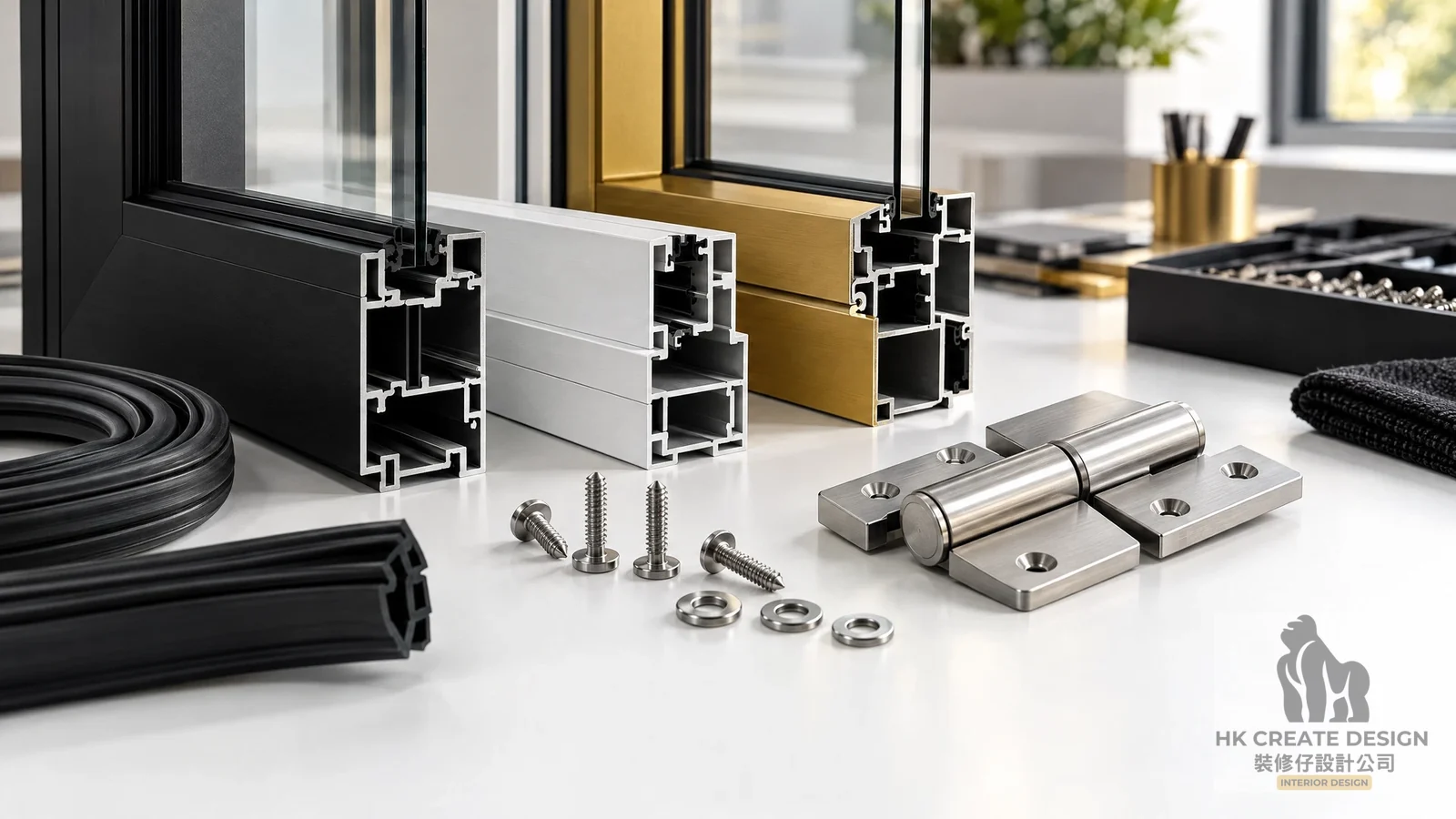
The material should not just say "leak-proof glue" or "high-end hardware." It is required to write down the product category, model or performance, applicable base material, size/compatibility; and it is agreed that if the base surface is loose, the window frame is deformed, the glass is damaged, or the exterior wall is cracked after disassembly, the price must be paid in writing before confirmation.
The Buildings Department points out that the cost of window inspection and repair is affected by the size of the building, the number and size of windows, the maintenance status and the market environment. It is recommended to obtain itemized quotations for comparison.[1] Therefore, this article does not make up Hong Kong’s average price per window, payment ratio or guaranteed construction period.
- Copy the fields from both tables to each inquiry.
- Clearly list whether exterior walls, exterior access, management fees, glass, finishes and removal are not included.
- Change "stop leakage" to include maintenance applicable location, period and processing method from another source.
07
Material information can be verified, but it cannot replace joint judgment.
Product name is not a substitute for seam design. An example is DOWSIL 791: the manufacturer lists it as a one-component, medium-modulus weathering silicone adhesive for general weathering, glass and curtain wall joints, with a stated ±50% joint displacement capability.[5] This is only specified product information and is not an exclusive recommendation or guarantee of leak resistance for any aluminum window.
Questions should be asked about the substrate, old glue/powder coat, joint size and movement, whether primer or backing is required, contact with glass/coating/aluminum, and protection when uncured. These will change material compatibility and construction methods. You cannot just look at the word "weather resistance".
Strips, fasteners, hinges and latches should be compatible with the original design and window type. The Buildings Department recommends that when replacing window hinges, at least three rivets or screws should be used; when replacing stainless steel window hinges or their fixings, stainless steel fixings should be used.[1] This is not a tutorial for residents to install themselves.
- It is required to list the material model or performance and compatibility basis.
- Do not think of glass fixing, window hinge supports and weather sealing as being solved by the same glue.
- Keep material information, photos and part quantities.
Example two: how much two “resealing” scopes can differ
Assumptions
- Not a company quote or recommended solution.
- Assume 4 windows of 1.20×1.50 meters; each window has 2 sash windows of 0.60×1.50 meters.
- A only counts the outer frame; B assumes that there are 8 sash windows on all four sides, but it has not been confirmed that these lines need to be processed.
How to calculate quantities
- Outer frame length = 2 × (1.20 + 1.50) × 4 = 21.60 m.
- Window sash=2×(0.60+1.50)×8=33.60 meters.
- The total of B is 55.20 meters; the difference is 33.60 meters, which is more than A (33.60÷21.60)×100=155.56%.
The two hypothetical ranges with similar names are 21.60 meters and 55.20 meters; you should first ask about the construction line, removal of old materials and acceptance, not the total price first.
The edges of the window sash may not be constructed or require sealing, and water leakage may also come from the exterior wall or drainage. There is no price in this example because the company has not disclosed the fixed unit price of aluminum windows. [3][6]
08
Our company’s estimate and scale: prepare the information first, don’t use it as an aluminum window pricer
The company's online estimates and enquiries are free. WhatsApp 5243 7747. On-site measurement is free through 31 December 2026 for two or more work items, with no deposit. After that, the HK$500 fee is credited against the order.[6] Before the access, safety conditions and management arrangements for aluminum windows are clear, do not dismantle them or lean out of the window for measurement.
The calculator has 117 projects and supporting options in 8 categories; 116 items have reference unit prices, and 1 rooftop package is pending price revision. However, there is no fixed unit price for aluminum windows and they are not included in the quick budget. They must be separately evaluated based on the problem, quantity, site conditions and construction arrangements.[6] It is not the Hong Kong market average price.
The three quick examples cover basic whole-flat renovation, repainting and floor tiling. They do not price aluminium windows. Saleable area × 3 is an initial paint-area estimate. The 20% is an owner's contingency. Full kitchens and bathrooms, services, furniture and finishes are excluded.[6]
- Please prepare the number of windows, width and height, floors, photos, videos and management requirements before contacting us.
- First confirm the applicability of the HK$500 scale and rebate arrangement.
- Aluminum windows, paint and wall repairs should be separated and should not be called a full house package.
09
Collaboration and acceptance of exterior walls: The scope of inspection has been agreed, but there is no guarantee that it will never leak again
Facades, management rules, deeds of mutual covenant, construction access and common locations may affect arrangements; this article cannot determine liability in any individual case. The Buildings Department pointed out that rainwater seeping through external walls, rooftops, balconies or windows is generally not within the scope of the joint office's follow-up action according to nuisance procedures, and may require the corporation to arrange professional inspections and necessary repairs.[3]
Before starting work, write down the procedures for processing windows, processes, materials, testing, protection, removal, unpackaged items and changes. After completion, check the construction lines, replaced parts, switch locks, photos and test records window by window; completion of partial sealing does not mean that the exterior walls or pipes have been completely eliminated.
When leakage occurs again, compare the location, weather and original treatment line: the same location and conditions can be reviewed according to written arrangements; different patterns may be another source. Clean with clean water on a daily basis. Do not use detergents or lubricants that can corrode parts. Do not forcefully push, pull or weight the window sash.[2]
- Save quotes, changes, receipts, materials, testing and administrative documents.
- Record the processing window performance after the next similar weather.
- Stop using it and call for help if there is cracked glass, falling glass, loose locks, or unusual noises.
FAQ
7 practical questions answered
01Does a leaking aluminum window require the entire window to be replaced?
uncertain. When it is confirmed that only local joints, drainage or strips are present, and there are no safety defects in the window frames, sash, glass and hardware, local treatment may be sufficient. If there are deformations, drops, cracked glass, loose or rusted fasteners, loose locks, or repeated leaks without being able to identify the source, first evaluate and then compare repairs and replacements.[2]
02It only leaks during typhoons or heavy rain. Is it definitely the window frame glue?
Not sure. This mode makes window frame to wall, window sash lamination and exterior wall interfaces worthy of priority inspection, but rainwater can also enter through exterior walls, balconies, platforms or rooftops. Record the wind direction, rain intensity, window status and the first location of water marks before making a judgment.[3]
03Does mandatory window inspection include re-applying waterproofing glue or replacing the tape?
The Buildings Department explains that weather-resistant sealants and strips that do not affect safety do not fall within the scope of mandatory window inspection.[1] They may still be leak prevention projects and should be listed separately; completing the window inspection does not mean that all water seepage has been resolved.
04After receiving the mandatory window inspection notice, can ordinary repairs be carried out directly?
Notified cases must appoint qualified persons to inspect and supervise the necessary repairs according to the plan; when repairs are required, they shall be carried out by registered contractors.[4] Check the notice and registration information first, and do not judge based on verbal titles alone.
05Why are the two quotes that are both called "glue repair" so different?
The scopes may differ: part or all of the frame, inclusion of the sash, removal of old material, surface preparation, outside access, testing and reinstatement. Ask the contractor to mark the work lines and quantities on photos. The 155.56% in example two illustrates a possible quantity difference, not a price.
06Can I use the company’s online calculator to calculate the aluminum window repair costs first?
Preliminary budgets for other listed projects can be checked free of charge, but no extrapolation can be made for aluminum windows. The company explains that there is no fixed unit price for aluminum windows and it needs to be evaluated based on the problem, quantity, site conditions and construction arrangements.[6] Site measurement is free through 31 December 2026 for two or more work items, with no deposit. After that, the HK$500 fee is credited against an order.
07Is it guaranteed to never leak again after completion testing?
cannot. Testing only reflects the agreed location and prevailing conditions; actual rain direction, exterior wall conditions, other water sources and subsequent part changes all vary. Save the record and compare it to the same location and situation if it leaks again.
CHECK THE BASIS
Data and technical basis, sources can be verified
- [1]Buildings Department: Frequently Asked Questions on Window Maintenance Accessed: 2026-10-21
- [2]Buildings Department: Window Safety Tips Accessed: 2026-10-21
- [3]Buildings Department: Frequently Asked Questions on Water Seepage Problems Accessed: 2026-10-21
- [4]Buildings Department: Mandatory Window Inspection Scheme Accessed: 2026-10-21
- [5]Dow: DOWSIL 791 Weatherproofing Sealant Product Information Accessed: 2026-10-21
- [6]HK Create Design: 2026 Company Price List and Budget Calculator Instructions Accessed: 2026-10-21