01
Four aluminium window styles at a glance
Side-hung casements swing out on stays and are common in Hong Kong homes. Closing the sash compresses gaskets around its perimeter, usually improving sealing, sound insulation and rain resistance. They give a large opening but need exterior clearance, secure locking in typhoons and regular checks. The Buildings Department identifies corroded stay screws and rivets as a cause of falling windows.[3]
Sliding sashes move sideways on tracks without projecting outwards, useful on balconies or beside an air conditioner or planter. A typical two-panel slider opens to about half the width. Dirt and standing water in the track can affect drainage and sealing.
A top-hung sash pivots at the top and opens outwards at the bottom. It can allow ventilation in light rain and suits bathrooms and kitchens. A fixed light has no opening hardware, so is generally the simplest and cheapest choice for the centre of a large window or where ventilation is unnecessary.
- Casement: good seal, with stays to maintain
- Sliding: no swing space; roughly half-width opening
- Top-hung: ventilation in light rain
- Fixed: stable and economical
02
Which opening style suits each room?
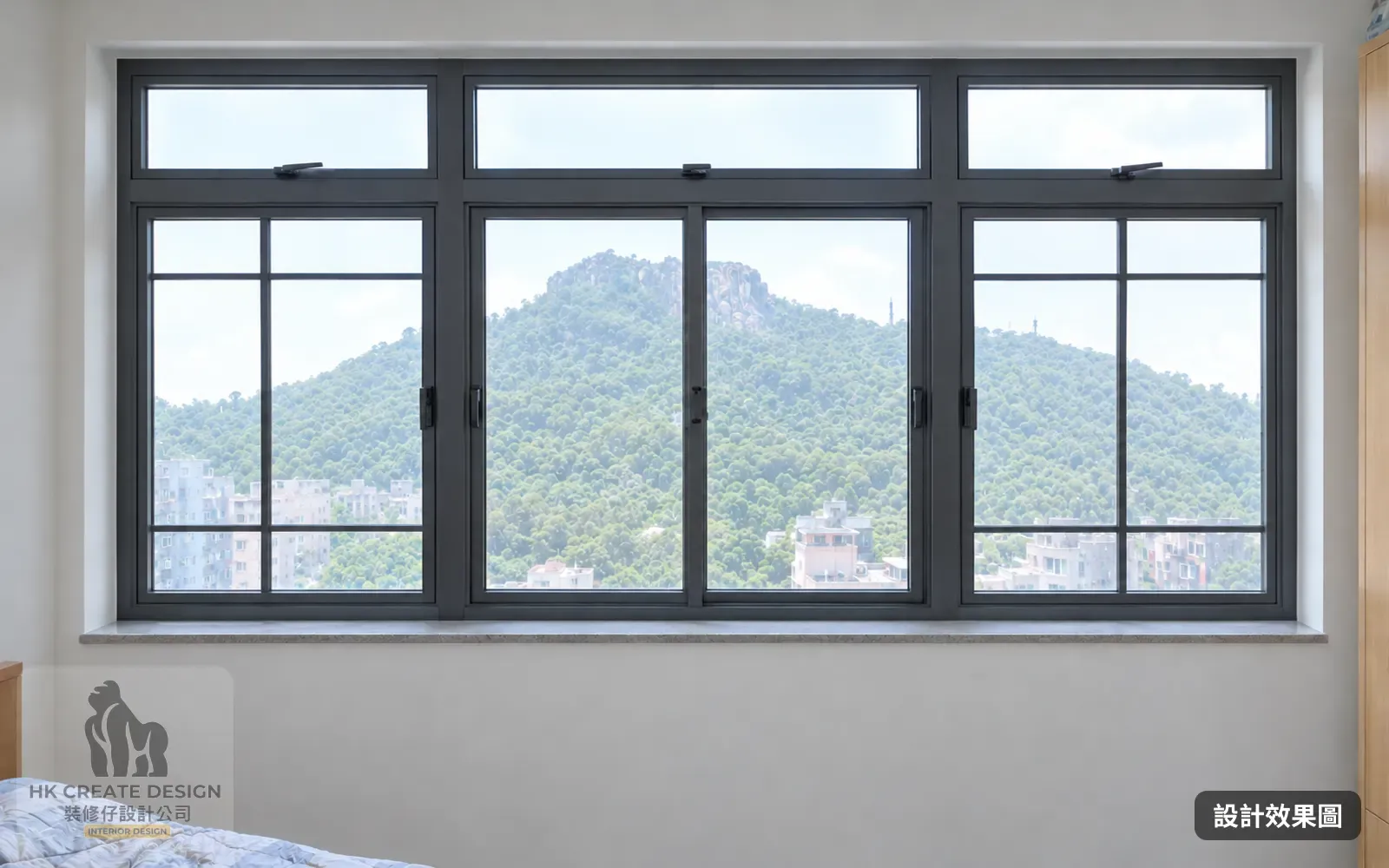
For a bedroom by a busy road, casements with insulating or laminated glass can help control noise. If an air-conditioner bracket obstructs the swing, consider a slider. A large living-room window can combine a fixed centre with side casements for views, ventilation and fewer stays to maintain.
Top-hung windows or small casements can clear humidity and cooking fumes. Frosted or patterned bathroom glass provides privacy. In children's rooms, check sill height and opening width, and provide restrictors or protective barriers where needed.[2]
Our designers use SketchUp and 3ds Max to show the frame proportions and opening direction in the flat before you order.
- Bedroom: casements with acoustic glazing
- Living room: fixed centre and opening sides
- Bathrooms and kitchens: top-hung
- Children's rooms: restrictors and barriers
You can swipe left or right on your phone to view the complete table.
| Style | Sealing and sound insulation | Openable area | clean | Main maintenance tasks | Suitable locations |
|---|---|---|---|---|---|
| Casement window | Generally better | Large | Outside surface difficult to reach | Stays and rivets | Bedrooms and living rooms |
| Sliding windows | Typical | Up to half the opening | Easier | Tracks and drainage holes | Balconies or windows facing an air conditioner |
| Top-hung window | Generally better | Small | Typical | Hinges and stays | Bathrooms and kitchens |
| Fixed window | Best | No | Hard to clean the outside | Apply sealant | Centre of a large window |
Based on HK Create Design's residential projects. [10]
03
Comparing clear, toughened, laminated and insulating glass
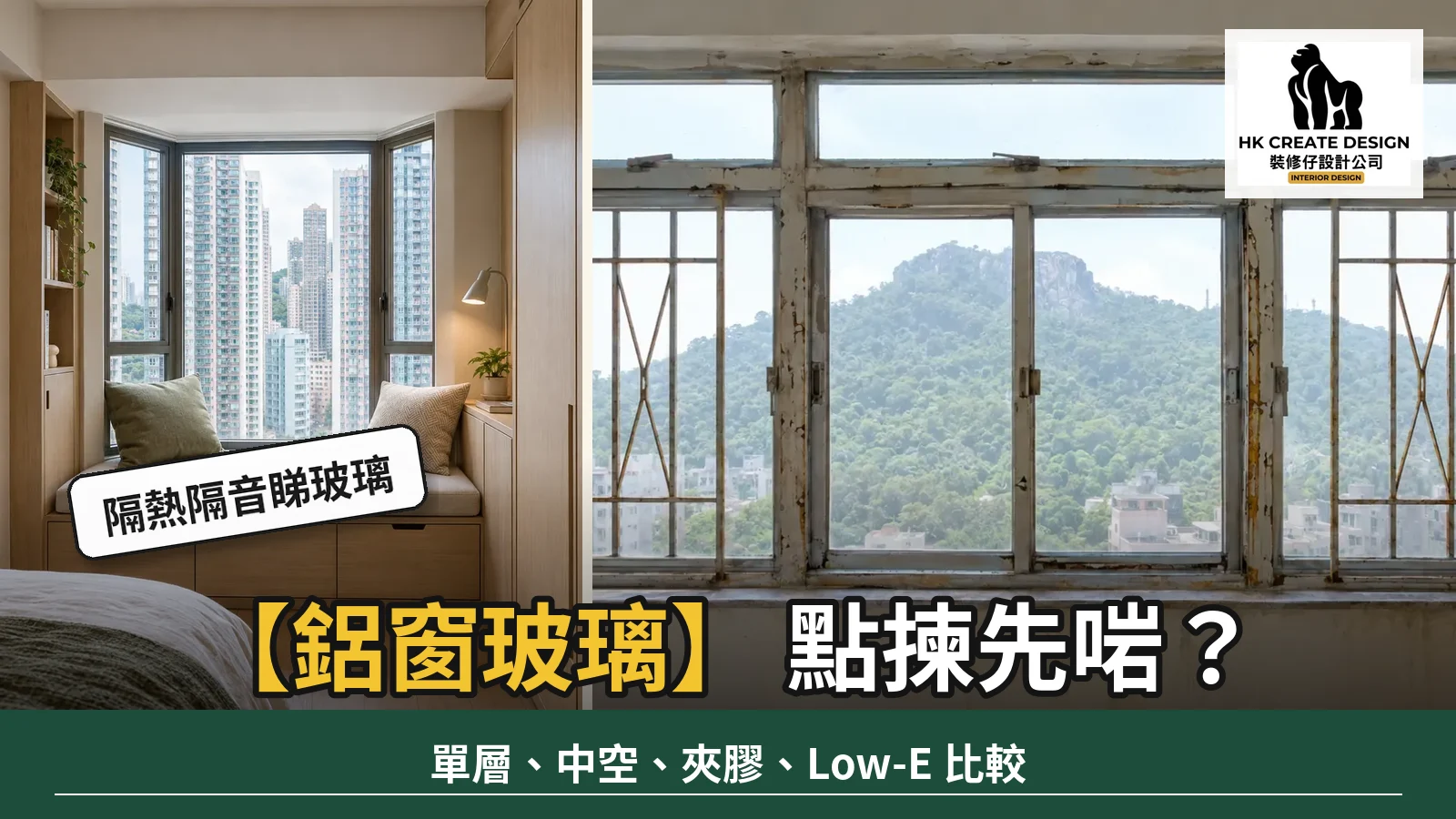
Clear annealed float glass is the least expensive but can break into sharp shards. Toughened glass is heat-treated for strength and breaks into small pieces. Nickel sulphide inclusions can cause spontaneous breakage. The Buildings Department's glass code recommends heat-soak testing to identify and reject susceptible panes before installation.[1]
Laminated glass has an interlayer between two panes. Broken fragments tend to remain bonded to it, improving retention and sound insulation. The glass code specifies toughened or laminated glass for external glazing that also serves as a protective barrier.[1] An insulating glass unit has two panes separated by an air space. It can improve thermal and sound insulation in west-facing rooms and homes near traffic.
Confirm the glass thickness, build-up and supplier with the installer and include these details in the quotation.
- Clear glass: low cost, sharp fragments if broken
- Toughened: ask about heat-soak testing
- Laminated: retains fragments and helps reduce noise
- Insulating glass units: thermal and sound insulation
「For a large living-room window, we often suggest a fixed centre with opening side casements. It preserves the view and, in this layout, halves the number of stays needing maintenance.」
04
Frame profiles and surface finishes
Aluminium windowsThe profile is the aluminium extrusion used in the frame and sash. Check its series, wall thickness and cross-section. A suitably substantial profile improves durability and wind resistance but raises the price. High floors and coastal homes may have greater wind exposure.
Powder coating and anodising differ in colour choice and weather resistance. Typical local colours include white, champagne, brown and black. Black suits modern interiors, but check the external appearance and any restrictions in the estate deed.
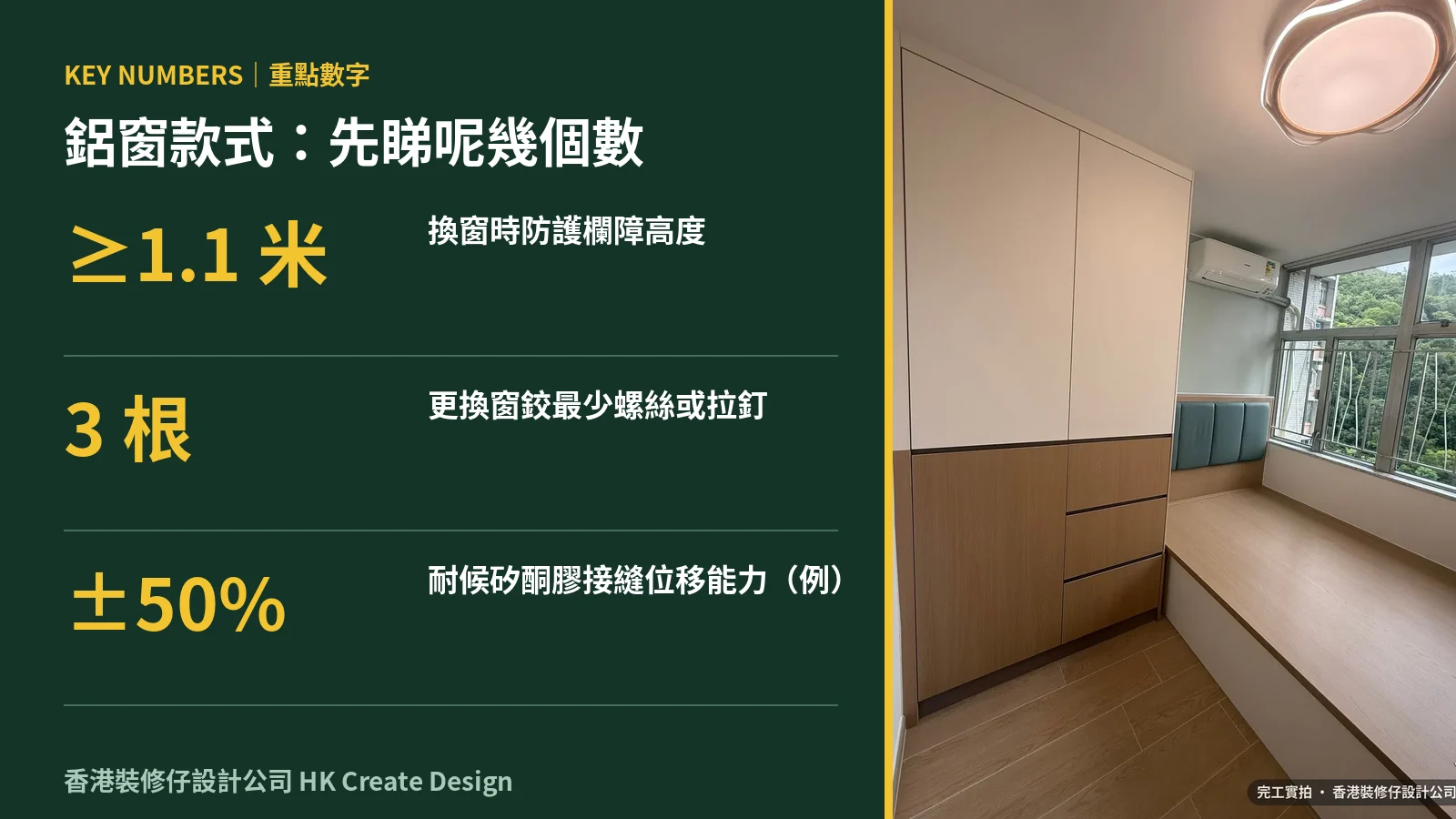
Gaskets and seals: the Buildings Department's glass code specifies compatible materials such as silicone or EPDM for use with silicone sealants.[4] A weatherproof silicone such as DOWSIL 791 can be used around the frame. The manufacturer rates its joint movement capability at ±50%.[5]
- Ask for the profile series and wall thickness
- Surface finish and colour
- Gasket material and perimeter sealant
05
Hardware: stays, locks and opening restrictors
The main casement fitting is the four-bar friction stay. The Buildings Department specifies at least three screws or rivets for a replacement stay and stainless steel fasteners for stainless steel stays.[6] Apply the same principle when specifying stainless steel hardware for new windows.
Common fittings include cockspur handles and multipoint locks. On a large sash, locking at the top and bottom helps keep it secure in strong winds. Opening restrictors can limit the swing in homes with children.
Indicative hardware repair costs per sash: HK$170–200 for hinges, HK$70–100 for a cockspur lock and HK$70–100 for a multipoint lock.[7] Well-made hardware can help reduce later repair costs.
- Stainless steel stays with stainless steel fasteners
- Use a multipoint lock on a large sash
- Consider opening restrictors for homes with children
06
Safety requirements for barriers and minor works
The Buildings Department's guidance on window-related minor works calls for a protective barrier at least 1.1 m high where the existing sill is too low for the replacement window.[2] This is a basic safeguard for residents, particularly children.
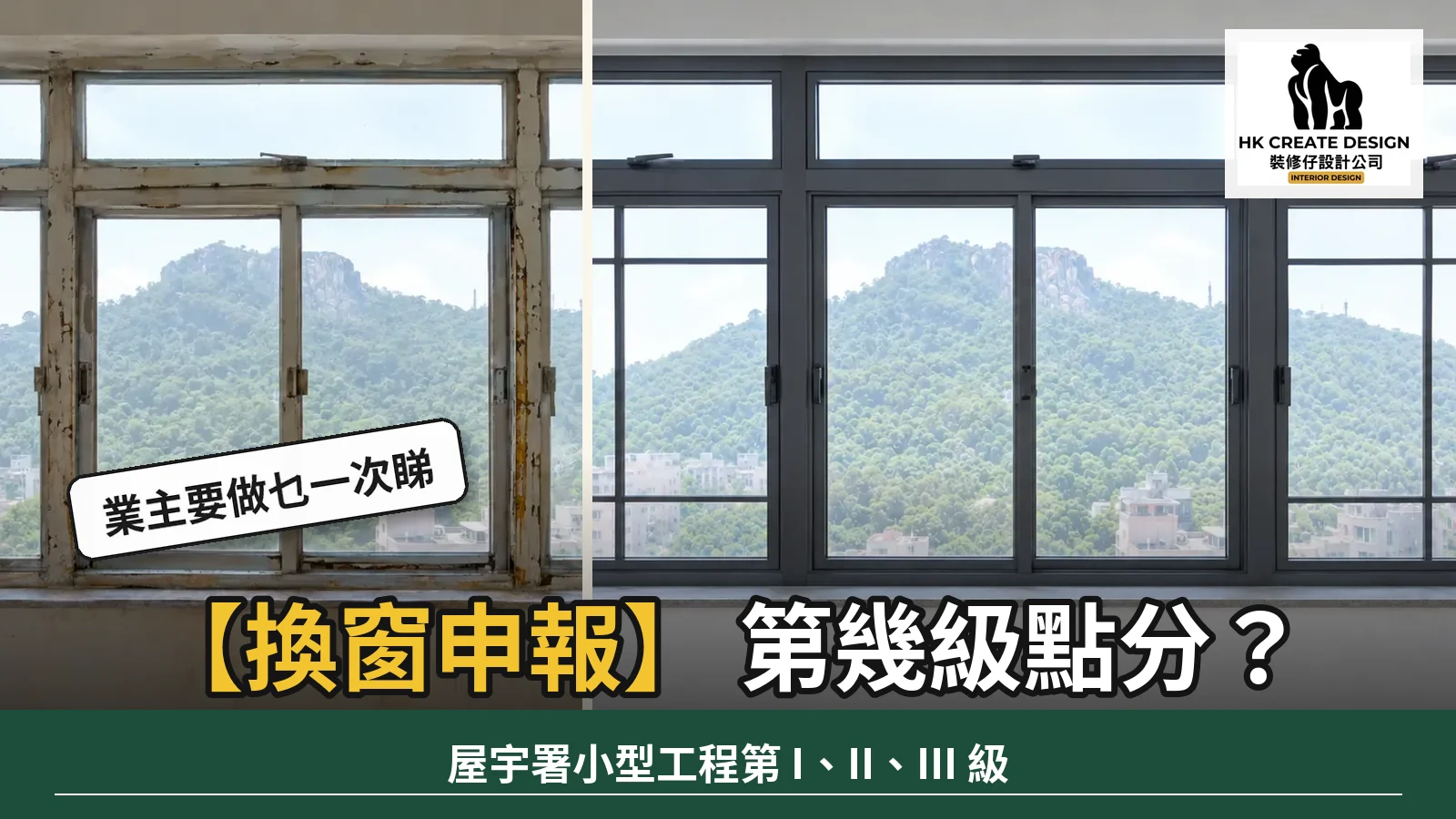
For a highest point over 3.5m and up to 100m, a span of at most 6m and work involving the main frame or a sub-frame longer than 1.2m, Class II item 2.8 may apply. Class III item 3.6 covers qualifying work involving only a sub-frame no longer than 1.2m. Like-for-like repair or replacement outside items 2.8 and 3.6 may fall under Class I item 1.60. Check each item’s full conditions.[2]
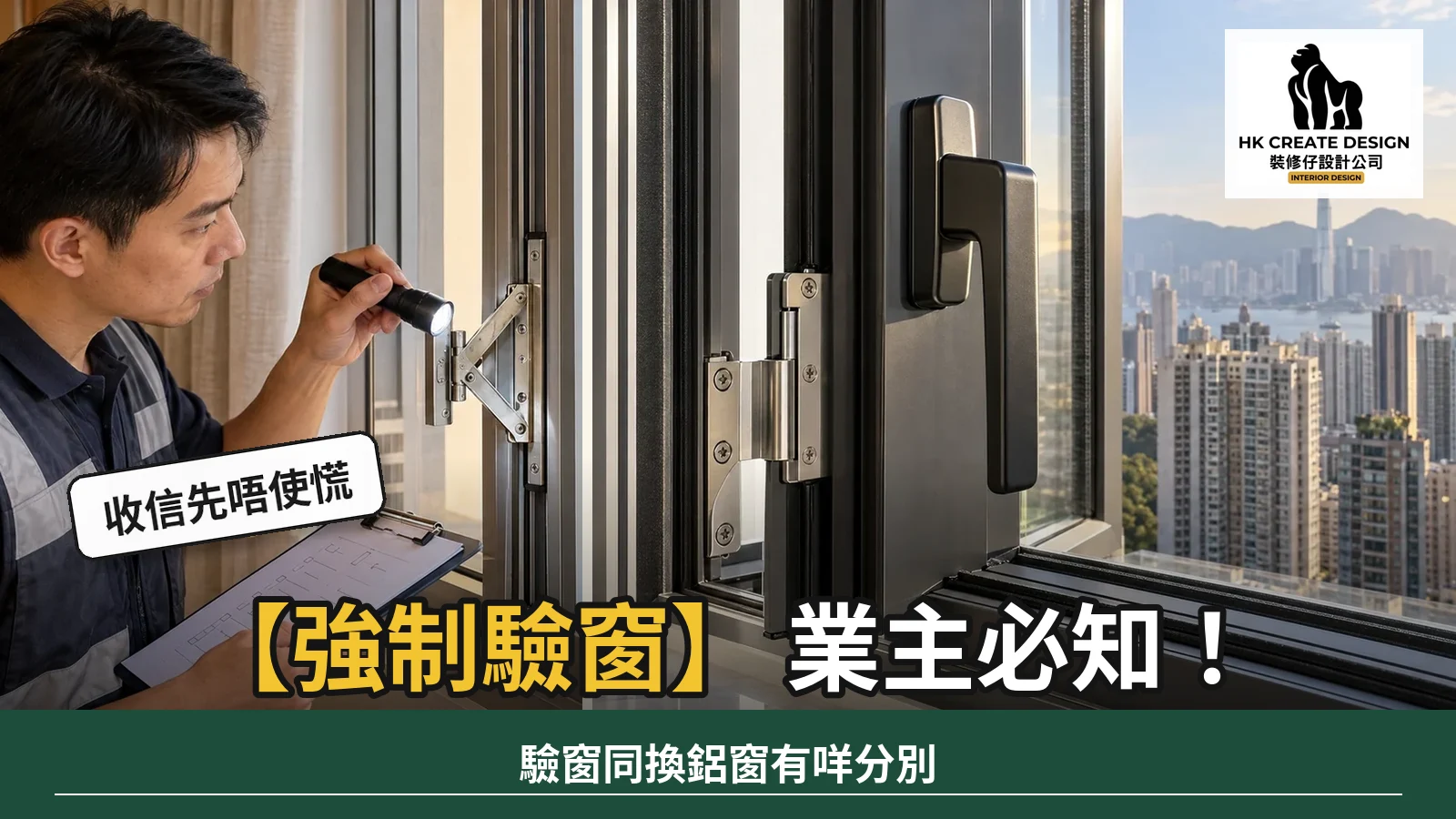
Changing from sliding to casement windows or resizing the opening can depart from the original design. An authorised person may need to handle the work. Further reading:Window replacement under the Minor Works Control Systemhow to file the paperwork. According to government figures, between 25,772 and 49,930Mandatory window inspectionNotice [11]. Before replacing windows, check whether your building has received a notice.
- Low sill: barrier at least 1.1 m high
- Confirm the minor works classification
- Check whether a proposed change falls within the original design
Example: choosing windows for a two-bedroom flat
Assumptions
- One large living-room window near a road
- Two bedrooms with one window each, one facing an air-conditioner bracket
- One small bathroom window
How to calculate quantities
- Living room: fixed centre, casements either side, and laminated or insulating glass for noise control
- Main bedroom: casements with multipoint locks
- Small bedroom: use a slider where an air-conditioner bracket obstructs the swing
- Bathroom: top-hung with frosted glass
Matching each window to the room reduced the number of casement stays to maintain while providing sound insulation, ventilation and privacy.
Check the original design, the relevant minor works class and any estate deed restrictions before changing the style. [2]
07
How Hong Kong's climate affects window choice
Typhoons in summer and autumn make wind resistance and water tightness important on high floors. Hong Kong Observatory climate data put average relative humidity at about 78%.[8] Humidity can accelerate hardware corrosion and encourage mould on sealant.
On wind-exposed elevations, consider casements with compression seals. On sliding windows, check the drainage detail. For coastal flats, specify a corrosion-resistant finish and stainless steel hardware.
Close and lock windows before a typhoon and inspect the sashes and glass afterwards. The Buildings Department's maintenance guide covers clearing grit from the stay channels, applying lubricant sparingly and washing frames with clean water.[9]
- Wind-exposed elevation: casement
- Sliding windows: check the drainage holes
- Coastal homes: corrosion-resistant finish
08
Eight questions to ask the window contractor
1. Which style do you recommend and why? 2. Which profile series will you use and how thick are the walls? 3. What glass type, thickness and build-up are included? Has the toughened glass been heat-soak tested?[1] 4. Which hardware brand is included, and are the stays and rivets stainless steel?[6]
5. How will you repair and waterproof the opening after removal, and which perimeter sealant will you use? 6. Are scaffolding or a suspended working platform needed and included? 7. Which minor works class applies and who files the documents?[2] 8. How long do the workmanship and material warranties last, and what does each cover?
An installer who can answer these eight questions should be able to put the details in writing. HK Create Design includes them in our quotations.
- Reason for the opening style
- Profile, glass and hardware specifications
- Removal, making good and waterproofing
- Scaffolding, submissions and warranty
You can swipe left or right on your phone to view the complete table.
| Glass | Features | Note |
|---|---|---|
| Clear glass | Lowest price | Breaks into sharp fragments |
| Toughened glass | High strength; breaks into small pieces | Heat-soak testing reduces the risk of spontaneous breakage |
| Laminated glass | The interlayer holds fragments and can improve sound insulation | Higher cost |
| Insulating glass unit | Thermal and sound insulation | Heavier; check the frame capacity |
See the Buildings Department's Code of Practice for Structural Use of Glass 2018. [1]
09
Window replacement sequence and timing
1. Measure the opening and confirm the style, glass and colour. 2. Approve the quotation and pay the deposit. Profiles and glass are made to measure, usually over several weeks. 3. During installation the contractor removes the old window, cleans the opening, aligns the new frame level and plumb, then fits the glass and hardware.
4. Seal the perimeter and make good the plasterwork and paint inside. 5. Test opening, closing, locking and water resistance, including a spray test where needed. 6. For minor works, the registered contractor files the required documents.[2]
Arrange for someone to be at home on installation day and move furniture away from the windows. High-level work stops during typhoons, so allow flexibility in the programme.
- Measure and confirm the style
- Several weeks for fabrication
- Installation and finishing
- Testing and submissions
10
Choosing a frame colour and finish: grey, black, white or champagne
Dark grey, black, white and champagne are common frame colours in Hong Kong homes. Dark grey and black suit modern interiors and show marks less readily. White works with lighter rooms but can show yellowing. Champagne is common in older estates.
Common finishes are powder coating and anodising. Powder coating offers many colours and good scratch resistance. Anodising gives a metallic appearance and good weather resistance. Consider the orientation and salt exposure, especially near the coast.
Before ordering, ask management whether the estate requires a uniform external frame colour. An unapproved colour could mean replacing the frames again.
We bring colour swatches to site or show physical samples at our Wong Tai Sin showroom. Our team can also prepare 3D views of the proposed replacement.
- Dark grey and black are popular choices
- Choose a corrosion-resistant finish near the coast
- Check the estate's façade requirements first
- Choose from physical colour samples
- Consider the room's useBedrooms, kitchens and bathrooms have different needs.
- Choose the opening styleCasement, sliding, top-hung or fixed.
- Choose the glazingClear, insulating, laminated or low-emissivity glass.
- Choose the frameAluminium thickness, colour and surface finish.
- Check against the quotationMatch the specifications and submission scope item by item.
Compiled by HK Create Design.
11
Coordinate the sill, grille and air-conditioner opening
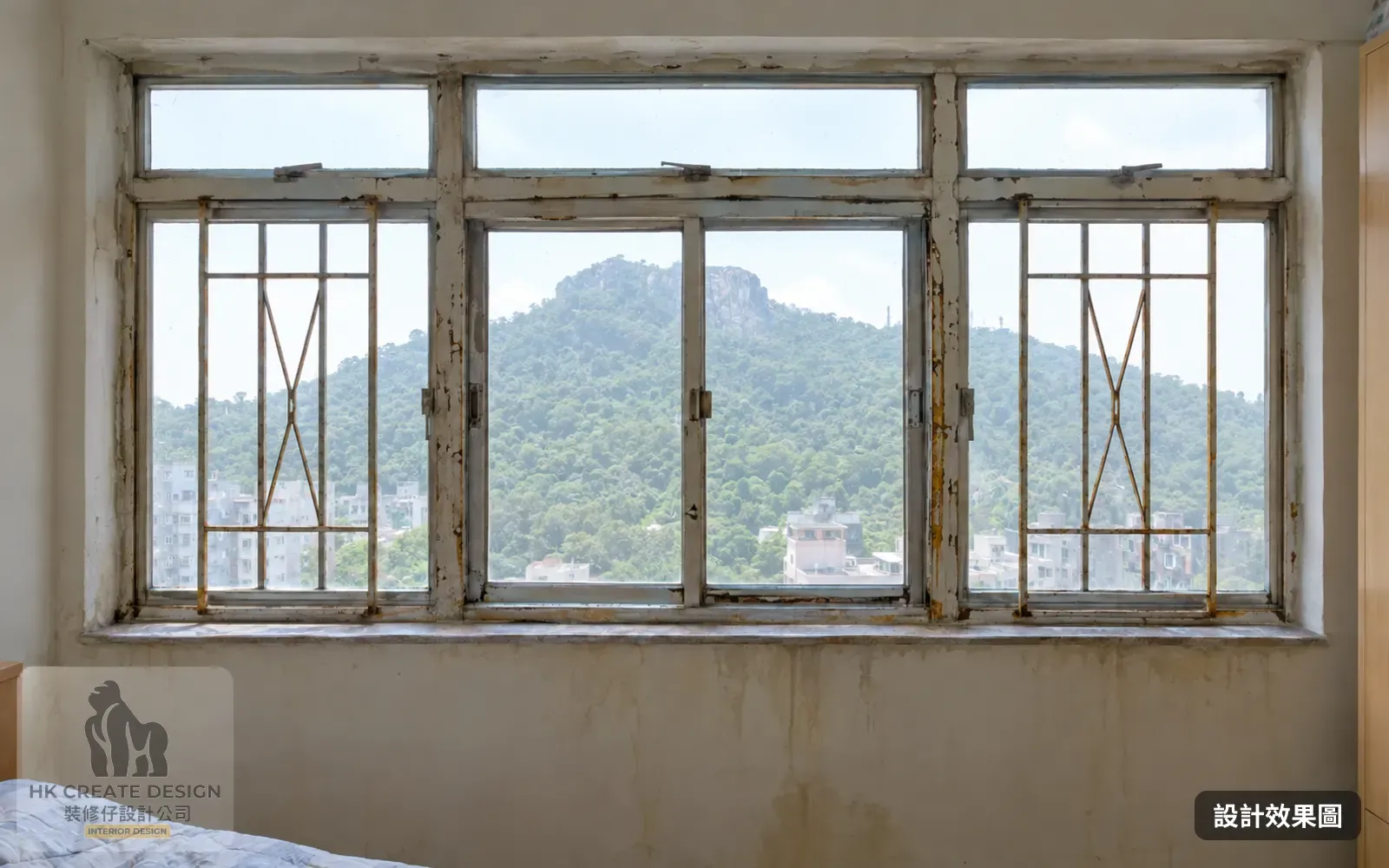
A window replacement can also address cracked sills, corroded grilles or an opening that does not fit the air conditioner. Coordinating these items saves reopening the area later.
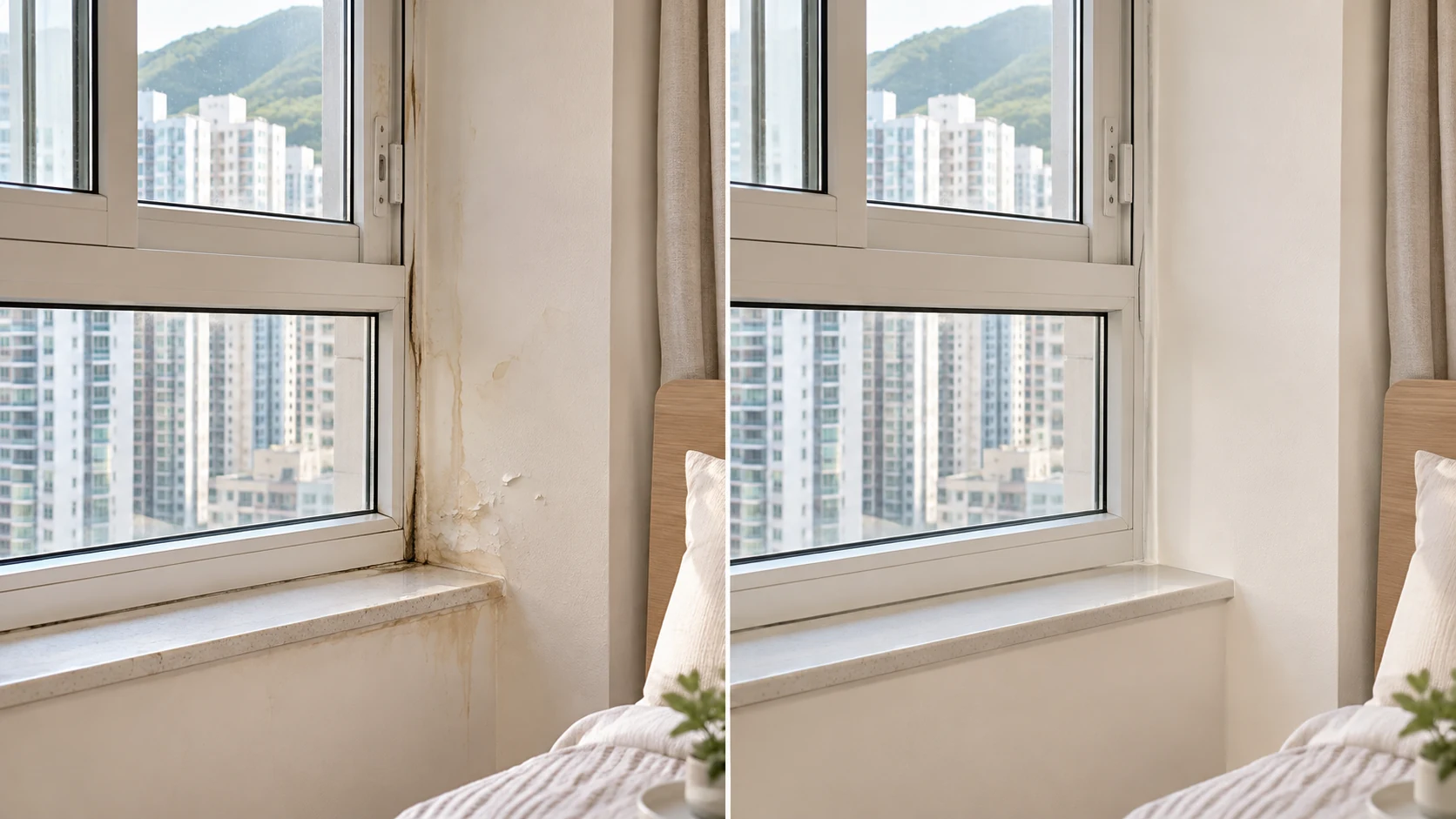
Repair cracked render or signs of water ingress and restore waterproofing before fitting the window. Decide whether to retain the grille according to safety needs. Families with children may consider a suitable cable grille or opening restrictor while preserving the view.
Size a window air-conditioner opening to the appliance and finish all four edges to keep rain out. For a planned split system, allow for a wall penetration for the pipework.
Window alterations may fall under the Minor Works Control System and require the appropriate registered contractor and submissions[2]. HK Create Design coordinates the windows, plastering, painting and air-conditioner openings.
- Repair and waterproof cracked sills first
- Window grilles: safety and sightlines
- Finish all four edges of the air-conditioner opening
- File the applicable submissions for alterations
Example: choosing sash or full replacement for a draughty sliding window in an older building
Assumptions
- Structurally sound frame
- Only the sash is distorted or the gaskets have aged
- Keep the original style and dimensions
How to calculate quantities
- Have a qualified person check the frame, stays and rivets first
- Sound frame: consider replacing the sash, gaskets and hardware
- Corroded or distorted frame: consider a complete replacement to the original design under the applicable minor works procedure
Assess the frame before deciding whether to replace the sash alone or the complete window.
Follow Buildings Department requirements for minor works. Obtain a site-specific quotation. [2][3]
12
Six habits for looking after aluminium windows
1. Clean frames and tracks regularly, especially on sliders where grit can obstruct the sash. 2. Inspect stays and screws every six months and have loose or corroded fittings repaired. 3. Lubricate stays and locks sparingly, as excess oil attracts dust.
4. Check for darkened or cracked perimeter sealant and arrange resealing where necessary. 5. Close and lock all windows before a typhoon. 6. Never hang heavy items on a sash or wrench it open.
The Buildings Department's window maintenance guidance asks owners to check windows regularly and arrange prompt repair when defects appear[9]. Under the Mandatory Window Inspection Scheme, private buildings aged ten years or more can be selected for periodic inspection[6].
HK Create Design repairs window stays, locks and perimeter seals. Find itemised prices in our website calculator[10].
- Clean tracks regularly
- Check stays every six months
- Arrange resealing if the perimeter sealant cracks
- Close and lock before a typhoon
- Better weather sealCasement windowGood sound and draught control. Allow clearance for the outward swing and maintain the stays.
- Saves spaceSliding windowsSliding windows suit balconies and tight spaces. They generally seal less tightly, provide less sound insulation and need regular track cleaning.
Typical comparisons. Performance varies with the model and installation.
13
Eight specifications to align when comparing window quotations
Compare like-for-like profile models and thicknesses, glass type and thickness, hardware brands for stays, locks and handles, frame colour and finish, and sealant. Check whether removal, disposal, minor works submissions and the warranty are included.
The aluminium profile thickness and the hardware manufacturer are easy to overlook. A thinner profile may provide less wind resistance, and poor-quality hardware may rust within a year or two. Specify a weather-resistant sealant for external joints[5]. Interior glazing silicone is unsuitable as a substitute.
Glass also matters. Toughened and laminated glass cost more but can improve safety. Consider safety glazing in high-rise homes and windows overlooking a street[1].
Our quotations itemise these specifications, allowing customers to compare like for like and choose a window suited to their home.
- Aluminium profile model and wall thickness
- Glass type and thickness
- Hardware manufacturer
- Sealant specification and submissions
You can swipe left or right on your phone to view the complete table.
| How to address it | Features | suitable for |
|---|---|---|
| Powder coating | Many colours and good scratch resistance | Most homes |
| Anodising | Metallic finish and good weather resistance | For a metallic appearance or a coastal flat |
| Woodgrain transfer finish | Woodgrain appearance | For a warmer colour scheme |
Finishes vary between manufacturers and models. Look at a physical sample before ordering. [10]
14
Recommended window styles by room
For a bedroom facing traffic, consider a well-sealed casement with insulating or laminated glass. In a child's room, provide an opening restrictor or protective barrier as appropriate.
For an open view, combine a large fixed pane with smaller casements for ventilation. Low-emissivity glass can reduce solar heat in a west-facing living room.
Casements and top-hung windows can help clear cooking fumes. A top-hung sash can offer some ventilation in light rain. Allow distance from the hob so heat and flames do not affect the frame or seals.
For privacy and ventilation, pair a top-hung window with frosted glass or glazing with a decorative mesh interlayer. In humid bathrooms, specify corrosion-resistant stainless steel fittings.
We recommend styles and glazing for each room's use and orientation, then show the result in a design rendering[10].
- Bedrooms: sound insulation and safety
- Living rooms: views and solar heat control
- Kitchens: ventilation
- Bathrooms: privacy and corrosion resistance
15
Choosing windows with HK Create Design
HK Create Design began with a young team learning on site. Over more than a decade we have worked with aluminium window contractors on replacements across local estates. We weigh each room's ventilation, sound insulation, safety and budget alongside the appearance.
During measurement we check the opening, external wall and estate deed restrictions. We recommend the style, glazing and hardware and itemise each window. The appropriately registered contractor handles any required submissions. Our standard workmanship warranty lasts a year and excludes deliberate damage.[10]
WhatsApp 5243 7747. Further reading:Aluminium window replacement prices, Aluminium window glasshow to choose andacoustic windows, Window hinge repair, Window perimeter sealant.
- Check the opening, façade and estate deed during measurement
- Itemise the style, glazing and hardware for each window
- Follow the required submission procedure
Advice from our tradespeople
「For a large living-room window, we often suggest a fixed centre with opening side casements. It preserves the view and, in this layout, halves the number of stays needing maintenance.」
「Frame width and colour change the appearance of a room. We show white, champagne and black frames in the design renderings so the client can compare them.」
「Consider the window alongside the room design. Frame colours, sill finishes and curtain positions affect how the finished room looks.」
FAQ
14 practical questions answered
01Which offers better sound reduction, casement or sliding windows?
A closed casement generally compresses seals on all four sides for better sealing and sound insulation. A sliding window relies on tracks and brush seals.
02Which window suits a bathroom?
A top-hung or small casement window can limit rain ingress when slightly open. Frosted glass can provide privacy.
03Can toughened glass break spontaneously?
Toughened glass containing nickel sulphide inclusions can break spontaneously. The Buildings Department glass code recommends heat-soak treatment to reduce the risk.
04What are the benefits of laminated glass?
If laminated glass breaks, fragments adhere to the interlayer, reducing the risk of falling pieces and providing safety and acoustic benefits.
05Does changing the window style require a submission?
External window replacement generally falls under minor works. Changing the opening or original design may fall under a different item or require an authorised person. Confirm beforehand.
06Can I use black window frames?
Yes. Check the estate deed or appearance rules and confirm the surface finish with the installer.
07Does HK Create Design have aluminium window design renderings?
The designer can prepare renderings in SketchUp or 3ds Max so you can preview the proposal before ordering.
08Can I live in the flat while the windows are replaced?
Yes. Each window opening is usually exposed briefly on installation day and can be closed by the end of the day. Clear the space in front beforehand.
09Will dark grey window frames get very hot?
Dark frames absorb a little more heat, but the glass is the main influence. For west-facing flats, consider low-E or insulating glass and choose the preferred frame colour.
10Do window grilles have to be removed for window replacement?
Not necessarily. Grilles can be retained, replaced or changed to discreet security netting. Prioritise safety where children live.
11What should I check when comparing window replacement quotes?
Compare aluminium profile thickness, glazing, hardware brand, finish, sealant model, old window removal, submissions and warranty period as well as totals.
12How long do aluminium windows usually last?
A well-maintained frame can last into its second decade or about twenty years. Hinges, locks and seals generally need inspection and possible replacement every few years.
13How long does window replacement take?
For a typical flat, removal and fitting take about one to three days depending on the number of windows, plus material lead time. Sealing and curing follow installation.
14Can I replace just the glass and keep the frame?
Yes, if the existing frame is sound and can take the thickness and weight of the new glass. Have the installer assess it on site.
CHECK THE BASIS
Data and technical basis, sources can be verified
- [1]Buildings Department: Code of Practice for Structural Use of Glass 2018 Accessed: 2026-11-03
- [2]Buildings Department: Minor Works Relating to Windows Accessed: 2026-11-03
- [3]Buildings Department: Frequently Asked Questions on Window Maintenance Accessed: 2026-11-03
- [4]Buildings Department: Amendments to the Code of Practice for Structural Use of Glass 2018 (2020) Accessed: 2026-11-03
- [5]Dow:DOWSIL 791 Silicone Weatherproofing Sealant Accessed: 2026-11-03
- [6]Buildings Department: Mandatory Window Inspection Scheme booklet Accessed: 2026-11-03
- [7]Buildings Department: Cost Information for Window Inspection and Repair under the Mandatory Window Inspection Scheme Accessed: 2026-11-03
- [8]Hong Kong Observatory climatological normals, 1991–2020 Accessed: 2026-11-03
- [9]Buildings Department: Window Maintenance Accessed: 2026-11-03
- [10]HK Create Design 2026 detailed project budget and public price list Accessed: 2026-11-03
- [11]Hong Kong Government press release: Legislative Council Question 15 on the Mandatory Window Inspection Scheme Accessed: 2026-11-03