01
Why hinges matter
The top and bottom hinges support a typical side-hung casement sash. Rivets or screws attach the hinges to the sash and frame and take loads each time the window moves. Wind increases those forces. Corroded or loose fixings can let the entire sash fall.
Buildings Department investigations identified corrosion and wear causing hinge rivets or screws to fail as a major cause of falling windows. Inadequate maintenance and improper use also contributed.[2] The Buildings Department also explains thatAluminium windows have no fixed service life. Inspect hinges, screws and rivets and arrange repairs or replacement when their condition requires it.[2]
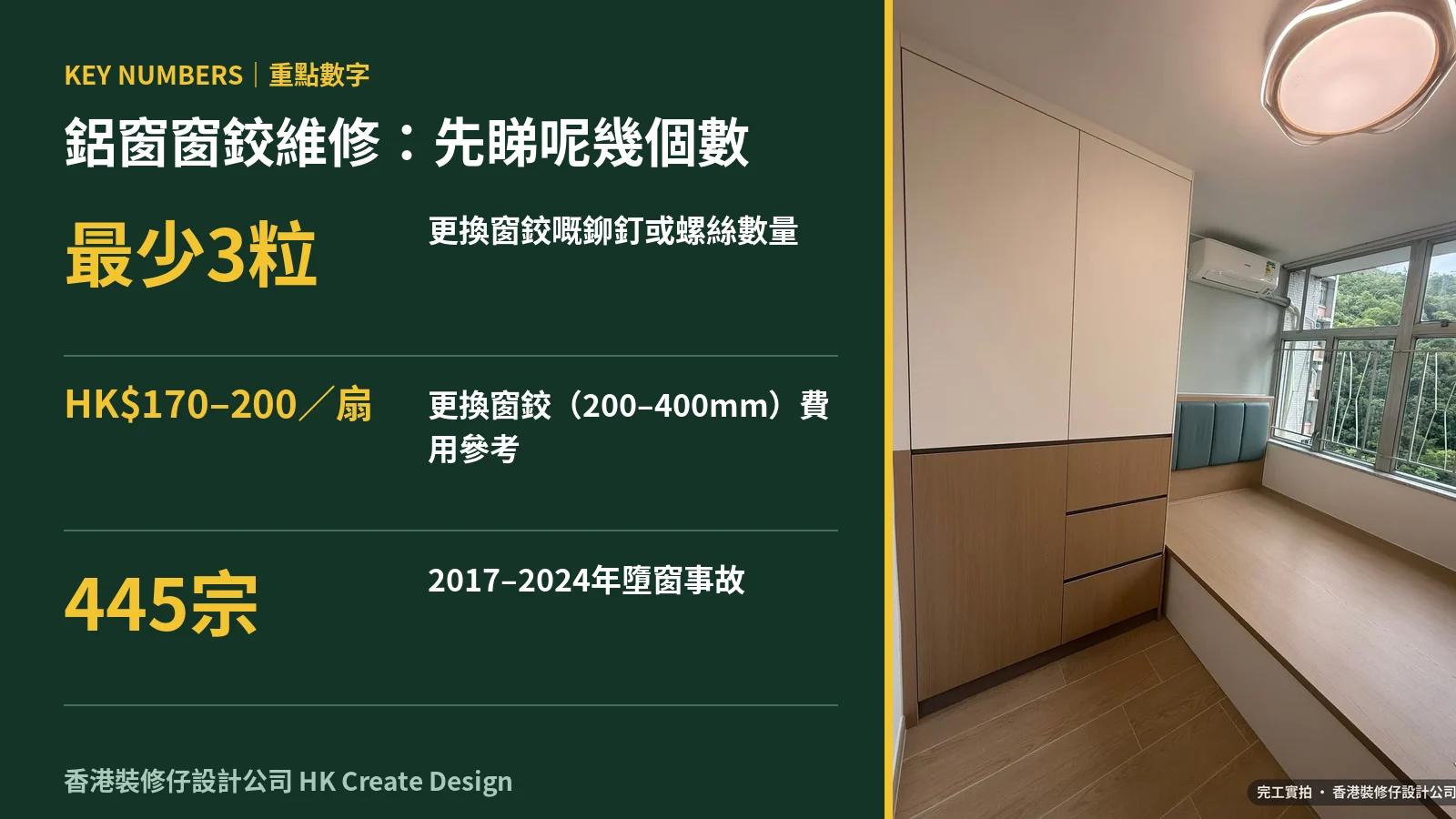
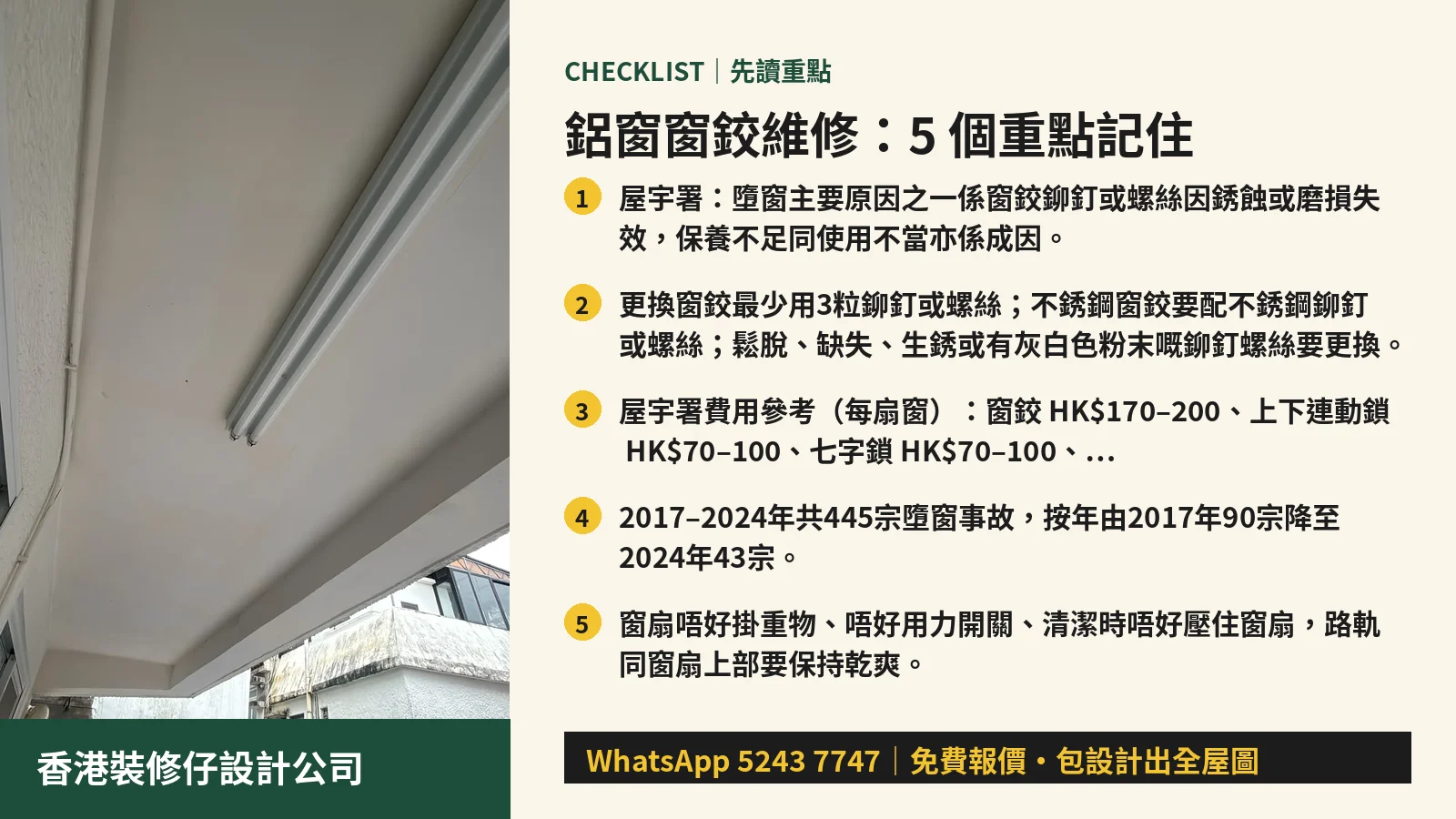
The Audit Commission recorded 445 fallen-window incidents from January 2017 through December 2024. Six incidents caused one death and seven injuries.[5] The Legislative Council Public Accounts Committee appendix identifies corrosion or loosening of components, broken panes and improper operation among the main causes.[3] A falling sash can seriously injure people below in Hong Kong's densely built neighbourhoods.
Regular checks can identify rust, loose fixings and stiff operation before damage worsens. Our team often sees long-standing corrosion only when a resident reports a sagging sash or lock that no longer engages. Stop operating suspect sashes and arrange inspection.
- Check visible hinges periodically from inside while the window is in safe working order
- Look for rust or grey-white deposits around rivets
- Check before a typhoon
- Stop using the window if a defect appears
You can swipe left or right on your phone to view the complete table.
| Signs | Possible cause | risk | Recommended treatment |
|---|---|---|---|
| Brown rust stains on the hinge [4] | Hinge corrosion | Medium to high | Arrange an inspection and assess whether the hinges need replacement |
| Bent or loose hinge [4] | Bent hinge or failed attachment | High | Stop operating the window and arrange prompt repair |
| Grey-white deposits on hinges, tracks or rivets [4] | Aluminium or metal corrosion | High | Replace defective fixings and inspect the hinge [2] |
| Broken, loose, corroded or missing fixings at the top or bottom of a sash [4] | Failed fixing | High | Stop using the sash and have the rivets or screws replaced |
| Cracking or unusual noise on opening or closing [4] | Damaged hinge or sash | Medium to high | Arrange an inspection |
| Open sash does not hold its position [4] | Insufficient hinge friction | Medium | Adjust or replace hinges |
| Failure to lock or difficulty operating the window [4] | Damaged cam or dual lock, or a distorted sash | Medium | Inspect the sash and its hardware |
| Loose sash handle [4] | Handle or lock fixing has failed | Medium | Tighten or replace |
Stop using a window showing serious defects and arrange prompt inspection by a qualified person and repairs by a registered contractor. [4] [4][2]
02
Initial checks you can make from inside
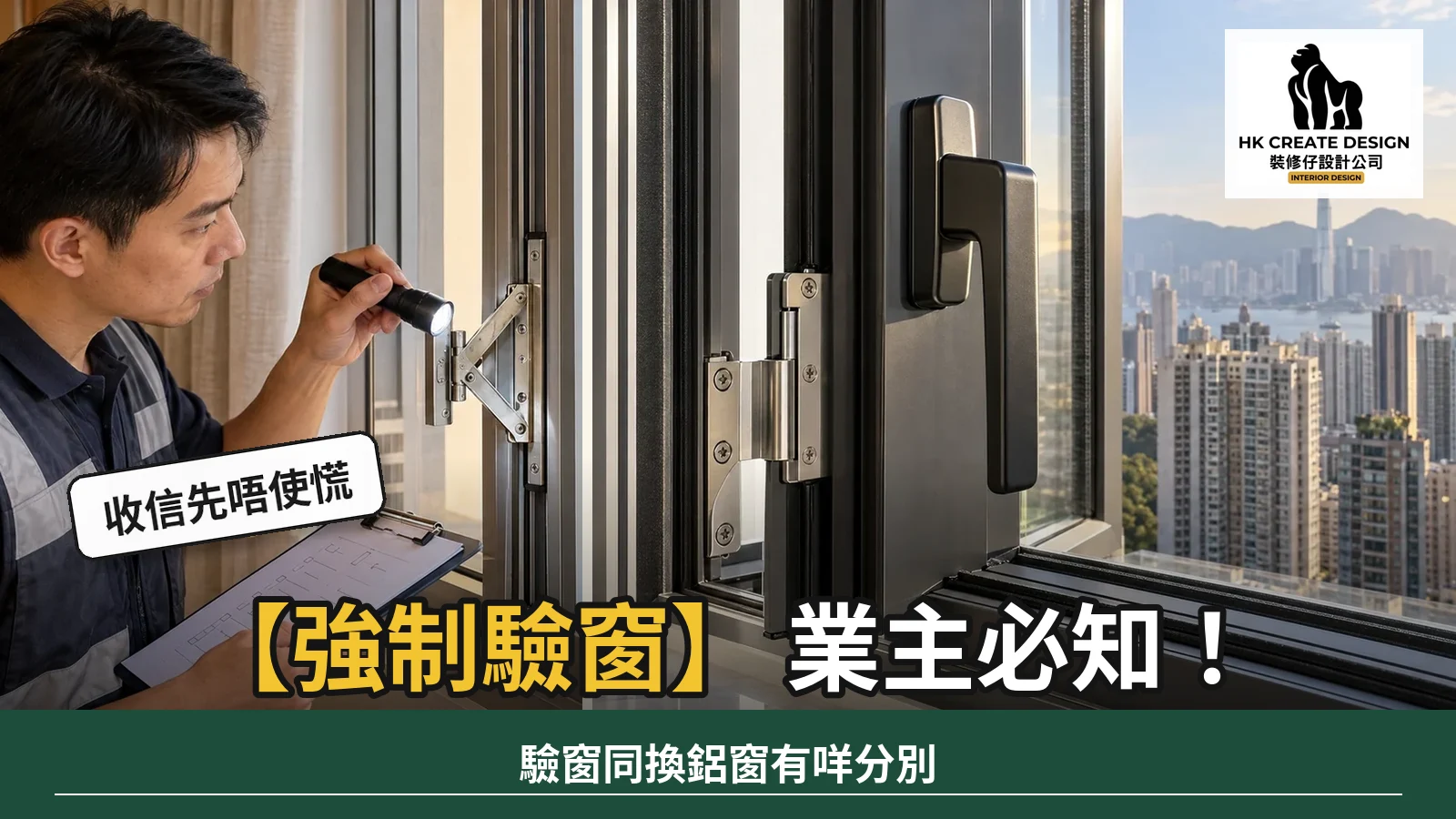
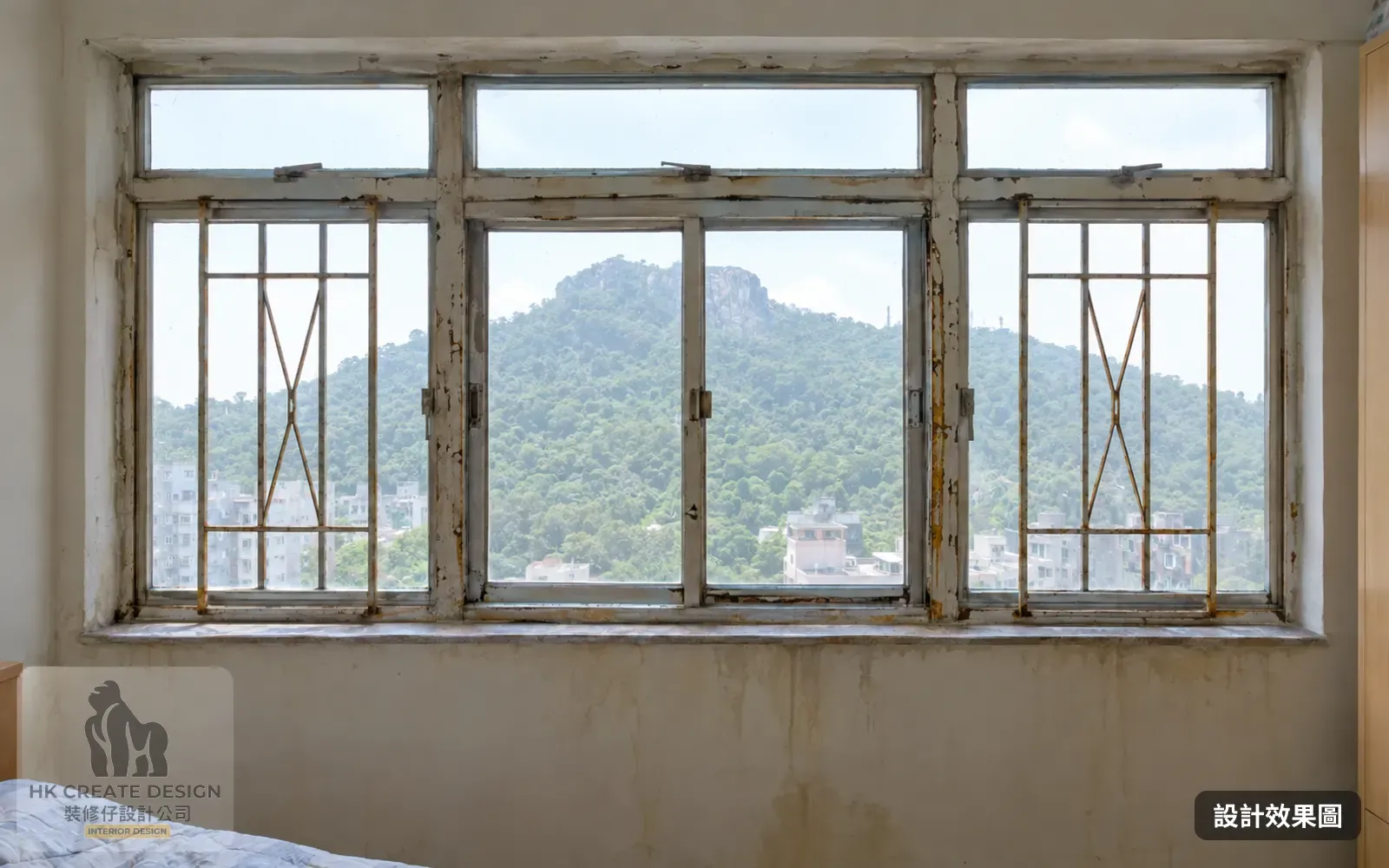
The Buildings Department's window safety guidance lists visible signs to look for from a safe position inside.[4] Look for rust, bent or loose hinges and grey-white deposits on tracks, fixings and locks. The contractor should check for broken, loose, corroded or missing fixings at both ends of the sash.[4]
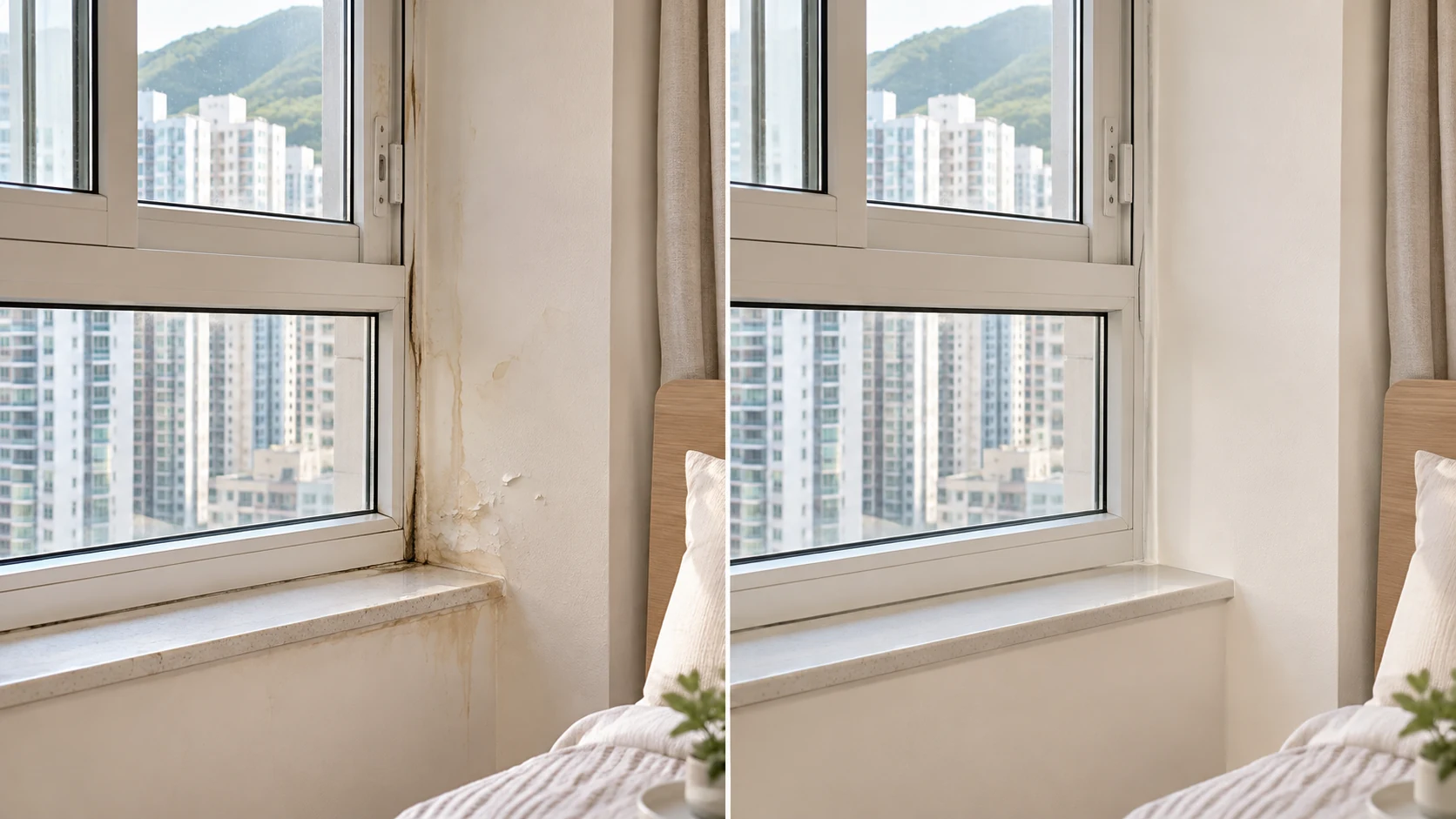
Look for cracking or unusual noises, stiff operation, failure to lock or a sash that does not stay open. Visible distortion, sagging, unusual gaps and loose handles or locks are also reasons to arrange inspection.[4] Look for leakage between the frame and sash and staining around the frame.[4]
Check only from a safe indoor position. Keep off the sill and do not lean outside. If a sash is already loose, leave it closed and arrange an inspection. From inside, in calm daylight, a photo of visible upper and lower fixings can be enlarged for a preliminary check.
If you notice any of these warning signs, the Buildings Department advises arranging prompt inspection by a qualified person and necessary repairs by a registered contractor.[4] Tape, wire and household adhesives cannot restore hinge load capacity. Keep the affected window out of use.
- Look for rusty, bent or loose hinges
- Check rivets and screws
- Test opening, closing and locking
- Look for a sagging sash
- Stay inside the window opening
03
Differences between hinges, cam locks and handles
The hinge is the metal linkage that supports the sash as it slides and pivots. The Buildings Department reference for replacing 200–400mm hinges is HK$170–HK$200 per sash.[1] Hinges come in different materials, lengths and load ratings. Choose the correct model for the actual sash size and weight.
A cam lock secures a casement sash at one point. A dual lock operates top and bottom locking points from one handle and is common on larger sashes. The Buildings Department's reference range is HK$70–HK$100 per sash for replacing either type.[1] Strong wind can force an insecurely latched sash open and increase the load on its hinges.
A handle operates the sash and may be integrated with the lock. A loose handle or lock is one of the Buildings Department's listed defects.[4] Gaskets seal the gap between sash and frame against air and water. The Buildings Department's reference is HK$100–HK$250 per sash to replace them,[1] Gaskets and perimeter weather sealants fall outside theMandatory window inspection prescribed inspection and repair scope.[2]
Sliding windows run on tracks and rollers. The Buildings Department advises removing sand and dirt from tracks and keeping the tracks and top of the sash dry.[4] Worn rollers or a distorted track can allow a sliding sash to come out.
- Hinges, locks, handles and gaskets
- Match the hinge rating to sash size and weight
- Arrange repairs promptly if the sash will not lock
- Keep sliding window tracks clean
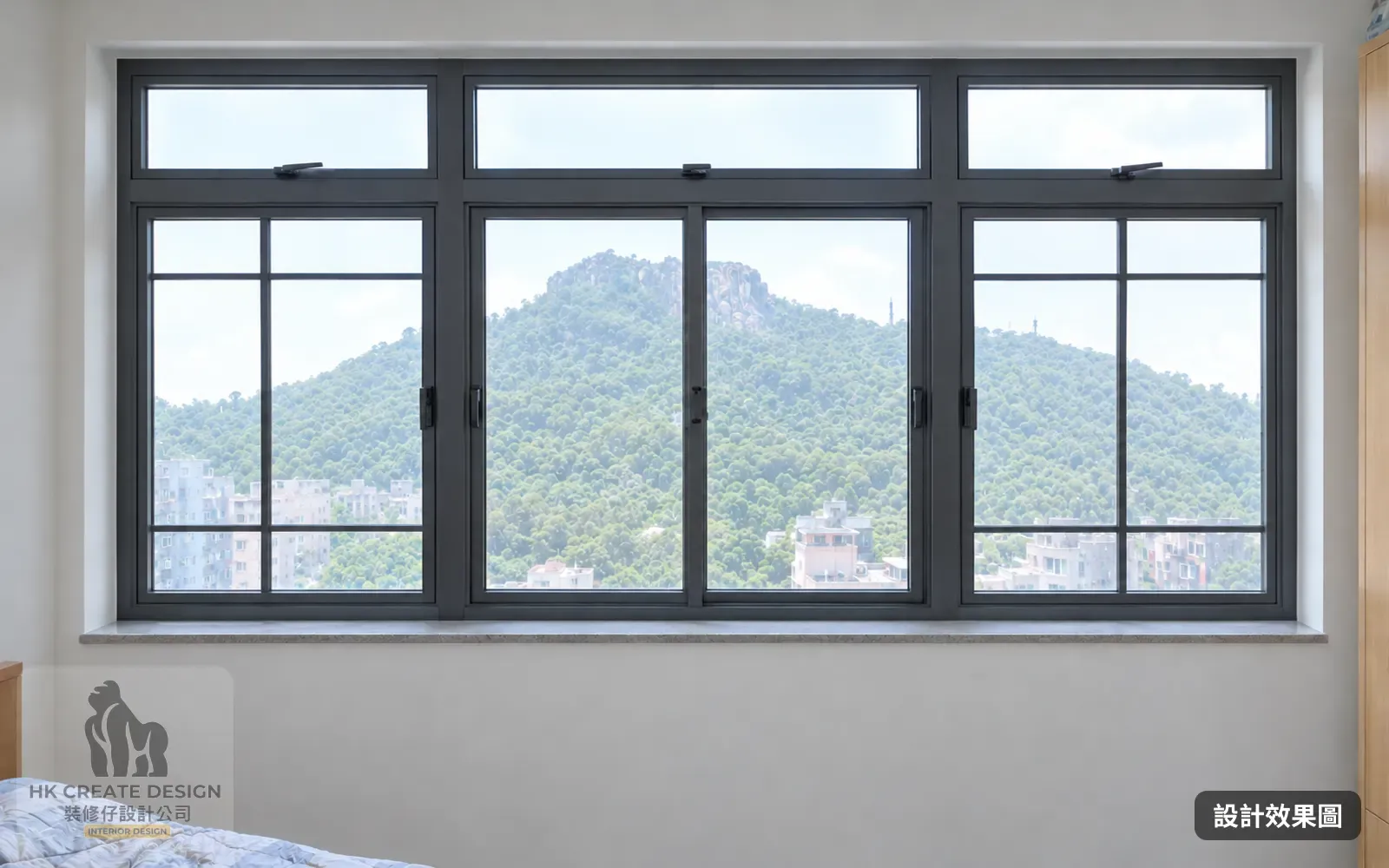
「Sagging, corroded hinges or a sash that will not close can sometimes be repaired with new hinges. Distorted or severely corroded frames may need replacement.」
04
When to replace parts and when to replace the window
If the frame and sash are sound and only hinges, rivets or locks have deteriorated, replacement parts may be sufficient. Buildings Department reference costs are HK$170–HK$200 per sash for hinges and HK$120–HK$150 per sash for rivets and screws.[1]
A replacement sash or window may be needed if the frame or sash is distorted or sagging, the aluminium is badly corroded, fixings no longer grip the profile, the frame-to-wall joint repeatedly leaks or compatible hardware is unavailable.
Buildings Department guidance requires repair to at least the original design standard, including the material and dimensions of replacement parts.[2] . A smaller or thinner hinge may be unsuitable. A complete window replacement has a different scope and cost. See ourAluminium window replacement pricesandWindow replacement under the Minor Works Control Systemarticle.
Conditions can vary across one flat. Sea-facing and exposed windows and humid bathrooms can show different patterns of corrosion. Assessing each unit individually can allow some to be repaired while others are replaced.
- Sound frame — consider replacing the parts
- Corroded or deformed profiles may require window replacement
- Replacement parts must meet or exceed the original specification
- Assess each window separately
Example 1: replacing hinges and rivets on three casement windows
Assumptions
- Three casement sashes need replacement hinges and rivets. One also needs a new cam lock.
- Calculated using Buildings Department reference rates per sash. [1]
How to calculate quantities
- Hinges: 3 × HK$170–HK$200 = HK$510–HK$600.
- Rivets and screws: 3 × HK$120–HK$150 = HK$360–HK$450.
- Cam lock: 1 × HK$70–HK$100 = HK$70–HK$100.
- Total range: HK$510 + HK$360 + HK$70 = HK$940, up to HK$600 + HK$450 + HK$100 = HK$1,150.
The official reference figures give an example total of HK$940–HK$1,150, excluding the contractor's submission and site visit fees.
These surveyed costs are indicative. For prescribed repairs under the mandatory scheme, allow for the qualified person's supervision fee. [1] [1]
05
Hinge replacement requirements
The first fixing requirement is at least three rivets or screws when replacing a hinge.[2] Second, use stainless steel rivets or screws when installing a stainless steel hinge or replacing fixings on an existing one.[2] Third, replace loose, missing, rusty or corroded fixings, including those with grey-white deposits. Replacement parts must meet at least the original dimensions and material specification.[2]
Dissimilar metals exposed to moisture can corrode more quickly. Ordinary iron rivets in a stainless steel hinge can rust even while the hinge remains sound. Ask for the fixing material at handover and keep the packaging or specification.
The installer must follow the specified hinge position and fixing design. Enlarged or damaged holes need an appropriate repair. Sealant cannot carry hinge loads. After installation, the contractor should align the sash and confirm it opens, holds its position and closes against the frame.
Hinge repair is window repair work. Use an appropriately registered contractor and follow the applicable minor works requirements.[6] For hinge replacement in an upper-floor flat, the contractor must secure the sash against falling and provide suitable safe access. The Labour Department identifies window replacement as a common example of work at height involving a risk of a fall of 2m or more.[7]
- At least three rivets or screws per hinge
- Use stainless steel rivets or screws with stainless steel hinges
- Parts must meet the original design standard
- Align the sash after fitting the hinges
- Work at height needs fall prevention
You can swipe left or right on your phone to view the complete table.
| Component | function | Buildings Department cost reference per sash | Within the mandatory inspection scope? |
|---|---|---|---|
| Casement window hinges, 200–400mm | Support the sash as it opens and closes | HK$170–200[1] | Safety-related component |
| Screws and rivets | Fix the hinge to the frame and sash | HK$120–150[1] | Safety-related component |
| Casement window handle | Secure the sash | HK$70–100[1] | Within the inspection scope |
| Dual lock | Secures the sash at top and bottom | HK$70–100[1] | Within the inspection scope |
| Sash gasket | Weather sealing | HK$100–250[1] | Outside prescribed inspection and repair scope [2] |
| Handles | Open and close the sash | Outside the published cost reference | Subject to the site quotation |
The figures reflect surveyed costs and exclude the contractor's minor works submission fee. [1] [1][2]
06
Everyday use and maintenance
The Buildings Department advises keeping items off sashes and hinges, opening and closing windows gently, and avoiding additional pressure on the sash when cleaning.[4] Hanging clothes, wind chimes or towels on a sash places extra load on the hinges and can distort them over time.
The Buildings Department advises cleaning windows with water, removing dirt from hinges and tracks and keeping the tracks and sash tops dry. Use an appropriate lubricant for the hinges and avoid corrosive cleaners or lubricants.[4] Check the cleaner before use. Strong substances can corrode aluminium and fixings.
Before a typhoon, close and lock every window. Avoid opening a casement while strong winds could overload its hinges. Once conditions are safe, check for loose hinges and locks.
If the household includesOlder residents or children, ask about suitable opening restrictors and easy-to-use locks. See our guide to safer homes for older residents.
- Keep objects off the sash
- Clean with water
- Clean tracks and hinges regularly
- Use a suitable lubricant
- Secure all windows before a typhoon
07
Mandatory inspection and hinge repairs
After a statutory Mandatory Window Inspection Scheme notice, appoint a qualified person for the prescribed inspection. If repairs are required, appoint a registered contractor to work under that person's supervision.[4] Hinges, rivets and locks are central inspection points.
The Buildings Department reference for a qualified person's prescribed inspection and supervision of prescribed repairs is HK$80–HK$880. Repair items are priced per sash.[1] The figures give you a basis for comparison. The Buildings Department does not set a recommended price.[1]
Non-safety items such as gaskets and weather sealant are outside the prescribed inspection and repair scope of the Mandatory Window Inspection Scheme.[2] Gasket replacement and perimeter resealing require a separate scope and price.
The Buildings Department encourages regular inspection and timely repairs even without a statutory notice.[4] The Audit Commission reported that 295 of 445 falling-window incidents involved buildings that had not been selected for mandatory window inspection at the time.[5] See our guide to the Mandatory Window Inspection Scheme for the inspection process.
- Appoint a qualified person after receiving a statutory notice
- Repairs by a registered contractor
- Gaskets priced separately
- Arrange periodic inspection even without a notice
Example 2: calculating the minimum number of rivets
Assumptions
- The example casement sash has two hinges, one upper and one lower.
- The Buildings Department calls for at least three rivets or screws when replacing a hinge. [2]
- The example flat has four casement sashes requiring new hinges.
How to calculate quantities
- Per sash: two hinges × at least three fixings = at least six fixings.
- Four sashes: 4 × 6 = at least 24 fixings.
- If the hinges are stainless steel, all 24 example fixings must also be stainless steel. [2]
For four sashes with two replacement hinges each, the example requires at least 24 rivets or screws. Ask the installer to show the fixings at handover.
Actual numbers may be higher depending on the hinge model and original design. Manufacturer specifications determine attachment positions. [2]
08
Professional and official guidance
Owners are responsible for maintaining their windows and can face liability if a falling sash causes injury or damage. Under section 4B of the Summary Offences Ordinance, dropping or allowing an object to fall from a building so as to endanger or injure someone in or near a public place can attract a HK$10,000 fine and six months' imprisonment. Injured people or their families may also seek civil compensation.[2]
The Buildings Department advises correct operation, regular inspection and timely maintenance to keep aluminium windows safe.[2] Regular checks and correctly specified replacement parts can help prevent hinge failures.
The Public Accounts Committee appendix shows incidents falling from 90 in 2017 to 43 in 2024, with a rise to 50 in 2023.[3] The annual total has fallen, but dozens of incidents still occur each year.
The Labour Department advises risk assessment and suitable working platforms for replacement at height.[7] Ask the contractor to explain the safe working arrangements before appointment.
- Owner's legal responsibility
- Correct operation and maintenance improve safety
- Dozens of fallen-window incidents still occur each year
- Hinge replacement requires safe access and fall protection
You can swipe left or right on your phone to view the complete table.
| compare | Replace hinges and hardware | Replace the sash or complete window |
|---|---|---|
| Suitable for the situation | Sound frame with worn hardware only | Distorted or badly corroded frame, or persistent leakage around it |
| Cost | See the Buildings Department reference per sash [1] | Subject to site measurement and a written quotation |
| Duration | Usually shorter | Made-to-order parts take longer |
| minor projects | Repair quality must be at least equal to the original design [2] | File under the relevant item, such as 2.8 or 3.6 [6] |
| Making good around the window | Usually unnecessary | Usually requires rendering and painting |
Decide after the installer or qualified person inspects the sash. [1][2][6]
09
Common mistakes in window hinge repair
First, leave hinge replacement to a registered contractor. A high-level sash can fall during removal and the repair must meet the fixing, material and original design requirements,[2] Leave this work to a registered contractor.
Second, avoid incompatible fixings. The Buildings Department calls for stainless steel screws or rivets with stainless steel hinges.[2]
Third, have both the upper and lower hinges assessed. Damage to one can coincide with wear in the other.
Fourth, glue and wire cannot restore load capacity and may conceal a hazard. Fifth, require the quote to specify hinge size and material so the replacement can be checked.
- Leave high-level sash removal to the contractor
- Match the fixing material to the hinge
- Assess the upper and lower hinges together
- Avoid improvised supports
- Specify the parts in the quotation
10
Handover checks after hinge replacement
First, ask the installer to demonstrate the number of fixings. Each replacement hinge needs at least three rivets or screws,[2] At handover, ask the installer to show the top and bottom fixings and photograph them from a safe indoor position. Ask for the hinge and fixing materials and the product specification or packaging.
Third, after repairs check operation with the contractor. The sash should travel smoothly without unusual noises, hold its open position and close against the frame with a secure lock. Difficulty opening, failure to lock and an unstable sash are listed defects.[4]
Fourth, check the clearance around the closed sash for visible sagging. Fifth, inspect gaskets and glazing beads for displacement after the sash has been refitted.
Collect the repair record and warranty terms. A qualified person must confirm completion of prescribed repairs under the mandatory scheme. Our one-year warranty is subject to its written terms.
- Fixing check — at least three per replacement hinge
- Confirm the material
- Check sash operation and locking
- Check the gaps between sash and frame
- Check gaskets and glazing beads
- Collect the repair records
Example 3: using official figures to examine trends in falling windows
Assumptions
- Annual figures from the Legislative Council Public Accounts Committee appendix. [3]
How to calculate quantities
- Eight-year average: 445 ÷ 8 ≈ 55.6 incidents per year.
- From 90 incidents in 2017 to 43 in 2024: (90 − 43) ÷ 90 ≈ 52%, a drop of roughly half.
- There were 50 incidents in 2023, up 18 from 32 in 2022.
The overall incident count fell, although dozens still occurred every year and the annual trend fluctuated.
The Department did not provide counts by cause. The figures cannot establish what proportion involved a hinge fault. [3] [3]
11
Cost and scheduling
Hinge repairs are priced by sash count and parts. Buildings Department reference costs per sash are HK$170–HK$200 for hinges, HK$120–HK$150 for screws and rivets, HK$70–HK$100 for a cam or dual lock and HK$100–HK$250 for gaskets.[1] These repair ranges exclude the highest and lowest 5% of quotations.
Allow separately for the contractor's minor works filing charge, site visit and minimum job charge. The Buildings Department's repair figures exclude the filing charge.[1] Our L04 visit costs HK$500, credited in full against a confirmed job. Small jobs have a HK$2,000 minimum charge.[9] Hinge repair charges depend on the inspection and written quotation.
Availability affects the repair date. Standard parts may be available sooner than made-to-order hinges. Class III repairs need no pre-start filing but require prescribed documents within 14 days of completion.[8]
If other small tasks are needed, such as changing a lock, touching up paint or fixing plumbing, ask whether they can share one visit and minimum charge. See our small works guide.
- Priced by sash count and parts
- Ask about submission charges
- Combine small jobs
- Check whether parts are in stock
You can swipe left or right on your phone to view the complete table.
| Item | The quotation should specify | Usually included? |
|---|---|---|
| window hinge | Dimensions, material such as stainless steel, and quantity | What should be included |
| Rivets and screws | Use compatible fixings, at least three per hinge [2] | What should be included |
| Locks and handles | Model and quantity | Depends on the quotation |
| Sash alignment | Align the sash and check operation | What should be included |
| Rubber strip | Are both included in the replacement? | May be excluded |
| Minor works submission | Who is responsible? | should be written clearly |
| Site visit | L04 site visit HK$500, credited in full against a confirmed order [9] | depending on |
| Minimum charge | Minimum small-job charge HK$2,000 [9] | — |
HK Create Design quotes hinge repairs after inspecting the site. [2][9]
12
Follow up with the construction team
HK Create Design opened in 2019, and the team has more than ten years of project experience. We assess each window and quote in writing for parts or replacement. Our window specialist and the appropriate registered contractor handle applicable minor works. The written terms provide a one-year warranty.
Measurement arrangements are as follows. On-site measurement is free through 31 December 2026 for two or more work items, with no deposit. After that, the HK$500 fee is credited against the order.
For a free quotation from the HK Create Design team, WhatsApp 5243 7747 or visit our Wong Tai Sin shop, Monday to Saturday, 10:00–18:00.
From inside and only where safely visible, photograph the top and bottom hinges, lock and gap around the closed sash. You can send these on WhatsApp for an initial discussion.
- Photograph hinges and locks from inside
- Provide the number of affected sashes
- Book a site visit
- Compare written quotations
Advice from our tradespeople
「Sagging, corroded hinges or a sash that will not close can sometimes be repaired with new hinges. Distorted or severely corroded frames may need replacement.」
「Use hinges of the specified size and material. Match stainless steel hinges with stainless steel screws or rivets to limit corrosion.」
「Arrange an inspection promptly if a sash wobbles or will not latch, especially before typhoon season.」
FAQ
12 practical questions answered
01How much does replacing one window hinge cost?
The Buildings Department reference for replacing 200–400mm hinges is HK$170–HK$200 per sash. The figure comes from surveyed prices.[1]
02Do the Cantonese terms for a window hinge refer to the same fitting?
Yes. Both are common Cantonese names in Hong Kong for the bar hinge on a casement window.
03How many rivets are required to replace a window hinge?
The Buildings Department calls for at least three rivets or screws when replacing a hinge.[2]
04Can ordinary rivets be used with stainless steel window hinges?
Stainless steel hinges require stainless steel screws or rivets under Buildings Department guidance.[2]
05What does greyish-white powder on a rivet mean?
It indicates corrosion. The Buildings Department advises replacing rivets and screws that show greyish-white powder, are loose, missing or rusty.[2]
06Is a sagging window sash still safe to use?
Distortion or obvious sagging of a sash or frame is a Buildings Department warning sign. Stop using it and arrange inspection and repair.[4]
07Can I replace window hinges myself?
Hinge replacement involves safe access at height and compliance with the original design. Use an appropriately registered contractor.[7][2]
08Are window seals included in mandatory window inspection?
Gaskets and weather sealant fall outside the prescribed inspection and repair scope cited by the Buildings Department.[2]
09What lubricant can be used for window hinges?
The Buildings Department recommends periodically lubricating hinges with a suitable product. Avoid substances that corrode the window components.[4]
10After how many years do aluminium windows need replacing?
According to the Buildings Department, aluminium windows have no fixed service life. Inspect individual hinges, screws and rivets.[2]
11Does HK Create Design repair window hinges?
Yes. HK Create Design issues a written quote after a site visit. The visit is HK$500, fully credited on order. Small jobs have a HK$2,000 minimum.[9]
12How should window hinges be protected during a typhoon?
Before a typhoon, close and lock the windows. Leave casements closed during strong winds, and check hinges and locks after the storm.
CHECK THE BASIS
Data and technical basis, sources can be verified
- [1]Buildings Department: Mandatory Window Inspection Scheme: Cost Reference (July 2025 to June 2026) Accessed: 2026-11-03
- [2]Buildings Department: Frequently Asked Questions: Windows Maintenance Accessed: 2026-11-03
- [3]Legislative Council Public Accounts Committee, Report No. 84, Appendix 13 Accessed: 2026-11-03
- [4]Buildings Department: Important Notes about Window Safety Accessed: 2026-11-03
- [5]Audit Commission: Management of Mandatory Window Inspection Scheme by the Buildings Department (Report No. 84, Chapter 4, summary) Accessed: 2026-11-03
- [6]Buildings Department: Minor works related to windows Accessed: 2026-11-03
- [7]Labour Department: Overview of Safety at Work at Height Accessed: 2026-11-03
- [8]Buildings Department: Introduction to the Minor Works Control System Accessed: 2026-11-03
- [9]HK Create Design 2026 detailed project budget and public price list Accessed: 2026-11-03