01
Removing 100 sq ft of floor tiles: what should you compare in two quotes?
Assume the same 100 sq ft area and that the stated item applies in each example. This compares removal charges only. Site verification determines which option is appropriate.[2]
You can swipe left or right on your phone to view the complete table.
| Comparison item | Option A: A01 | Option B: A02 |
|---|---|---|
| Stopping point | Remove old tiles to the cement bedding | Remove the tiles and cement bedding to expose the concrete |
| Worked line-item example | 100×30=HK$3,000 | 100×52=HK$5,200 |
| Still to confirm separately | Repairs to the existing bedding, levelling, haulage and new installation | Deep chiselling and sunken slab restrictions, levelling, haulage and new installation |
| Pricing the same area | Do not add the full A02 charge again | Do not add the full A01 charge again |
Confirm where the A01 surcharge of HK$10 per sq ft applies. Adding 30 + 10 does not automatically provide the full A02 scope. [2]
02
Four details for a floor tile removal enquiry
Provide the location, actual tile area, desired stopping layer and any fittings to keep. If the bedding condition is unknown, send photos first and confirm it on site.
For tiling after demolition, you can also compareMasonry and tiling. For removal and clearance only, go toDemolition quotation enquiries. List removal, waste haulage and retiling separately. A unit rate for part of the work cannot establish the full cost.
03
How does removing finish tiles differ from removing the bedding as well?
Different removal depths leave different substrates and follow-on work.
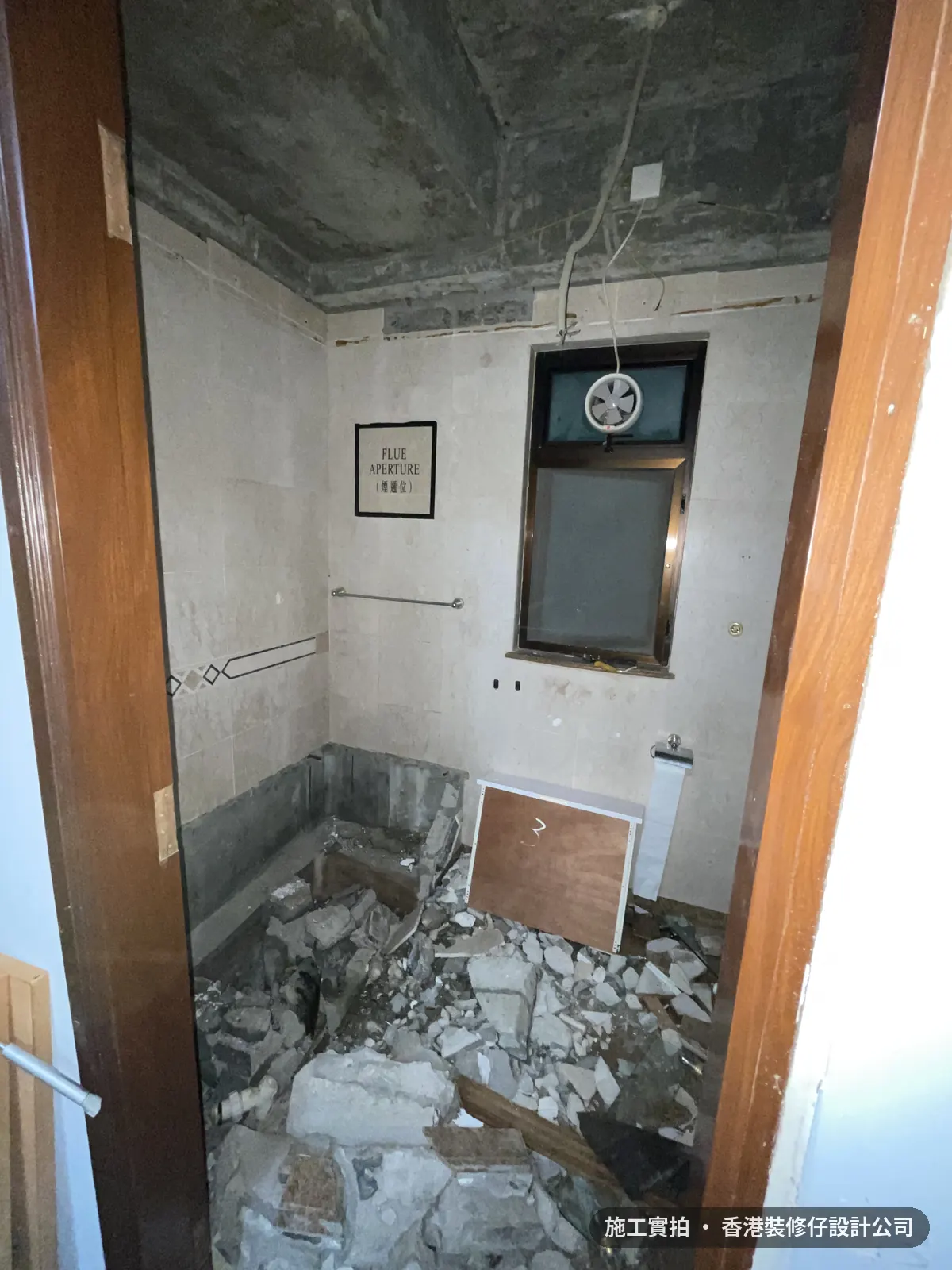
Removing the finish tiles only: check the retained bedding
After tile removal, the bedding may need repair or levelling. Choosing a shallower removal scope does not establish that the remaining surface is ready for the new finish.
Removing the bedding: define a stopping point for chiselling
Define the removal area and stopping point. Sunken slabs, services, floor slabs and unknown construction need assessment beyond ordinary tile removal. Structural issues require professional assessment under the applicable procedures.[1]
100 sq ft under A01
Assumptions
- Assume the basic A01 scope alone has been confirmed.
Checks to make
- 100 × HK$30=HK$3,000。
- Check any difficult removal, haulage or follow-on work separately.
HK$3,000 is an example removal charge. The entire retiling project will have its own total.
This hypothetical example illustrates planning only. It represents neither an actual job nor an agreed price or schedule. The site assessment determines the actual plan. [2]
04
How to compare the company's published rates
The table uses published company rates, rather than market averages. The A01 page also lists a HK$10 per sq ft surcharge for particular treatments.A calculation of 30 + 10 alone cannot establish that the full A02 scope is included. Ask the contractor to specify when it applies.[2]
You can swipe left or right on your phone to view the complete table.
| Item | Our indicative price | Defined boundaries |
|---|---|---|
| A01 Remove wall/floor tiles | HK$30 per sq ft | Remove old tiles to the cement bedding. Check difficult removal or exposed-concrete arrangements separately |
| A02 Remove the platform and floor tiles | HK$52 per sq ft | Includes breaking out the cement bedding to expose the concrete. Deep chiselling and sunken slab areas are agreed separately |
The company price list gives indicative rates. The confirmed scope determines the planning checklist and the formal all-inclusive quotation. [2]
05
Use the next stage of work to determine which layer to remove
Confirm the requirements of the new floor, then match the removal scope.
Determine what the new floor requires first
New tiles, a different floor finish or a change in finished level may need different preparation. Ask the flooring contractor to specify the substrate and align removal with that requirement to avoid a disputed handover.
Allow for adjustments based on the existing condition
If substrate condition is uncertain, distinguish confirmed and provisional items. When opening up reveals a problem, photograph it, explain the effect and price, then obtain the client's approval for the variation.
06
What work may be needed after removal?
Why do two tile-removal quotes differ so much? Remove personal details, then send scope descriptions and site photos so we can see whether the quotes cover the same work. The final check takes place on site.
You can swipe left or right on your phone to view the complete table.
| Follow-on work | Confirm separately from the tile removal charge |
|---|---|
| Substrate repairs | Scope, materials and treatment method |
| Levelling or forming falls | Finished level and adjacent junctions |
| Waterproofing and testing | Applicable locations, system and records |
| New finish material | Finish materials, bedding, laying pattern and edge finishing |
| Waste removal | Bagging, carrying, vehicle trips and disposal |
The company price list gives indicative rates. The confirmed scope determines the planning checklist and the formal all-inclusive quotation. [2]
07
At handover, first check the work against the agreed scope
Check demolition handover against the agreed limits and the next trade's requirements.
Check the retained items and removal boundaries individually
Check the floor outside the doorway, wall edges, pipes and retained items against the agreement. Assign responsibility for all junctions and waste still to be removed.
Leave depth verification to the appropriate personnel and avoid destructive checks yourself
Owners can record issues with photos and a checklist for qualified personnel to assess. Avoid opening slabs, digging deeper or disturbing unidentified services yourself.
Further reading:Floor levelling, Tiling prices and Demolition and strip-out services.
The same 100 sq ft under A02
Assumptions
- Assume A02 has been confirmed as the applicable item in place of A01.
Checks to make
- 100 × HK$52=HK$5,200。
- This alternative excludes a second A01 charge of HK$3,000.
The examples differ by HK$2,200 because they cover different work. Choose according to the site and subsequent flooring requirements.
This hypothetical example illustrates planning only. It represents neither an actual job nor an agreed price or schedule. The site assessment determines the actual plan. [2]
08
How to measure tile removal: list walls and floors separately
Mark floor and wall areas separately. Identify fixed cabinet bases, doorways and retained areas. Confirm deductions for areas left in place against actual measurements and the written scope.
Use the actual work area. A single room cannot be priced from the whole flat's saleable area. If wall tiles are being removed too, include the walls separately.
09
Who signs off the handover when different contractors handle demolition and tiling?
Have both trades agree the stopping point, substrate requirements and responsibility for junctions before starting. After removal, use the same scope plan to record conditions and identify areas needing repair or reinspection.
If the original quote could not establish a substrate problem, explain the extra work and cost. Where the demolition and tiling contractors interpret the handover differently, agree on a common scope before continuing.
10
What details should I provide for a floor tile removal enquiry?
If the stopping layer is unknown, mark it as pending and explain the purpose of replacing the floor.
Compare related workLarge-format floor tile installation prices.
- Room, area and photos of existing conditions
- New floor material, doorway and adjoining floor
- Pipes, cabinets and finishes to retain
- Does the quote list haulage, levelling, waterproofing and new installation separately?
FAQ
6 practical questions answered
01Is removing material down to exposed concrete always best?
No. Choose a depth based on the objective, existing construction and site restrictions. Removing more material is not a measure of quality.
02Can new tiles go straight down after removing only the finish tiles?
Inspect the retained substrate first. Carry out any necessary repairs and levelling.
03Does the demolition charge include a debris truck?
Check the specific quote and its inclusions. “Tile removal” alone does not settle the question.
04Can the same unit rate be applied directly to a bathroom floor?
Sunken slabs, pipe positions, waterproofing and removal conditions can differ and need a site check.
05Does adding HK$10 to A01 make it equivalent to A02?
Do not assume equivalence. The published descriptions have different stopping points. Ask the contractor to identify the applicable item and scope.[2]
06If the tiler asks for more work after removal, is it necessarily a duplicate charge?
Possibly. Check the agreed removal boundary and new work. Distinguish genuinely additional repairs from unfinished work that was already included.
CHECK THE BASIS